FRANKLIN, Tenn.—On Wednesday, April 22, the student-produced Global Concentration Capstone Project was presented at Battle Ground Academy. The Project debuted with an impressive, far-reaching documentary film put together by Battle Ground Senior students Alison Zierdon and Victoria Blanco, ably supervised by Project Director/Teacher Lee Roberts.
The Project weas the culmination of months of hard work by students and teacher. Its main theme was “Indigeneity and Sustainability,” emphasizing the connection between Indigenous peoples and the environment. Sub-themes included “Who controls the Narrative? Indigenous Culture and Sustainability in Nashville and Beyond”; “How to Support Native American Culture”; “Support Local Native Organizations”; “Attend Indigenous-led Events”; and “Listen to Indigenous Voices.”
To provide some relevant background information, Battle Ground Academy is an independent college-preparatory educational institution. It is situated in Franklin, a few miles south of Tennessee’s state capital, Nashville. Founded in 1889, the school was first located on the Civil War site of the Battle of Franklin.
The preparation for the Project took several months, with interviews conducted in both the Indigenous and non-Indigenous community and also internationally with contacts being made with sources in Canada and the Māori people in New Zealand.
The Project began with the thesis that, despite Nashville’s ancient roots, Indigenous culture is too often overlooked here. Hence, the most meaningful sustainability demands putting forth Indigenous narratives and utilizing Native viewpoints on land, water, and cultural reality are not regularly taken into account by policymakers.
In the previous year, students in the Global Concentration Studies program at Battle Ground embarked on a tour, meeting with Indigenous activists who shared their history and cultural perspectives and visiting ancient Indigenous sites throughout Nashville and adjacent areas.
This year, inspired by Nashville’s profound Indigenous background, they delved further into contemporary Indigenous culture and its connection to sustainability and the city of Nashville in its modern-day environment.
The goal of the Project was to increase awareness of the connection Indigenous perspectives have to sustainability and to enlighten the non-Native population to this reality for the benefit of all people.
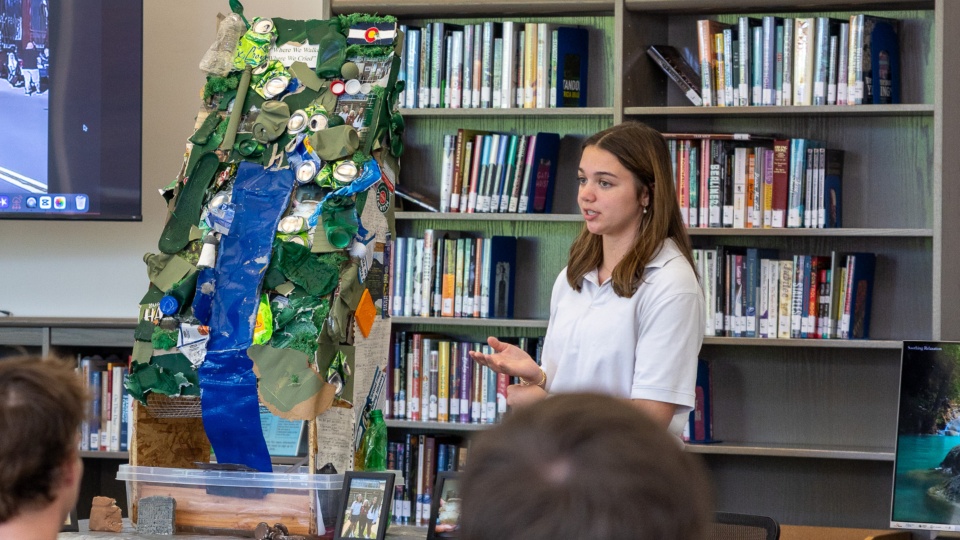
Accompanying the documentary presentation was a sculpture crafted by the Project to represent how Indigenous culture surrounds contemporary society in so many venues, often beneath layers of intrusive urbanization.
For example, Indigenous mounds have been encountered on many golf courses, but they remain unmarked. The reason given by city planners was that this provided protection against possible looters and grave robbers. As a side note, in years past, there have indeed been numerous instances of grave robbing at ancient Indigenous burial sites throughout Tennessee. Also, there have been reports of construction underway at or near some ancient sites.
It was also brought to the attention of the Project that the entire city of present-day Nashville sits atop a huge, ancient Indigenous metropolis that was known for its prodigious production of salt 1,000 years ago. This huge city had an estimated population of 400,000 that stretched to the suburban areas of contemporary Nashville in the Mississippian period of Indigenous history.
Among the many community members interviewed was Melba Checote-Eads, a member of the Muscogee Creek Nation of Oklahoma, who has long resided in Middle Tennessee. Checote-Eads was involved in the struggle to preserve the history of ancient Nashville when the discovery was made of the ancient Indigenous city that lies beneath it. This discovery was made when excavation was underway for a new baseball stadium in 2014.
The Project also visited the ruins of an early 19th-century toll bridge in Nashville that was prominently involved in Cherokee history. Information on the site was provided by Toy Heap, a Native American historian and long-time preservation advocate. Heap disclosed that this was the first bridge over the Cumberland River and was crossed by Cherokees on the tragic Trail of Tears in 1838.
It In the course of interviews with Indigenous community members, students gained appreciation of how water is an essential part of Native culture. It is seen as a living entity in Indigenous culture; indeed, it has a personified status. Without water, life on Earth could not exist.
The Project was made aware that to understand culture relationships must be built with Indigenous communities. Fieldwork requires more than just the collecting of data; it requires trust, empathy, and conversation.
What is really groundbreaking about the Project is that it did more than just study and present history—it reached out to living, breathing, contemporary Indigenous people of today.
The Project is a milestone of progress for social justice in educational institutions across the country and should be replicated across the U.S.
We hope you appreciated this article. At People’s World, we believe news and information should be free and accessible to all, but we need your help. Our journalism is free of corporate influence and paywalls because we are totally reader-supported. Only you, our readers and supporters, make this possible. If you enjoy reading People’s World and the stories we bring you, please support our work by donating or becoming a monthly sustainer today. Thank you!
CONTRIBUTOR