

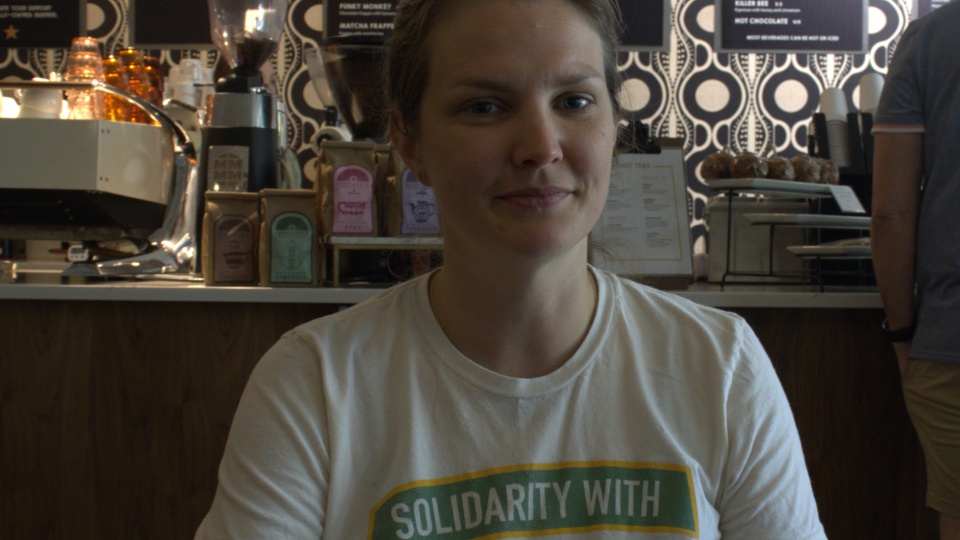
ASHEVILLE, N.C.—Molly Zenker is a former nurse at Mission Hospital, a medical center owned by HCA Healthcare Inc., who is known throughout the western North Carolina working class movement as a labor organizer with National Nurses United.
Molly, prior to her termination of employment, worked at Mission Hospital for about eight years. In this time, Molly organized the nurses to advocate for better pay, working conditions, time off, and many other demands. On Feb. 19, Molly was escorted out of Mission Hospital after a heated meeting with management about the dangerous conditions patients were subjected to due to staffing and scheduling issues.
In an interview with People’s World, Molly spoke about her experience with Mission Hospital’s owner, HCA, as well as her ultimate firing.
Molly’s been a nurse for 15 years. “I moved up to Asheville in 2017 and started at Mission before HCA was a thing. I worked for Mission in the heart tower and took care of the heart patients for about five years.” It was during that time, in 2019, that HCA bought the hospital.
“From that point, I helped with what was initially a book club, which turned out to be the start of unionizing at Mission Hospital,” she said of how organizing got underway. For the last three years, Molly has been part of the staffing pool, moving from the heart tower to a position dealing with the “adult in-patient population so that I got an overview of all the patients.”
We asked whether she considered herself a labor organizer as well as an experienced medical professional. “Really, it’s something that I never really thought I’d be involved in,” she said. Prior to working for HCA in Asheville, Molly had worked for the same company in Florida.
“My first job out of nursing school was with HCA at North Florida Regional Medical Center in Gainesville, so, I kind of knew what was in store for Mission when it came,” she explained. “Unfortunately, they very much fulfilled everything I thought would happen.”
The Gainesville hospital where she worked was rebranded to HCA Florida Regional Medical Center in March 2022.
“I actually left that job after a year because I was so scared that that was what nursing was.” Molly went on to work at a hospital in her home town before moving to Asheville prior to HCA’s acquisition of Mission Hospital.
In February 2026, after being in the staffing pool for three years, Molly was suddenly fired by HCA. She explained to People’s World what happened in the lead-up to that incident.
“Part of the union’s presence is being part of different committees. So, we have the staffing committee and the professional practice committee. I was on both. The professional practice committee meets monthly and is a group of 12 registered nurses that get together and bring all of the different problems that they hear about or experience to the CNO directly, who responds with ways in which they are going to address the issues.”
The CNO is the Chief Nursing Officer, the most senior nursing professional in a healthcare system. The CNO oversees the professional and leadership practice as well as serving as a member of the executive team of a healthcare center.
“Unfortunately, we’ve been doing this since 2020. We’ve been doing this for six years, and really throughout that whole time, we’ve been put on the backburner. It’s been mostly lip-service to make us feel like we were doing something when we really weren’t affecting much change. Because ultimately all the things that the professional practice committee brought to the management of the hospital were pretty much ignored.
“So, on Feb. 10, the union filed a grievance and had a meeting with the Director of Human Relations at Mission, Scott Rogers. There were three people on their [management] side, and several of the professional practices committee on ours. We were filing a grievance that we were being ignored and asking them to give us answers to all of these problems we bring to them and they are not fixing.”
During the meeting, Molly said she made the connection that “a lot of what we suggested in the professional practice committee would have prevented the hospital from being placed in immediate jeopardy.”
Immediate jeopardy is a legal term; it’s the most serious sanction a hospital can face from the regulatory body known as the Centers for Medicare and Medicaid Services. According to the CMMS, it’s not necessary that harm already being occurring to patients, only that “the potential for harm is enough to trigger an investigation.” Mission Hospital has been in immediate jeopardy four times since HCA purchased it in 2019.
The key components, as outlined by the State Operations Manual of the CMMS, are:
“Noncompliance: An entity has failed to meet one or more federal health, safety, and/or quality regulations; AND
“Serious Adverse Outcome or Likely Serious Adverse Outcome: As a result of the identified noncompliance, serious injury, serious harm, serious impairment or death has occurred, is occurring, or is likely to occur to one or more identified recipients at risk; AND
“Need for Immediate Action: The noncompliance creates a need for immediate corrective action by the provider/supplier to prevent serious injury, serious harm, serious impairment or death from occurring or recurring.”
All three components are necessary for the regulatory body to declare immediate jeopardy.
Molly declared at that February meeting that if management was not willing to fix the issues brought forth by the professional practices committee, she was “going to go public with this information. Because we have months of emails that we’ve sent back and forth that we’ve been suggesting things that would have made these immediate jeopardy [conditions] not exist.”
The meeting ended, and Molly was suspended two days later, on Feb. 12. A week after that, Molly Zenker was fired from Mission Hospital.
“Every moment I’ve been at Mission Hospital I’ve been advocating for patients. I’ve done rallies and interviews. Every day I show up on the floors fighting for patients, so I’m in their faces all the time,” she said, recalling her firing.
By the time she spoke up about going public, Molly was already known as an organizer by HCA management. “Frankly, I just think they had enough of me. I got under their skin enough, and they were tired of having to deal with me, so they were looking for a reason to fire me.”
Asked if she believed her history of publicly advocating for patients and organizing workers at Mission Hospital—along with her declared intention of going public concerning the immediate jeopardy concerns—motivated the company to fire her, Molly responded: “I 100% do; I’ve made a point that I’ve been active in the union.”
The official reason given for her termination, though, she said, was “that I was being investigated for pulling a medication from a patient and not notifying the provider. Ultimately, that’s what led to the decision that I needed to be fired.”
On the day of this supposed incident, Molly told People’s World, the unit she worked in, one full of heart patients, was already understaffed. With much of the nursing staff being travel workers, Molly was one of the few nurses who was an active member of Mission Hospital from the community.
“One of the patients was getting a new medication, and he got it around noon. This medication affects your blood pressure and your heartrate.” Molly said the provider had put in an order for the medication late, which meant that the medicine was administered later than the time intended. “I checked his blood pressure later, and it dropped. The normal schedule for this medication was 8:00 a.m. and 5:00 p.m. I gave it at noon, but it still said 5:00 p.m., so I held it.”
Due to the closeness in time as well as low blood pressure, Molly, exercising her professional judgment, decided to withhold the second dose due to patient safety concerns—standard practice with blood pressure medication, as administering it while a patient has low blood pressure could harm them rather than help.
“They’re not questioning my decision to hold it. The thing they are firing me for is that I didn’t tell the person who prescribed it.”
According Mission Hospital policy, under the Nursing Responsibilities section:
3. If a medication administration is omitted/held, document the omitted dose…
a.) Document reason for omission/held (i.e. medication falls outside ordered parameters or patient unavailable).
b. ) Consult with provider or pharmacist to discuss omission and plan for future doses if appropriate.
c. )Document omission in the medication error reporting system (if it constitutes an error).
This policy includes not only heart medication but also Tylenol, stool softeners, and any medication ordered by a medical provider to be administered to a patient. Molly described the conditions of the day in question as poor. The unit was understaffed, as per the hospital’s staffing policy, with too many patients for the number of nurses on the floor.
“If there was a day where I went to work, and I had three patients, everybody else in the unit knew exactly what they were doing and also had three patients, we had enough CNAs to help us do our jobs, and I wasn’t completely drowning, I would love to say that I definitely would have notified the provider.”
Unfortunately, as exemplified by National Nurses United’s consistent complaints of understaffing and poor working conditions, this was not the case. As noted, conditions in Mission Hospital have deteriorated to the point in which the regulatory body, the CMMS, already declared the hospital to be in immediate jeopardy. And these are all conditions that the workers, which includes nurses, aides, and physicians, have no control over.
Despite Molly’s documentation of holding the medication prescribed to her patient, the provider went on to report her and four other nurses after reading the patient reports the next morning. The medication in question is carvedilol, known by the brand name Coreg. It is recommended that a patient wait 10 to 12 hours between doses.
When Molly was fired by HCA on Feb. 19, she was escorted off the premises after eight years of practice, with no known reports or consequences against her for medical malpractice or patient care. Molly has, however, stated she previously was reprimanded for using the internal communications of Mission Hospital for union activity, though HCA did not state this in their termination notice.
Molly continues to fight for patient care as well as working conditions for Mission nurses, despite the firing. She currently is fighting her termination, demanding patient needs and working conditions be met and improved so as to not only remove the immediate jeopardy from Mission Hospital but to also provide quality care to the people of Asheville.
We hope you appreciated this article. At People’s World, we believe news and information should be free and accessible to all, but we need your help. Our journalism is free of corporate influence and paywalls because we are totally reader-supported. Only you, our readers and supporters, make this possible. If you enjoy reading People’s World and the stories we bring you, please support our work by donating or becoming a monthly sustainer today. Thank you!
CONTRIBUTOR



MOST POPULAR TODAY

Credible sources say Trump readies to steal the midterm elections

Leonard Peltier, longest serving U.S. political prisoner, should be free

How the bad science of AI doomerism is good for big business

Dark day for Hollywood labor: Paramount-Warner Bros. mega merger approved

Controversial ‘God made Trump’ campaign ad produces bipartisan uproar