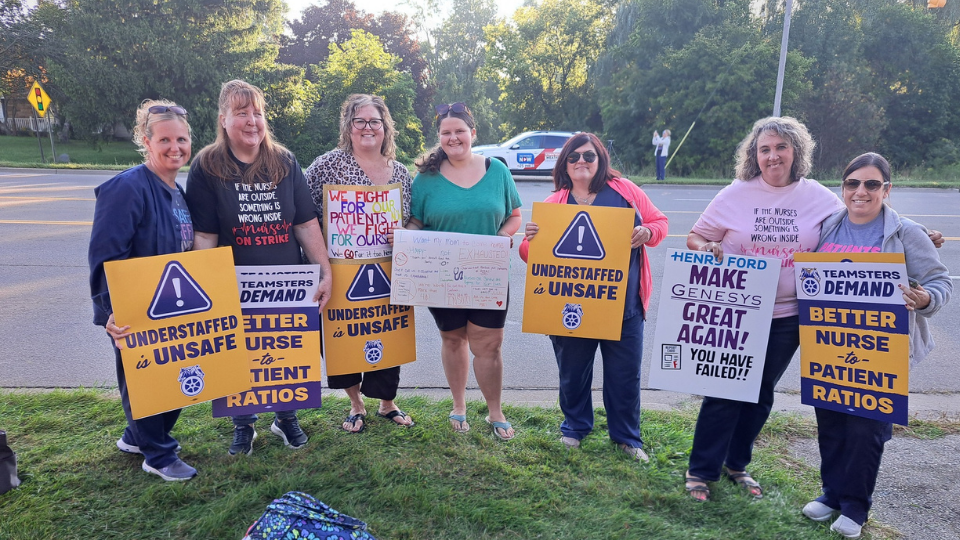
GRAND BLANC, Mich.—Anyone driving down Holly Rd. would be hard-pressed to miss the entrance to the newly acquired Henry Ford Hospital. In the eight months since Labor Day, local nurses have picketed outside with signs that read, “patient care over profits” and “it’s health care, not wealth care.”
This area is no stranger to collective bargaining; Detroit, the birthplace of the United Auto Workers (UAW), is a mere hour’s drive from where these nurses are carrying out one of the longest strikes in Michigan history. Organizers for Local 332 proudly channel that history as they stand against the second-largest health system in Michigan.
Necessity of the strike
Henry Ford Health System (HFH) has expanded rapidly in the past few years. In 2024, it invested $3 billion to expand its firm in Detroit, then merged with Ascension Genesys to reach into other cities.
This purchase secured two things: the hard-working nurses of Teamsters Local 332, and a singular desire to maximize output. The latter could only be realized by exploiting the former, yielding over $1 billion in net revenue in just two years.
Ascension Hospital first demanded an increased patient-to-nurse ratio, justified by post-COVID nursing shortages and decades of existing austerity measures, which have eroded healthcare on a global scale. The union then filed ULP charges against Ascension. And then, a tentative agreement was reached in the summer of 2024.
In October of 2024, Henry Ford purchased the hospital and wanted to impose harsher demands on the nurses. This did not stop the union from attempting to bargain in good faith.
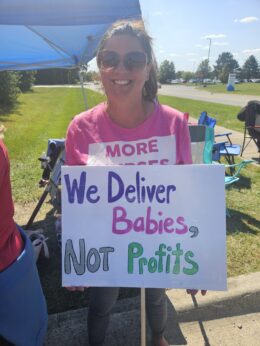
Local 332 attempted to negotiate, explaining that such demands would reduce the quality of care and jeopardize patients’ lives, but the negotiations broke down quickly. Good-faith bargaining could have resolved the issue, but according to the union, Henry Ford’s indifference to their staff’s concerns made a labor strike the only viable option for preserving workers’ rights and patients’ safety.
Anti-union posturing
A document written by Keith Flynn for Local 332 shows many examples of Henry Ford’s bad-faith bargaining and anti-union posturing, which ultimately forced and prolonged the strike.
The union document outlines 14 cases filed with the National Labor Relations Board (NLRB) against Ascension and Henry Ford, each falling under three broad methods: only offering “supposals,” backtracking on said “supposals,” and rewarding non-union nurses for their indifference and inaction.
On August 4, 2025, Henry Ford put up a “‘last, best’ offer” (LBO) after the Union had already passed a package addressing both parties’ open concerns. As the 750-strong workers’ strike began, Henry Ford kept putting forth their own proposals while seemingly ignoring those published by the Union’s bargaining committee.
In November, Local 332 alleges that Henry Ford failed to set future bargaining dates and even altered their own LBO a full three months after its initial release, changing terms that both parties had already agreed to implement.
Though Henry Ford had promised in an October letter that striking nurses would keep their positions once conditions returned to normal, at least one manager began reaching out to individual nurses in November to inform them that only workers deemed “not toxic” and who would “not cause issues” were eligible to come back. Later that month, Henry Ford penned an open letter demanding that nurses cross the picket line, declaring that “nurses who have not returned will have recall rights, but not bumping rights… Nurses who permanently filled positions during the strike will remain in those roles.”
To “bump” a worker means to re-hire them at a reduced salary, lower position, or markedly worse schedule (i.e., fewer paid hours, significant and unexplained shift changes, etc.). In addition to this blatant favoritism, HFH also refused to share its “Position Control List” with the union, which kept striking workers from knowing if they would even have jobs to return to once demands were met.
Per the NLRB’s own website, striking is a “fundamental right,” and employers cannot admonish or retaliate against workers just for exercising said right. The HFH’s admissions that they would favor workers who took no time off to strike and only re-admit strikers in diminished capacities became the foundation for Local 332’s case with the NLRB.
Further adding to the air of uncertainty was the HFH’s poor and confusing communication strategy: whenever one HFH representative appeared to make progress with the union, another would backtrack. Jerald James, director of Labor Relations for the Hospital, confirmed via email that the Hospital had agreed to a series of supposals. Later, Hospital attorney Grant Pecor declared that those same supposals “were no longer appropriate.” When the Union re-asserted their rights under the NLRA to obtain the Position Control List and its vital information on job openings, Pecor stated that the information was “none of your business.”
When People’s World asked for comment on their union-related conduct, representatives at Henry Ford referred to their press release, which the Teamsters had previously characterized as a misleading presentation of the events.
Gutting the NLRB
Much like these healthcare workers, the NLRB has suffered under its own set of austerity measures. While the rate of ULP charges has risen since 2020, settlements of such charges have stagnated, only peaking at about 6000 resolved cases in 2019. Between years of budget cuts and the Trump administration’s firings of key agency officials, the supply of NLRB services simply cannot meet the current demand. Many ULP charges dating back to 2020 remain open and unresolved.
Long before their current ULP strike, Local 332 made charges against Ascension in 2022, which were not addressed until 2023. Because the NLRB could not address these ULP charges in a timelier fashion, the problems simply festered. Perhaps this inaction even made the newer HFH management believe they could get away with all the same infractions. Many would argue that failing to fund the NLRB leaves justice for workers in the hands of management.
It can be argued that, though this nursing strike is a product of dissatisfied workers, it is also the product of an apathetic company and an ineffective government. Worker dissatisfaction cannot thrive without managerial apathy and systemic negligence.
Picketers are people too
The power of the strike lies not just in collective bargaining sessions, but in the rank and file comprising the 24/7 picket line. Angela Spohn is a nurse who has been with the hospital since the late 90s. Spohn spoke fondly of the late 90s, when “we were taken care of,” before the corporatization of healthcare ate away at the hospital’s infrastructure.
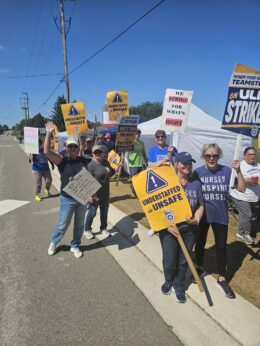
Amidst these changes in management and best practices, Spohn expressed that “without our union there, we would have had a lot of things that weren’t protected.” The union helped hold new management accountable, reminding them of the workers’ needs without resorting to disruptive strikes. But as management became more interested in the bottom line and less concerned with employee well-being, an Unfair Labor Practice strike became unavoidable. “We have almost gone on strike probably 4-5 times in the 30 years that I’ve been there,” said Spohn, “and it was always on safe staffing issues.”
“We have all been pushed,” Spohn admitted of the protests. Despite the pressure, many in the community have rallied around the nurses. Dr. Abdul El-Sayed, a politician running for local office, visited the picket line on April 23. On May 3, El-Sayed expressed solidarity, stating that, “workers have every right to stand together and demand better for themselves and our health. I stand with the Teamsters nurses in Grand Blanc.” Other union representatives, from rank-and-file members to presidents, have come out to show support, including CWA, UAW, AFT, and more.
Despite this solidarity, workers note that Henry Ford remained bullishly oppositional at both the bargaining table and the picket line. “They came through and said we could only have 3 porta-potties for the whole strike line,” said Spohn. On top of that, as Michigan’s winter set in, Henry Ford also demanded that strikers remove their burn barrels.
Just then, a couple of long-time Grand Blanc residents stepped in to help. “The Fitzpatricks–they came out of their house multiple times to support, and they were just adorable,” Spohn laughed. “And they were like, no, you’re going to put your stuff in our yard. You guys can be here, whatever you need, put your tent up, put your burn barrels, the porta-potties, like whatever you need.” In a Facebook post by Grand Blanc Nurses on Strike, Glen and Shirley Fitzpatrick were described as “a reminder of what solidarity truly means.”
On organizing, Spohn shared that, “If you have a union and don’t have an NLRB, you might as well not have a union.” Without a larger governing body to which the union can report its gripes, “then there’s no gripe.”
We hope you appreciated this article. At People’s World, we believe news and information should be free and accessible to all, but we need your help. Our journalism is free of corporate influence and paywalls because we are totally reader-supported. Only you, our readers and supporters, make this possible. If you enjoy reading People’s World and the stories we bring you, please support our work by donating or becoming a monthly sustainer today. Thank you!
CONTRIBUTOR