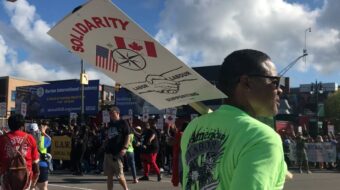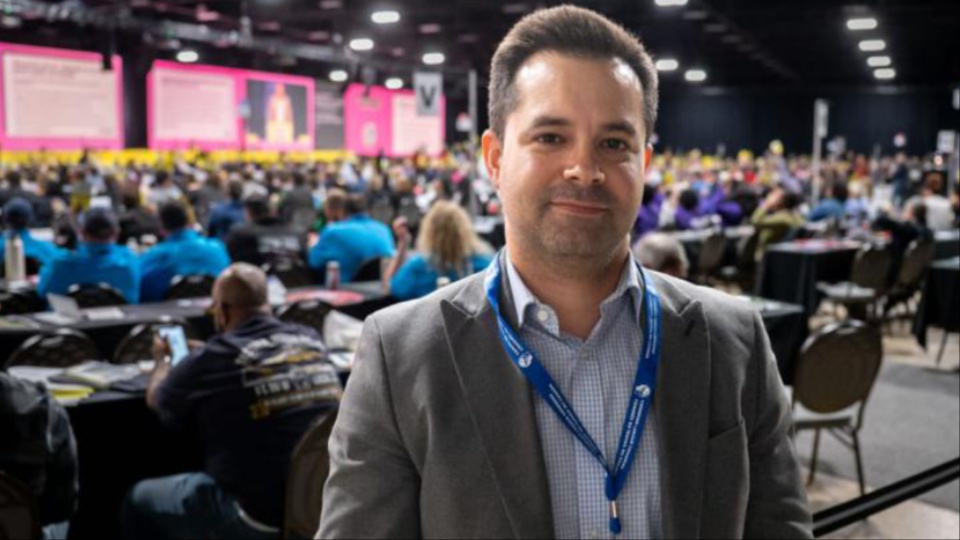
WINNIPEG, Manitoba—Canada’s unions spoke as one at the recently concluded 31st convention of the Canadian Labour Congress, voting almost unanimously in support of an emergency resolution in solidarity with Cuba.
The resolution passed with Deputy Head of Mission of the Cuban Embassy in Canada, Dany Tur de la Concepción, in the room to hear the proceedings as chants of “¡Cuba Sí, bloqueo no!” rose from the floor.
Compiling language from several resolutions submitted from across the country, the CLC resolved to demand immediate action from the Canadian government to support the people of Cuba through solidarity aid, to push for an end to the ongoing U.S. blockade, and to publicly affirm Canada’s commitment to “the principles of sovereignty, non-intervention, self-determination of peoples and human rights.”
Beyond these lobbying commitments, the CLC also committed to deepen its affiliates’ practical working relationships with the Cuban people through pertinent bodies on the island and in Canada. These include the Workers’ Central Union of Cuba (CTC) and the Canadian Network on Cuba (CNC), which comprises over two dozen member groups across Canada and works with the Cuban Institute of Friendship with the Peoples (ICAP) on its political and material aid campaigns.
Cuba’s salutary role in the world was clear from the debate, where delegates spoke of Cuba’s medical assistance to the Caribbean and beyond. Multiple speakers were freshly returned from labor brigades to the island, where Canadian trade unionists have witnessed firsthand what a society outside the profit system can accomplish for itself, even under decades of economic pressure.
To this end, delegates spoke powerfully against Donald Trump’s new sanctions and the unfinished anti-Cuba vendetta of the U.S. right, pledging tens of thousands of dollars to the CNC’s ongoing material aid campaigns from the convention floor.
No war on Cuba
This emergency resolution builds on a number of high-profile campaigns for Cuba. On May 8, Member of Parliament Alexandre Boulerice presented a parliamentary petition initiated by the Canadian Network on Cuba to the House of Commons. At present, the Canadian government has one month to respond to the more than 12,500 signatories who have called on Ottawa to refuse participation in military and economic aggression against Latin America, reaffirm the Caribbean as a Zone of Peace, and actively oppose the U.S. blockade of Cuba.
The CNC originated these demands against the backdrop of the illegal kidnapping of Venezuelan President Nicolás Maduro and First Lady Cilia Flores on Jan. 3. But after Trump’s executive order of Jan. 29 declaring Cuba “an unusual and extraordinary threat” and preventing any fuel from reaching the island, the petition quickly became a tool for urgent solidarity with the Cuban people under renewed threat.
These sequences are closely related, and one predicts the other. By all accounts, the U.S. continues to entertain the idea of a military operation against Cuba, and as the blockade pushes Cubans to the brink, U.S. Sec. of State Marco Rubio and his hawkish conspirators continue to search for the right pretense. Last week, for example, the U.S. Department of Justice moved to indict former President Raúl Castro for his involvement in the 1996 downing of two planes associated with the anti-Cuban terrorist group Brothers to the Rescue.
Not only did this event take place 30 years ago, but General Puente of the Cuban Air Defense Force and the pilots responsible were already indicted without extradition in 2003. If anything, the arbitrariness and outdatedness of the case against the 94-year-old Castro only speaks to the blamelessness of Cuba on the world stage. But Trump and Rubio’s eagerness to duplicate their Venezuelan heist in Cuba still requires a tenuously legal target.
As this proceeds, Axios has claimed that 300 Cuban drones are hovering over the U.S. Naval Base at Guantánamo Bay, preparing to attack at any moment. Any competent student of the region knows that the base at Guantánamo is in fact an illegal U.S. occupation of Cuban soil, for which the revolutionary government has refused a modest rent since 1959. Even so, Cuba has largely left the base alone, and these scarcely believable stories of Cuban aggression clearly intend to pave the way for a military operation or outright invasion.
Canadian Prime Minister Mark Carney has so far had a non-response to U.S. aggression in both Venezuela and Iran, and more importantly, has been deafeningly silent on Trump’s collective punishment of the Cuban people. As Canadian travel advisories and cancelled flights to Cuba conspire to deprive the island of badly needed currency and concerned eyewitnesses, it’s fair to say that the Canadian government is passively participating in the heightened U.S. blockade.
And while Canadian companies like Sherritt corporation withdraw from Cuba under threat of new sanctions, Carney’s meek endorsement of the U.S. plan for Cuba appears more cowardly still.
Unconditional defense
The Canadian government continues to neglect the situation of the Cuban people. But this indifference cannot be imputed to the working class, here or anywhere. The global trade union movement has long stood with Cuba, including Canada’s trade unions and their international counterparts.
In a February statement, the Trade Union Confederation of the Americas (to which the CLC affiliates) clearly identified Trump’s exaggerations of the Cuban “threat” as a maneuver to justify “an illegal naval siege (and to impose) new sanctions against those countries or companies that trade oil and other energy derivatives with the island.”
Not only did the TUCA name access to energy as a fundamental human right; its statement was equally clear that aid cannot be used to extort changes in a country’s political system.
While the CLC offers a stage for the urgent solidarity Cuba needs, the resolution at the convention still lacks this fundamental clarity. From now on, every overture of friendship and each container of aid, solidarity activists say, must be accompanied by unconditional support for Cuba’s sovereignty and backed by comprehensive opposition to U.S. imperialism.
People’s Voice
We hope you appreciated this article. At People’s World, we believe news and information should be free and accessible to all, but we need your help. Our journalism is free of corporate influence and paywalls because we are totally reader-supported. Only you, our readers and supporters, make this possible. If you enjoy reading People’s World and the stories we bring you, please support our work by donating or becoming a monthly sustainer today. Thank you!
CONTRIBUTOR