Set against pagan associations of midsummer festivity and disorder, A Midsummer Night’s Dream is usually presented as one of Shakespeare’s most carefree comedies. Yet such a reading risks overlooking the darker foundation upon which the comedy rests. The play’s enchantment and comic confusion emerge from a social order defined by violence, hierarchy, and coercion. Shakespeare exposes the structural brutality of Athens with remarkable clarity: a patriarchal legal system grants fathers authority over their daughters’ lives, political sovereignty is grounded in conquest, women are silenced, and laborers are ridiculed and marginalized. Against this oppressive civic order, the play constructs an alternative realm in the forest outside Athens—a theatrical and imaginative utopia in which death threats are transformed into play, violence into equality, and hierarchy into humor.
At the same time, Shakespeare’s dramaturgy continually unsettles the audience. Through abrupt shifts in tone, contrasts between verse and prose, comic interruptions, and the juxtaposition of radically different worlds, spectators are prevented from simply surrendering to illusion. Instead, they become judges of the society presented before them. The comedy, therefore, does far more than entertain. It reflects on the possibilities of art itself and transforms the stage into a kind of tribunal before which the violence of Athenian society is exposed.
Athens and the order of violence
The Athens of A Midsummer Night’s Dream is a rigidly hierarchical and militarised society. Violence is institutionalized in law, politics, and social custom. At the very outset, Hermia’s father Egeus invokes “the ancient privilege of Athens,” insisting that because Hermia belongs to him, he may dispose of her either through marriage or death according to the law. Ruler Theseus, far from questioning this principle, reinforces it by declaring that “to you your father should be as a god.” Hermia’s alternatives are horrifyingly narrow: obedience, death, or lifelong confinement in a convent.
In this society, patriarchal authority is inseparable from legal violence. Women are treated as property, and male sovereignty is legitimized through coercion. The political order represented by Duke Theseus rests upon precisely this logic. His marriage to Hippolyta, queen of the Amazons, is itself the product of conquest. He “wooed” her with his sword and by inflicting injuries—marriage as an extension of military domination. Hippolyta’s near silence throughout most of the play reflects this disempowerment.
Athens’ social hierarchy is based on class as much as gender. The craftsmen—the “rude mechanicals”—are marginalized within the city; only in the forest do they become truly visible, and during their performance at court. Athens, therefore, depends on exclusion as much as domination.
Hippolyta and the memory of another world
Hippolyta is not portrayed primarily as an active warrior queen. Instead, she stands as a living reminder of the violence upon which Athenian peace depends. Yet in several brief but crucial moments, she subtly undermines the assumptions of the court.
Her most important speech occurs during the hunting scene. While Theseus admires the barking of his bloodhounds, Hippolyta recalls a very different experience from her past as a participant in heroic action:
“I was with Hercules and Cadmus once, When in a wood of Crete they bayed the bear…”
She speaks as someone who once belonged to another order of existence. The experience she describes differs fundamentally from Theseus’ celebration of domination. Rather than emphasizing control, she evokes resonance: groves, skies, fountains, and landscape merge into “one mutual cry,” an experience of intensity, freedom, and harmony with nature. Her speech becomes a fleeting vision of another possibility—a relationship to the forest that does not seek possession or domination.
Likewise, she validates the Athenian lovers’ dream and responds sympathetically to the craftsmen’s performance rather than mocking them. In doing so, she again distances herself from assumed aristocratic superiority. Through these moments, Shakespeare destabilizes the seemingly unquestioned authority of Athenian state reason.
The forest as utopia
The forest outside Athens functions as the structural opposite of the city. Here, the principles governing existence are fundamentally different. The rigid laws and lethal punishments of Athens disappear. In their place emerge confusion, transformation, and play. Conflicts in the forest do not culminate in execution or violence. Oberon’s anger manifests itself through enchantment, mischief rather than violence. The impending duel between Lysander and Demetrius is dissolved through magical intervention and comic disorientation. The harsh alternatives imposed by Athenian law are replaced by comic reversibility.
Conflict among the fairies has consequences unlike those in Athens. The fairy realm is organically interconnected with the natural world. Violence here disrupts ecological harmony rather than reinforcing power. Titania describes how their quarrel has produced floods, failed harvests, and disordered seasons, suggesting that political conflict cannot be separated from the wider environment. The forest, therefore, becomes more than a space of escape from Athenian authority. It represents an alternative model of social existence grounded in interdependence, transformation, and instability rather than rigid hierarchy.
Shakespeare’s dramatic structure reflects this alternative order. The worlds of court, craftsmen, and fairies exist side by side. The rapid transitions between palace, workshop, and forest undermine aristocratic centrality. By granting equal theatrical space to rulers, laborers, and supernatural beings, Shakespeare stages a democratic impulse that challenges Athens’ hierarchy. The craftsmen themselves embody a kind of comic egalitarianism. Their decisions emerge collectively through discussion, while their adaptation of “Pyramus and Thisbe” transforms tragic violence into comedy. Hierarchy temporarily loses its authority, and theatre itself becomes a space in which social divisions can be imaginatively reconfigured.
Fairies and craftsmen: Parallel worlds
The fairies and craftsmen are linked by their roots in folklore and popular culture. Bottom enters the fairy world without fear or alienation. Though magically transformed, he remains fundamentally himself. This ease of movement between worlds suggests that imagination and ordinary labor belong together. In addition, the connection between fairies and craftsmen challenges aristocratic exclusivity. Both groups exist outside official structures of power. Together, they create an alternative sphere independent of the court. The play imagines—and, for its duration, creates—a society in which quite different beings coexist without one suppressing the others.
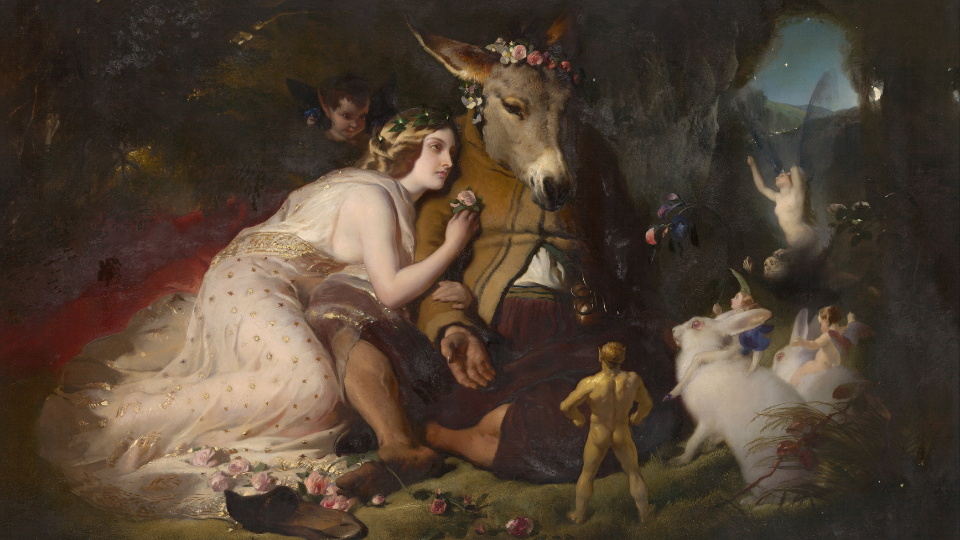
This principle defines the forest. Love here can be grotesque, even dangerous, yet never fatal. Titania’s enchantment with Bottom radically overturns social hierarchy: the queen loves the laborer, the fairy loves the human, and beauty loves the beast. The comedy lies precisely in its refusal of fixed categories.
Oberon creates disorder, only to redirect it towards reconciliation; catastrophe is avoided and harmony restored. The fairy king ultimately blesses even the marriages of the aristocrats, subtly implying that true sovereignty lies not with the state but with the invisible powers of imagination.
Language and social order
The play’s three worlds are distinguished not only socially. Shakespeare uses language itself to dramatize hierarchy and resistance. The court primarily speaks in blank verse. Its elevated style conveys authority, order, and aristocratic decorum. Yet, the speeches of the young lovers often rely heavily on conventional romantic clichés, revealing how deeply even their desires have been shaped by inherited conventions and social expectations. The craftsmen, by contrast, speak mostly in prose. Their dialogue is practical, direct, and comic. The fairies express themselves in lyrical verse, where words themselves appear magically unconstrained by physical boundaries.
The constant shifts in style throughout the play create a distancing effect. Shakespeare continually interrupts pathos with comedy, lyricism with prose, and aristocratic authority with parody. Spectators are therefore prevented from losing themselves completely in illusion. Instead, they are encouraged to compare, evaluate, and judge the different worlds presented before them. Brecht comes to mind.
The play within the play
The craftsmen’s performance of “Pyramus and Thisbe” transforms theatre itself into the object of reflection. Tragedy becomes comedy, pathos becomes absurdity, and illusion becomes visible. “Pyramus and Thisbe” mirrors the predicament of the young Athenians: forbidden love, parental prohibition, secret meetings, and the threat of death. Romeo and Juliet comes to mind. Yet, the craftsmen deliberately perform the story in such a way that its tragic conventions become comic. Their discussions about moonlight, walls, and lions openly expose the artificiality of theatrical representation. The audience is constantly reminded that what it is watching is a constructed illusion. Again, parallels to Brecht’s thinking on the distancing effect are striking.
Quince’s prologue reverses its apparent meaning by accusing the nobles. The aristocrats laugh because they fail to recognize the deeper critique hidden within the performance. As in many of Shakespeare’s plays, supposedly foolish characters become the ones who speak uncomfortable truths. The comedy directed against the craftsmen ultimately undermines aristocratic assumptions of superiority.
Comedy, tragedy, and the limits of resolution
One of Midsummer Night’s Dream’s most remarkable achievements is the way it continually balances between comedy and tragedy. Shakespeare repeatedly gestures toward catastrophic outcomes without fully crossing into them. Tragic material is displaced, transformed, or absorbed into comic structure. Patriarchal authority, coercive law, and aristocratic hierarchy appear not as eternal truths but as structures that can be mocked, interrupted, and imaginatively reconfigured.
The forest, therefore, functions not simply as a magical setting but as a space of alternative possibilities. Within it, identities become unstable, social boundaries blur, and desire escapes regulation. Lovers exchange affections, queens embrace laborers, and ordinary craftsmen move freely among supernatural beings.
Importantly, however, Shakespeare does not present the forest as a perfect utopia. Disorder there, too, can produce jealousy, confusion, and pain. The play does not imagine a world entirely free of power. Instead, it contrasts two fundamentally different models of order: Athens governs through law and punishment, while the forest operates through transformation and imagination. This distinction explains why the fairy world ultimately appears more humane. In Athens, mistakes lead toward death. In the forest, mistakes are reversible.
Theatre as utopian space
Theatre itself emerges as the medium through which these alternative possibilities can be imagined. The craftsmen’s play openly exposes the artificiality of theatre. Moonlight must be represented by a lantern, a wall by an actor, and a lion by a frightened workman, assuring the audience that he is not real. Illusion is deliberately made transparent. This transparency reveals that dramatic meaning depends upon the active participation of spectators. The audience imagines the moon, the wall, the forest, and the dream. In doing so, it becomes a collaborator in the creation of another reality.
This collaborative dimension is central to the play’s political force. Shakespeare does not preach directly against Athenian violence. Instead, he creates a theatrical structure that encourages comparison, judgment, and reflection. The audience experiences both the oppressive rigidity of Athens and the imaginative openness of the forest.
Puck’s epilogue completes this process by transferring responsibility to the audience itself:
“If we shadows have offended,
Think but this, and all is mended —
That you have but slumbered here…”
By describing the actors as “shadows,” Puck identifies theatre with illusion and instability. The audience is invited to interpret the drama as a dream. But the dream does not erase reality; rather, it opens a threshold in which reality can be reimagined. Transformation depends not only upon what occurs on stage, but upon how spectators continue to think about it afterward.
Shakespeare leaves the work deliberately open. The fairies may restore harmony within the play, but genuine transformation cannot occur entirely on stage. Responsibility passes outward to the audience. By inviting spectators to awaken from the dream with altered perception, A Midsummer Night’s Dream turns theatre into a form of collective reflection—and into a utopian space where another world becomes imaginable.
I am indebted to Kiernan Ryan’s analysis of A Midsummer Night’s Dream.
We hope you appreciated this article. At People’s World, we believe news and information should be free and accessible to all, but we need your help. Our journalism is free of corporate influence and paywalls because we are totally reader-supported. Only you, our readers and supporters, make this possible. If you enjoy reading People’s World and the stories we bring you, please support our work by donating or becoming a monthly sustainer today. Thank you!
CONTRIBUTOR