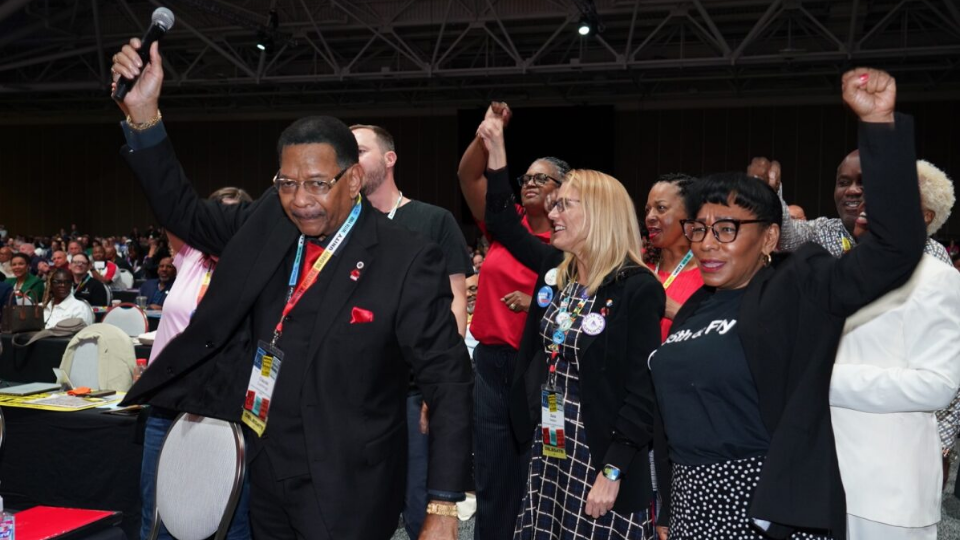
MINNEAPOLIS—On the opening day of the AFL-CIO’s 30th Constitutional Convention, hundreds of delegates gathered in downtown Minneapolis and re-elected President Liz Shuler and Secretary-Treasurer Fred Redmond to new terms, welcomed the return of the Service Employees International Union (SEIU) after more than two decades, and set an ambitious course for the labor movement in a moment defined by both renewed vitality and deepening peril.
Shuler and Redmond ran unopposed for a second term, leading the nation’s largest labor federation. Despite multiple appeals from the convention floor for additional nominations, no challengers emerged—a sign of the leadership’s consolidated position within the house of labor.
On the move, but not out of the woods
When Shuler and Redmond first took office in 2022, they inherited a federation that was facing the lowest union density in AFL-CIO history. Today, by contrast, union membership stands at its highest level in 16 years. The AFL-CIO now represents nearly 15 million workers across 65 affiliated unions, up from 57 unions when the current leadership began.
The return of SEIU—which had been outside the federation since the Change to Win split in 2005—added 2.1 million workers to the AFL-CIO’s ranks in a move widely hailed as the most significant step toward labor unity in decades. April Verrett, president of SEIU, seconded Shuler’s nomination for re-election and told delegates that the question facing the labor movement is not whether to return to a world “before Trump,” but “whether we’re going to build a new one.”
Yet for all the celebration, sobering statistics hung over the convention hall. Union density in the U.S. remains far below its post-World War II peak of 35% in 1954. The all-time high number of union members came in 1979, when 21 million workers were represented by unions—a figure that has since fallen to around 15 million today, and that’s including a decent year of new organizing in 2025. The labor movement has clawed back ground, but it has not yet returned to its former heights.
Minnesota Brave
No moment at the convention carried more emotional weight than the tribute to Minnesota’s labor movement, which has been on the front lines of resistance to the federal government’s immigration “enforcement” operations. In January, the Trump administration launched “Operation Metro Surge,” deploying thousands of ICE agents across the Twin Cities in a crackdown that resulted in mass arrests, the detention of union members, and the deaths of two U.S. citizens—Renee Good and Alex Pretti, a nurse and member of AFGE Local 3669.
Minnesota’s unions responded with tens of thousands of workers—estimates ranged from 70,000 to 100,000—who joined together in the Statewide Shutdown, or the “Day of Truth and Freedom.” They refused to work, shop, or attend school, while hundreds of businesses closed their doors in either solidarity or because nobody showed up to work.
Earlier in the morning, over 100 clergy and activists were arrested in a civil disobedience action at the Minneapolis-St. Paul International Airport is demanding that Delta Airlines end its complicity with ICE deportation flights.
Bernie Burnham, president of the Minnesota AFL-CIO, received a standing ovation as she described the state’s labor movement in action that day.
“When a hostile federal government invades your community, putting solidarity into action is not something any of us expected when we joined the labor movement,” Burnham told delegates. “But when Operation Metro Surge descended on Minnesota, our labor movement stepped up like never before. Nearly overnight, labor’s community services funds became legal defense and mutual aid funds for unlawfully detained workers and their families.”
She credited rank-and-file union members for often being the first to alert support networks about ICE raids, and union stewards and officers for having difficult conversations with members about why the raids were not simply attacks on immigrant workers but attacks on constitutional rights and freedoms.
“They invaded a winter people in winter, and our solidarity froze them in their tracks,” Burnham said, drawing thunderous applause. “Now they know. Now we know: Americans are not afraid.”
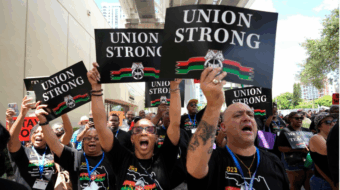
The convention honored the Minnesota labor movement as union members, stewards, and local officers flooded the stage, chanting, “How strong are we? Union strong!”
Chelsie Glaubitz Gabiou, president of the Minneapolis Regional Labor Federation, Kera Peterson, president of the Saint Paul Regional Labor Federation, and Burnham were all brought to the stage to speak.
Is it working?
Secretary-Treasurer Fred Redmond delivered a keynote address that was part history, part rallying cry, and part sober inventory of labor’s challenges.
“The wealthy and well-connected are consolidating power at an alarming rate,” Redmond said. “This administration is corrupt to its core. Trump does not care about America. He does not care about our well-being. As long as there is more for him and his billionaire buddies and less for everybody else.”
Redmond, the highest-ranking Black officer in the federation’s history, invoked Dr. Martin Luther King Jr., quoting his warning that “there is such a thing as being too late.”
“When the fertile ground that we have made as a movement, organized, and built at the bargaining table has turned to sand, it is not unreasonable to ask the question. Is it working?” Redmond asked. But he answered his own question by invoking the strike leaders, union siblings, and organizers who came before—many of whom fought and died for the right to join a union and the right to vote.
“We carry them in our hearts,” he said. “When the historians of the future write the story of our time, they will see a working class betrayed and knocked down by the billionaire class. And they will see trade unions once held back by the corporate elite shake free of these oppressive forces and join together, and rise together.”
Rising tide must lift more than yachts
President Liz Shuler laid out an ambitious agenda for the next five years, doubling down on the federation’s commitment to organizing.
“We said we would organize a million new workers over the next 10 years. We got it done in three,” Shuler declared. “Today, we are doubling down. We’re going to organize two million more workers over the next five years. And that’s the floor, not the ceiling.”
The pledge comes with significant headwinds. Federal labor law remains stacked against union organizing, and the Trump administration’s “single biggest act of union busting in American history,” stripping collective bargaining rights from 1.3 million federal workers, looms large—especially without a vigorous response from all of labor.
But in response, she said, federal worker unions have organized tens of thousands of new members, which shows that workers are ready and willing to fight back.
Shuler cast the labor movement’s fight not simply as resistance to Trump but as a broader struggle against an economic system rigged for billionaires.
“That economic pain, the uncertainty workers are living through right now, didn’t start with Donald Trump. And it won’t end with Donald Trump,” she said. “It’s going to end because we take on an entire system that has left working people behind. A rising tide doesn’t do any good if it’s only lifting up the yachts.”
On the political front, Shuler announced that the AFL-CIO aims to turn out 16 million union members and their families in the 2026 midterms, an increase of two million over the previous cycle. The federation also plans to deploy 50,000 trained election protectors to polling places where ICE might show up to intimidate immigrant voters.
The organizing challenge
For all the apparent unity on display, the most important question hovering over the convention hall was about a very basic question: new union organizing.
The victories she ticked off are real. Bus manufacturers and auto workers, healthcare workers, new educators, and public service workers are being organized. But there is the uncomfortable truth that union density in the United States still stands at barely 10% of the workforce.
Shuler acknowledged as much indirectly when she laid out the scale of the opposition. “More than 700,000 healthcare jobs are going to be created over the next decade, and we’re going to organize every single one of them,” she declared. But creating jobs and organizing them are two very different things, especially under a hostile administration that has already gutted collective bargaining for a million federal workers and stacked the courts against labor.
The federation has put resources behind the goal, and the AFL‑CIO Technology Institute is trying to get ahead of artificial intelligence on the shop floor. The new five‑year term gives the incumbent leadership time to see those investments through. But time is not unlimited.
Will the convention hear a program for how two million more workers will be organized in five years? What level of per‑capita spending will be committed? What will the federation do to encourage affiliates to put resources into organizing new workers? How will the labor movement overcome the fundamental structural reality that most organizing still happens union by union, employer by employer, while the anti-union forces have consolidated into a coordinated, well‑funded apparatus?
Shuler’s answer, in essence, was to argue that the momentum is on labor’s side. “We’ve shown people all over this country there is a way to fight back,” she said. “And it’s called the labor movement.”
Whether it is enough to turn back the tide—or merely slow it—is the question still yet unanswered.
The convention will go through Wednesday, June 10th.
We hope you appreciated this article. At People’s World, we believe news and information should be free and accessible to all, but we need your help. Our journalism is free of corporate influence and paywalls because we are totally reader-supported. Only you, our readers and supporters, make this possible. If you enjoy reading People’s World and the stories we bring you, please support our work by donating or becoming a monthly sustainer today. Thank you!
CONTRIBUTOR