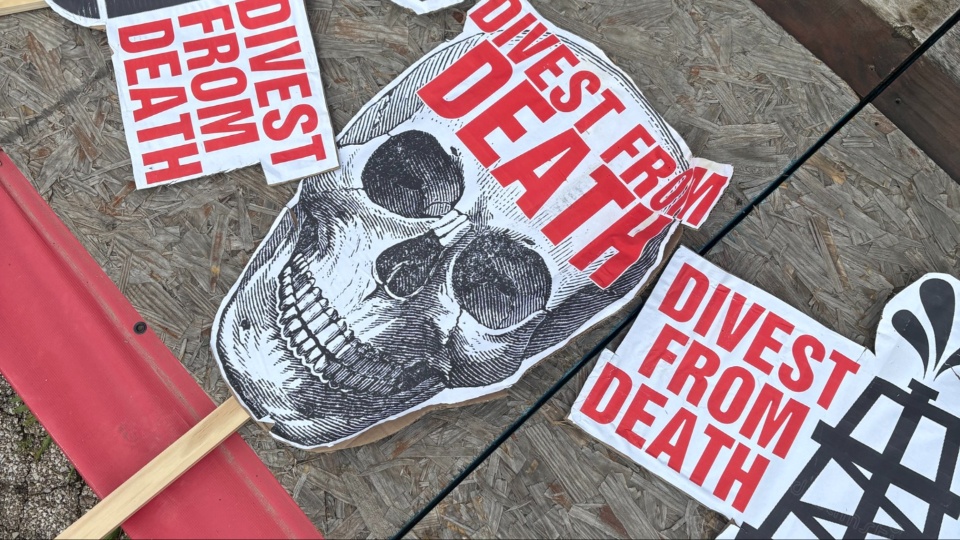
COLUMBUS, Ohio—Artists, activists, and community members gathered amongst the post-industrial landscape of the Milo-Grogan neighborhood on Sunday to protest against the building of an enormous AI weapons manufacturing plant in Columbus.
The AI industry, the latest sink for capital investment at the expense of working-class interests, is coming to central Ohio in a big way. Anduril Industries, an autonomous weapons system manufacturer founded by self-identified radical Zionist and Trump benefactor Palmer Luckey, announced in January 2025 that it would be constructing its first hyperscale manufacturing facility, known ominously as “Arsenal-1.” The plant will apparently redefine the scale and speed at which autonomous weapons can be produced for the United States military and its allies and partners.

Under the banner of “Make Art Not AI Weapons,” a dense coalition of activist groups from across the state of Ohio has united in opposition to the interests of finance capital and its military industrial complex. Sunday’s event was co-sponsored by No Ohio Anduril Plant (NOAP), Columbus Education Justice Coalition, Veterans for Peace, Jewish Voice for Peace, American Muslims for Palestine, Black Queer & Intersectional Collective, Black Transmen of Ohio, 614 ICE Watch, and the Communist Party USA.
With artists set up across an outdoor studio space and stage, the event opened with a discussion led by Zach, host of WGRN’s Marx in the Morning podcast, and featuring Kat Finneran of NOAP, the Buckeye Environmental Network, and 614 ICE Watch.
Finneran shared extensive insights into the nature of the new surveillance state and its ties to Anduril and AI weapons. “Anduril is a new wave of the military-industrial complex. It’s about software and drones, which creates a network known as ‘lattice’ that connects state and private surveillance to military war technology”, she said.
Finneran painted a picture reminiscent of George Orwell. “Everyone from DHS and other Federal entities to private companies like Lowes can access the information being collected by Anduril’s surveillance tech. We know these technologies are being used to track migrant workers.”

Among the many costs associated with the Anduril plant are extensive infrastructure improvements paid for by the city using taxes collected from Columbus workers and retirees. The site will also conduct test flights of Luckey’s unmanned weapons platforms in Columbus airspace, flying over communities like Milo-Grogan on a daily basis.
The construction of the plant has already had a detrimental impact on surrounding farmland and wilderness areas. Zach and Finnegan took questions from the gathered crowd regarding the environmental impact of the Anduril plant as several participants joined the pair on stage. Many participants brought used t-shirts from home for free screen-printing by local artists. The most popular print commemorated the event with “Make Art Not AI Weapons.”
Columbus labor folk band The Gadflies followed Finneran on the stage, opening with Pete Seeger’s “What a Friend We Have in Congress,” which features the lyrics:
Modern bombs are sure to carry
Loads of glory, joy and thrills
What a privilege to bury
All the dead our money kills
Subsequent songs from the five-piece band whipped the largest crowd of the day into frenzied singalongs on Woody Guthrie’s “Union Maid” and “Solidarity Forever.”

“I’ve never heard music like that before,” said DJ Typo Typo, who followed the Gadflies with an introspective and engaging ambient techno set that invoked the beauty of technology in stark contrast to the aims of Anduril and the AI surveillance industry.
“AI calls into question the meaning and authenticity of everything,” Finneran said. A graduate student and instructor, she pointed out experiences with her students. “I’m more proud when [their papers] are bad because I know they wrote it,” she said, compared to the sterile submissions produced with AI chatbots.
The people gathered at Sunday’s event were fundamentally questioning whether Columbus should be involved in building the kind of future seen in Terminator movies, where artificial intelligence-fueled robots make life and death decisions. Amongst the crumbling 19th century warehouses covered in art and wrapped in leafy vines, Make Art Not AI Weapons stood out as an authentic human moment in a world increasingly characterized by the absence of human connection.
Finneran offered direct advice: “The more we create in person, the more experiences we can draw from on our own, meaning the less AI has to learn from.”
We hope you appreciated this article. At People’s World, we believe news and information should be free and accessible to all, but we need your help. Our journalism is free of corporate influence and paywalls because we are totally reader-supported. Only you, our readers and supporters, make this possible. If you enjoy reading People’s World and the stories we bring you, please support our work by donating or becoming a monthly sustainer today. Thank you!
CONTRIBUTOR