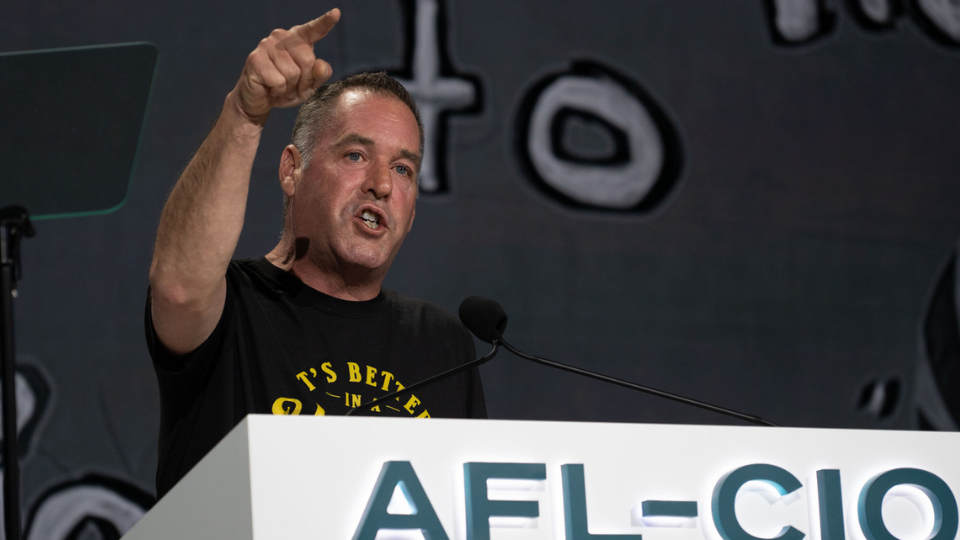
MINNEAPOLIS—The building trades have historically carried a reputation as exclusive, slow-to-change institutions within the labor movement. But at the AFL-CIO’s 30th Constitutional Convention here, General President Jimmy Williams of the International Union of Painters and Allied Trades (IUPAT), noted that his union, both in the past and present, is leading a progressive sea change from the inside out.
By actively fighting racism and sexism and building a diverse, inclusive rank-and-file, IUPAT is proving that the road to building the trade union movement runs through working-class unity. They were among the first to run training programs that included African American women, for example, and they remain committed to building diversity and inclusion in the movement today.
Sitting down for an exclusive interview with People’s World, Williams tackled the pressing crises facing workers today, from rampant wage theft targeting immigrant workers to a rigid two-party electoral system that leaves the working class behind. He candidly discussed the difficult, but essential, work of confronting bigotry within union ranks, arguing that the trade union movement cannot afford the divisions of the past.
As the largest labor federation in the United States, the AFL-CIO aims to mobilize and organize millions of new workers and voters, Williams’ perspective offers a roadmap for a more militant labor movement—one where cross-industry solidarity is the ultimate weapon against monopoly power.
The full interview is printed below.
People’s World: From your perspective, what should we be looking out for at this convention?
Jimmy Williams: Well, the convention sets the policy and sets the direction of the labor movement. There aren’t any structural changes to our movement happening this week, but it’s more about the direction—what are the pillars we’re looking to fight around? I think it’s also about the unity in the room, bringing this many labor organizations together as one, including having SEIU back at the table.
PW: That’s a big deal.
JW: It is. The main themes are organizing the unorganized and the labor program for the midterms, but also beyond that.
PW: On the organizing question—something I didn’t hear a lot from the floor so far was about the nuts and bolts of how. I know your union, the Painters, plus the Auto Workers, Teachers, and Service Employees—these unions are deeply interested in that question.
JW: It’s difficult. It’s difficult when you have the entirety of the labor movement together like this to talk strategy, because there are so many different industries—public sector versus private sector, for example—and every industry has its own organizing strategies. It’s hard to have a truly strategic conversation at a convention like this.
PW: From the Painters’ perspective, how do you plan to implement what’s been set out here?
JW: For us, the big thing is that working people as a whole need to know the labor movement is strong and thriving—especially at a time when workers want and need unions more than ever. So for us, this is a way to continue the organizing work we’re already doing and try to deepen it. But honestly, the unions affiliated with the AFL-CIO are the ones that have to organize, not the AFL-CIO itself. So it really isn’t going to change much for us. We’re just going to keep organizing.
PW: Coming out of one panel, I was struck by the focus on immigrant workers. I believe it was you who said we have to find a way to organize these workers into our unions to build up the entire labor movement. Could you speak to that a bit more?
JW: Immigrant workers are the predominant makeup of our industry. The construction industry is increasingly majority Latino immigrant workers. Our union is now a majority Latino union—mostly first-generation or recent immigrants. If that’s who makes up the workforce, that’s who we have to organize. It’s pretty simple.
But it becomes very complicated when there’s no functional immigration system. Wage theft is rampant. People are abused on the job site by their employers and have no pathway to organize. They have no rights as independent contractors. It’s a very complicated thing. Showing up for immigrant workers is also about engaging with them about how the system is rigged against them. If you’re there for their issues in their workplace, you can help them in the world, too.
PW: On the flip side, how do you build solidarity and unity between them and the U.S.-born workers, and white workers in particular?
JW: It’s day to day. It’s working our membership and educating them. You can’t change bigotry or racism unless you call it what it is, cut it out, and try to educate people around it. We have deep conversations with our “traditional” white construction workers—the ones who look like me —on a regular basis. I can tell you, those are probably the most difficult conversations. They’re not easy. But as you heard today from Brent Booker, president of LiUNA, there’s a real movement now to build unity within the building trades. This ain’t the building trades of 20 years ago. We’re in this fight together.
PW: It’s no secret that the Democratic Party establishment has been losing favor with union members and working-class people overall. That doesn’t necessarily mean they are switching to the Republicans. Many are just not voting at all. For example, with my coworkers when I was in UFCW, this was discussed every election period. But at the same time, as the labor movement, we need to fight Trump, MAGA, and the billionaires come November.
How can labor exert its political independence to put its own stamp on these elections?
JW: I’ve been saying it over and over: the Democratic Party can be an ally for the labor movement, but that shouldn’t be taken for granted. I think it’s very symbolic that on this convention agenda, there isn’t one political speaker in that traditional sense. Going forward, I wish more of the labor movement would just declare our independence, period. There are major factions within the Democratic Party that quite frankly don’t give two shits about us. We have to call that out.
You can try to reorganize the Democratic Party around our values—working-class people’s values—but you don’t have to take them for granted, and they shouldn’t take us for granted. Our members who vote Republican or MAGA believe we’re just a wing of the Democratic Party. But here’s the other problem: the Democratic Party thinks we’re just a wing of them, too. We’re stuck in this catch-22. Until we build up and declare our independence, we’ll be stuck here.
PW: Is the Labor 2026 POWER program you just voted on a step toward that?
JW: Yeah, that’s the political organizing work that has to take place within our movement. Every race is going to be different. There are going to be some candidates we obviously have to support. But at some point, we’ll get their attention when we stop supporting certain candidates.
PW: The AFL-CIO set a goal of organizing two million more working-class voters for the midterms. Do you think that’s realistic?
JW: I do. There’s true voter disenfranchisement in our country. I’m from Philadelphia. Going into the 2024 election, we did a survey and found there were 250,000 unregistered voters just in the city of Philadelphia. That’s just one city. Do the math. The labor movement can fill a void that the Democratic Party just can’t fill. We have the resources to mobilize and recruit more people to vote. I think two million voters is easily reachable.
PW: Similarly, do you think organizing two million workers in the next five years is realistic? Or, on the flip side, is it too little of a goal?
JW: I think it’s realistic. At the last convention four years ago, I think we set a goal of a million in ten years. And we hit it already. We hit it in three years. So we can’t do two million in five? Come on.
PW: Fred Redmond and Liz Shuler have both said union density is where we get our power. Will the rest of the affiliates hear that call and organize the unorganized to build that density?
JW: I think so. I can only speak for myself, but I talk to a lot of my counterparts. For years, we haven’t been able to put a real cross-industry effort together to go up against the corporate power holding back private sector unions. But those conversations are happening now—about how you match up the service sector with hospitality with construction. Construction workers work on hospitals, hotels, Amazon facilities, and data centers. If we can cross-coordinate, we can really build something.
PW: Sharing resources among affiliates?
JW: Totally. I think this is the best time it’s been in a long time in our labor movement to have those types of conversations. And they are happening. Having SEIU back at the table really helps. We just did a joint conference between the SEIU and the Painters at the Jobs with Justice convention in Atlanta about three weeks ago—all about putting our organizers together, strategizing together with community organizations, service sector, and construction unions. I’ve been around the labor movement for 25 years. This is the best time when it comes to actual solidarity, that I can remember.
PW: Coming back from this convention, what are you going to tell your members in the Painters about your takeaways?
JW: Honestly, if there’s one takeaway from this convention, it’s that we’re going to start digging deeper into other people’s fights. If there’s an organizing campaign taking place in your city and it doesn’t involve your union, get involved. Same thing with our political efforts. Let’s work together. Let’s go out and talk to each other’s members. Let’s start building worker solidarity.
The problem is, everyone is connected to their own union, but they don’t always associate with other unions like they used to—70 or 80 years ago. We’ve got to start putting back that word “solidarity” in our membership. Coming off of this convention, that’s the most primary thing I’ll be thinking about.
We hope you appreciated this article. At People’s World, we believe news and information should be free and accessible to all, but we need your help. Our journalism is free of corporate influence and paywalls because we are totally reader-supported. Only you, our readers and supporters, make this possible. If you enjoy reading People’s World and the stories we bring you, please support our work by donating or becoming a monthly sustainer today. Thank you!
CONTRIBUTOR