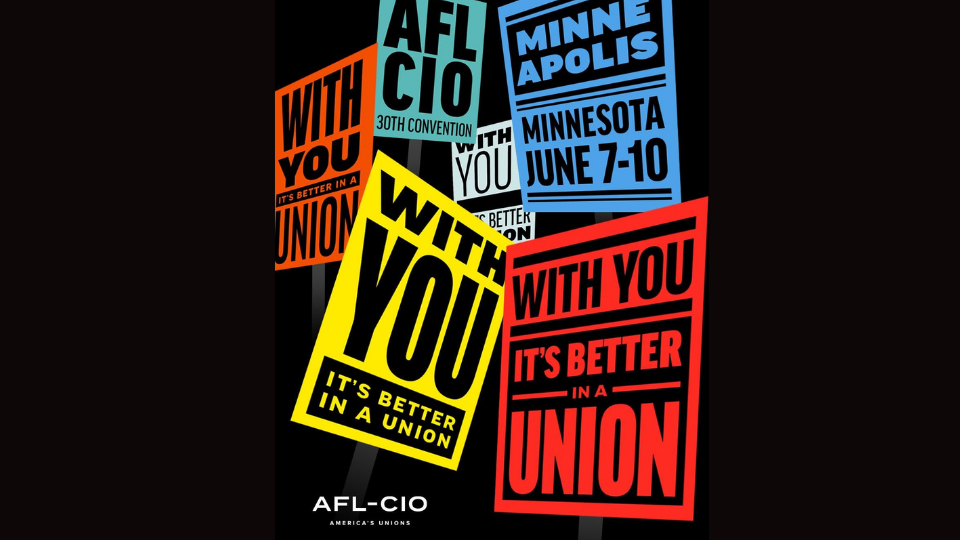
MINNEAPOLIS—A panel of top-level unionists at the recent AFL-CIO convention, moderated by Biden administration Labor Secretary Julie Su, delved into the future of the nation’s unions. The focus was on matters facing U.S. workers here at home, exclusive of issues like curbing the military budget.
“We should build an economy whose first principle is how just it is” for workers, said Su, now New York City’s first-ever Deputy Mayor for Economic Justice, named by the new Democratic Socialist Mayor Zohran Mamdani.
The future she envisions is in direct contrast to “the last year and a half,” which has seen “attack after attack” on workers from the far-right pro-corporate Republican Donald Trump administration. But “holding the line” against further attacks, or even going back to the “normalcy” under Biden, is not enough, Su and the panelists said.
AFL-CIO President Liz Shuler sounded the same themes and added political action during the mid-term elections to the mix in closing the convention on July 10.
“We organize. We win elections, get our own members into office. We pass laws to build our power. We stand together when they try to divide us. And we get it all done—with you,” she stated.
The panel discussion at the AFL-CIO Convention in Minneapolis preceded a resolution delegates approved by voice vote, increasing the focus on state and city legislation, given the continuing anti-labor focus of the GOP and its congressional majorities in the House and Senate.
Despite GOP control in Washington, D.C., “We have strong state and city governments that are bulwarks…They should be used to help people,” Su said.
That’s where the state federations and local central labor councils enter the picture, and the resolution recommits the federation to structural aid to them, especially to smaller councils that cannot afford staffing on their own.
“This resolution commits us to fighting for raising the minimum wage,” enhancing worker rights, “affordable health care for all, affordable retirement, good public schools and affordable housing,” said Machinists President Brian Bryant.
Su added taxing billionaires and increasing—not decreasing, as Trump has—factory jobs, which must be union jobs, in the green economy. And she added the movement should commit to having more of its members seek public office, using the tools and infrastructure unions can provide.
In return, “we expect they’ll benefit labor and unite us against the threat of technology,” particularly artificial intelligence, to workers’ jobs.
“If we do not define the future we want and come together to fight for it, someone else will do it for us,” Su warned. “It will be a future of poverty and union-busting.”
But even before the convention ended, the unionized jobs in green factories appeared in trouble in Congress, and not just from “the orange troll in the White House (Trump) and his skin-headed Nazi sidekick,” Steve Miller, as Musicians Secretary-Treasurer Kent Shirk labeled the duo.
The New York Times reported congressional Democrats have been told to stop discussing and pushing the “Green New Deal” and the prospects for solar, hydro, wind, and nuclear power to replace fossil fuels. Instead, given rising gasoline prices due to Trump’s war on Iran and closure of the oil lifeline through the Strait of Hormuz, the watchword is an “all of the above” energy policy.
Which is what the Building Trades have pushed for years, and which includes oil, natural gas, fracking, nuclear, and coal.
“Too many workers are being told to do more for less,” said Bryant. “The billionaires don’t want the middle class” to exist, Jeremy Sanders of Steelworkers Local 959 in Fayetteville, N.C., added during the subsequent discussion. “Today, people are doing things right and still falling behind,” and unions must tackle that, he said.
Panelist Sean McGarvey, president of North America’s Building Trades, advocated for union leaders to get out of D.C. more often and listen to their members. That’s what Shuler has done. She laces speeches with stories from workers nationwide, about what they face and what bosses do to them.
Other union leaders should tramp the country, too, said Transportation Trades Department President Greg Regan. “Meet people where they are,” he urged.
We have to be “spending more time in the field and listening to our rank and file, and then get public policy done” based on what unionists say they want, not what focus groups, lawmakers—or D.C. lobbyists and corporate donors—advocate. “If we don’t get that done now, we’ll be in the same place we were after NAFTA,” warned McGarvey.
That place, he added, was to tell jobless factory workers, after NAFTA, the North American Free Trade Agreement between the U.S., Canada, and Mexico, closed their plants, “Oh, here’s some community college (tuition) vouchers. Now go learn to code.”
The plants are still closing. Sanders reported that Local 959 faces the planned closure, by the end of 2027, of the largest plant, a Goodyear Tire factory, which his local represents. “More than 1,600 workers face an uncertain future,” he added.
The George W. Bush administration and corporate lobbyists, working behind closed doors, largely wrote NAFTA. “New Democrat” President Bill Clinton pushed it through a lame-duck Democratic-run Congress, through arm-twisting and dangling political goodies, over organized labor’s strong warnings that NAFTA would cause a mass exodus of factory jobs to low-wage Mexico.
In NAFTA’s succeeding years, it did. Some labor analysts believe the memory of NAFTA was one reason Hillary Clinton lost working-class union voters—including 52% in Ohio, McGarvey said then—to Trump in 2016.
The U.S.-Mexico-Canada Agreement (USMCA) replaced NAFTA during Trump’s first term. But labor, led by AFL-CIO Deputy Chief of Staff Thea Lee and legislative representatives from the former UAW and Teamsters leadership, had a big hand in writing the new pact, with more-favorable pro-worker trade provisions. They included minimum North American content for vehicles and higher pay for Mexican auto workers, though it still was nowhere near U.S. levels.
Congressional Democrats voted for the USMCA, but rank-and-file unionists, notably at UAW, still call it a sellout. So does current Auto Workers President Shawn Fain. His union’s convention runs from June 15-18. Expect a repeat condemnation. The pact is undergoing review in all three countries.
In discussion about the resolution, Doug Moore, executive director of AFSCME Local 3930, raised one more problem the AFL-CIO will have to confront on behalf of workers: The future of full Social Security payments to retirees.
The morning of the discussion, the retirement system’s trustees projected the Social Security trust fund’s interest income—which the rest of the government grabbed over the years to help offset part of the red ink in the rest of the federal budget—will be exhausted by 2034.
That will leave only payments from working people’s payroll taxes available to pay growing numbers of Social Security recipients, said Moore. The average Social Security recipient will lose $500 a month, he said.
Left unsaid: Only a portion of total income is taxed via W-2 and 1099 forms. For workers, the tax bite comes out of all of their yearly paychecks. For millionaires and billionaires, the “tax cap” on Social Security and Medicare payroll taxes means they contribute little to the system. And their unearned income—dividends, interest, capital gains, stock buybacks, etc.—isn’t taxed at all.
Sen. Bernie Sanders, Ind-Vt., labor’s longest-tenured congressional supporter, has long advocated “scrapping the cap” on earned income. But even in his denunciations of the millionaire class, Sanders has rarely, if ever, proposed subjecting unearned income to Social Security and Medicare taxes, too.
That looming shortfall will especially hurt the lowest-paid workers, including the nation’s child care and home care workers. AFSCME represents some 250,000 of them. “Without this” money from Medicare and Medicaid via their employers and/or child care and home care recipients use to pay those workers, “people would be forced into expensive nursing home care. And families would have to drop out of the work force to provide child care,” said Moore.
That’s not right, he added. “Workers should have the ability not just to survive, but to thrive.”
We hope you appreciated this article. At People’s World, we believe news and information should be free and accessible to all, but we need your help. Our journalism is free of corporate influence and paywalls because we are totally reader-supported. Only you, our readers and supporters, make this possible. If you enjoy reading People’s World and the stories we bring you, please support our work by donating or becoming a monthly sustainer today. Thank you!
CONTRIBUTOR