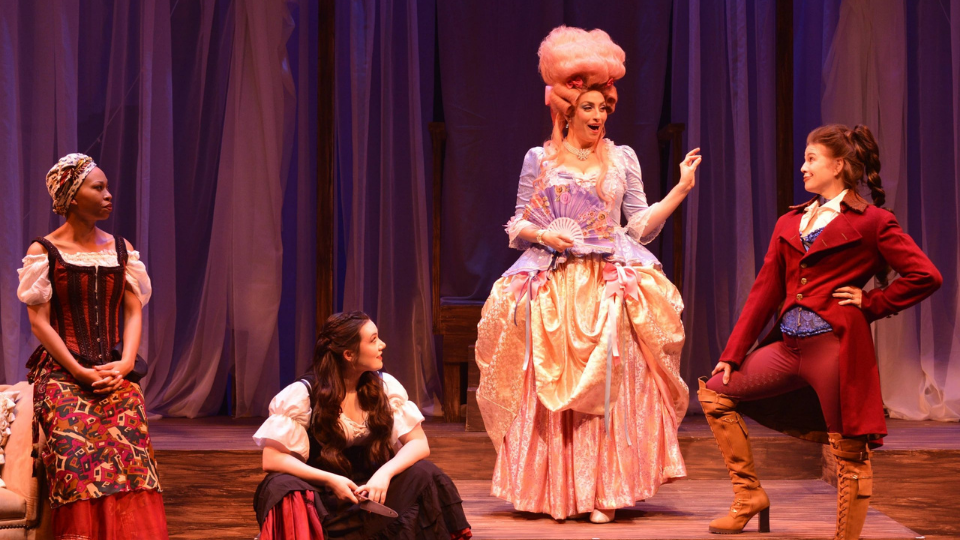
Set in Paris in 1793, award-winning playwright Lauren Gunderson’s très droll 2016 play The Revolutionists is a comedy about France’s Reign of Terror, with aristocrats and assorted enemies of the people quite literally laughing their heads off. Gunderson’s edgy guillotine-tinged satire focuses on four extraordinary Frenchwomen who may or may not have a date with the blade that beheaded thousands of foes of the French Revolution at Place de la Concorde and elsewhere.
Olympe de Gouges is the bard who opens The Revolutionists, played by Amie Farrell (Mank, American Sniper, This Is Us). I had never heard of this real-life scribe, who was an early supporter of the French Revolution, an abolitionist, playwright, and, as this two-act play notes, authored a feminist response to and version of the National Constituent Assembly’s “The Declaration of the Rights of Man and of the Citizen.” The fact that Olympe wrote plays provides Gunderson with ample opportunity to poke fun at theater, including a sly reference to Les Mis.
There is a lot of witty repartee and ripping ripostes in The Revolutionists’ dialogue, especially in the interaction between Olympe and the cleverly monikered Marianne Angelle—“Marianne” was also the name of France’s “goddess of liberty,” who personified and symbolized the French Revolution. In a bit of canny casting, the marvelously expressive Durban, South Africa-born Nondumiso Tembe portrays Marianne Angelle, a Haitian revolutionary who is the only member of the dramatis personae that’s not an actual historical person per se (rather, she’s a composite character). Nevertheless, Gunderson’s inclusion of a role for a Black Caribbean woman shows great political insight and sensitivity, as the French Revolution’s “Rights of Man” needed to be extended to women, and to the masses of enslaved Black people in Paris’ colonies at Haiti and beyond, where sugar and other commodities were produced and extracted to enrich the empire. (To this day, France remains one of Earth’s largest colonizers.) Furthermore, Gunderson is to be commended for accenting the issue of how a Black character is to be portrayed and represented— and by whom.
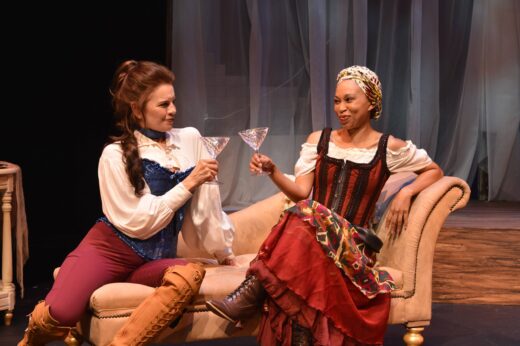
So far, so good; then, enter hush, hush, not-so-sweet Charlotte Corday, the vile murderer of the Jacobin revolutionary leader, Jean-Paul Marat. Sarah Pierce (a perfect last name for a knife-wielding assassin!) certainly captures the maniacal menace of the fanatically overzealous Corday, who was the Squeaky Fromme of the French Revolution. The deceitful Corday wangled her way into Marat’s inner sanctum, where while he was bathing (hiding out from the aristocrats in damp cellars and so on for years, Marat had contracted a skin rash or disease eased by being immersed in water) went Norman Bates on him, stabbing the unarmed Marat to death about 170 years before Hitchcock directed Psycho (which could also be the name of a biography about the truly despicable Corday).
The last member of the quartet to enter, stage (decidedly) right, is Queen Marie Antoinette, certainly The Revolutionists’ most famous (or rather, infamous) characters. Her Royal Anus is performed with kooky panache by Lyndsi LaRose; this alum of The Groundlings generates lots of laughs poking fun at her regal role. It was almost as if Judy Holliday was sending up the “dumb blonde” stereotype (or whatever color Her Majesty’s outrageous wig, presumably concocted by costume designer Kimberly DeShazo, is supposed to be).
I enjoyed this French Revolution farce, but there’s a big political problem with The Revolutionists’ historical take on and depiction of its characters that undercuts the believability of Gunderson’s four-actor. I can buy Olympe’s interactions with Marie Antoinette, who wants the playwright to sympathetically tell her side of the story in a play about the queen. In real life, the vain Olympe was from a well-to-do, not a peasant background, which the play humorously hints at. During the Revolution, Olympe sided with the Girondists, the more moderate faction. When Marie Antoinette’s husband was put on trial, she offered to defend King Luis XVI (who, as that great “historian” comic folksinger Allan Sherman sang: “Was the worst, since Louie the first”) and Olympe also publicly opposed Robespierre and his Montagnard faction and the excesses of the Reign of Terror.
I could also willingly suspend my disbelief in this dramatization of Olympe’s encounters with Charlotte Corday, as both of them were Girondists and were not of the impoverished masses. From a minor aristocratic family, Corday blamed the far-left Marat (who is an offstage presence in Gunderson’s production, spoken of but never seen) for excessive violence against the ruling class.
OK, so here’s the rub: Jean-Paul Marat’s newspaper was entitled L’Ami du Peuple, the “Friend of the People,” and he was the tireless champion of the rights of the sans-culottes, the masses of ordinary workers, against the privileges of the aristocrats. In Peter Weiss’ 1964 Marat/Sade (for my francs, the best political play of the second half of the 20th century), Marat rather memorably says: “The important thing is to pull yourself up by your own hair, to turn your eyes inside out, and see the whole world with fresh eyes.” Oh là là!
Although I do not know Marat’s specific stance on colonialism and the Haitian Revolution, from what I do know about him, I do not buy the interactions between The Revolutionists’ anti-slavery activist Marianne Angelle and Charlotte Corday, the detestable murderer of the Friend of the People, whatsoever. I tend to think that Marianne would have sided with Marat against Corday. (And by the way, like Glenda Jackson in her first major movie role in the 1967 screen adaptation of Marat/Sade, Sarah Pierce succeeds in conveying how truly disturbed, disturbing, and deadly Charlotte Corday was. Although, as I recall, Jackson was even more delusional, demented, and detached from reality, as Corday was supposed to be portrayed by the inmate of an insane asylum in Weiss’ play-within-a-play directed by Marquis de Sade.)
The Revolutionists raises questions about the dramatization of history in a work of fiction. Of course, like all playwrights, novelists, screenwriters, et al, Gunderson—who has been lauded as America’s most produced living playwright—has the First Amendment right to make things up in a work of fiction (that does not pretend to be a documentary). And the dead cannot sue storytellers for defamation of character or copyright infringement. But I can’t help but wonder what the responsibility of dramatists, etc., is when they are writing about people who really existed and actual events in works of historical fiction? Whatever the answer is to that perplexing question, one thing’s for sure: An ahistorical mistreatment and misrepresentation of reality can undercut Samuel Taylor Coleridge’s willing suspension of disbelief as surely as Corday cut poor Marat down.
To its credit, The Revolutionists ponders the issue of political violence, which, of course, is very timely—and revolutionary violence in particular. In addition, the play deals with race, gender, class, and the role of the arts in social movements. And this play is told from women’s point of view, with an all-female cast.
Director Jamie Torcellini, a Broadway veteran, elicits performances that range from the amusing to the cruising for a bruising from his ensemble and adroitly expands the play’s sensibility of the background as a mass drama. Hunter Moody’s sound design includes that chilling clang of the guillotine’s blade, as well as indications of the presence of the mob. Donna Ruzika’s lighting enhances a sense of dread among the laughs, and the set cunningly devises a doorway that doubles as a guillotine (Mio Okada-Nunez is the scenic designer, Patty Briles the resident property designer). Costume designer DeShazo’s apparel evokes the era in this period piece.
Despite my misgivings about the “miscasting” of Marat, je ne sais quoi, what can I say about this laugh and thought-provoking production other than: To the barricades at Long Beach and “Vive la Révolution!”
The Revolutionists is being performed Thursdays, Fridays, and Saturdays at 7:30 p.m., and Sundays at 2:00 p.m. through June 28 at International City Theatre, Long Beach Convention & Entertainment Center, 330 East Seaside Way, Long Beach, CA 90802. Info can be found here or call (562)436-4610.
We hope you appreciated this article. At People’s World, we believe news and information should be free and accessible to all, but we need your help. Our journalism is free of corporate influence and paywalls because we are totally reader-supported. Only you, our readers and supporters, make this possible. If you enjoy reading People’s World and the stories we bring you, please support our work by donating or becoming a monthly sustainer today. Thank you!
CONTRIBUTOR