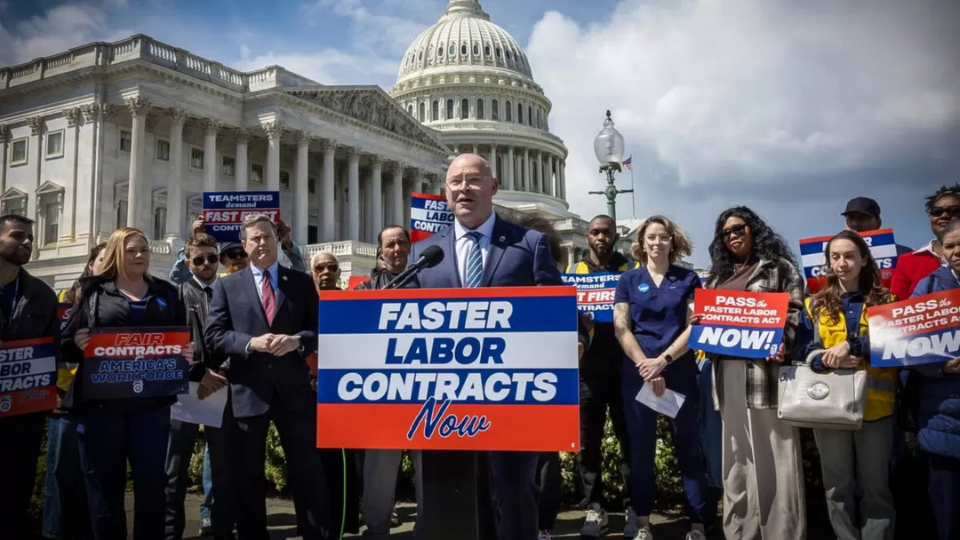
WASHINGTON—Defying the anti-worker House Republican leadership, a bipartisan coalition of lawmakers approved the Faster Labor Contracts Act, to force bosses to start bargaining quickly when workers vote for union representation.
The early-June vote was 230-193 with 20 Republicans, most of them from “swing” districts or from the Northeast, defying House Speaker Mike Johnson, R-La., other party leaders and, quite probably, President Donald Trump. All voting Democrats backed the bill.
The main reason some Republicans jumped over to the other side on the vote was that they fear retribution from workers in the mid-term elections, not because they have had a change of heart on support for working people.
The Teamsters strongly pushed the measure, which would enact one key section of the Protect The Right To Organize Act, organized labor’s #1 legislative priority. It’s going nowhere on Capitol Hill.
In approving this measure, the House did not consider the rest of the PRO Act, including its ban on “captive audience” meetings during union organizing drives, its removal of 78 years of corporate-generated obstacles to unions, and its higher fines for firms that break U.S. labor laws.
A Democratic-led attempt to defy U.S. House rules earlier this year and then pass the PRO Act failed by one vote.
Nevertheless, AFL-CIO Legislative and Advocacy Director Jody Calemine hailed passage of the Faster Labor Contracts Act. He issued a statement during the federation’s convention in Minneapolis.
“For the second time this Congress, a bill to restore or strengthen collective bargaining rights has been forced to the House floor by a working majority and passed with a bipartisan vote,” he said.
“The reason is simple: The country is hungry for pro-worker labor law reform.” He called it “an important first step toward passing the PRO Act. It underscores a basic truth: it’s better in a union.
“More collective bargaining means higher wages, more access to affordable health care, a secure retirement, and a way for working people to take control over their lives and finally get ahead. Let working people organize and exercise their bargaining power, and the economy will start working for them, not just the billionaires.”
The Teamsters and the measure’s top House sponsor, Rep. Donald Norcross, D-N.J., a former president of the South Jersey Building and Construction Trades Council, called their bill the most meaningful pro-worker labor legislation in more than a generation.
“The biggest loophole in labor law is how the richest executives in human history can simply run out the clock on their workers’ first union contract, denying their employees their fundamental collective bargaining rights,” said Norcross, an Electrical Worker, after the measure passed.
“That dirty tactic is selfish, it’s immoral, and today’s vote also puts it one step closer to being a relic of history. Unions represent workers of all political stripes, and today’s resounding bipartisan vote should clearly demonstrate the collective power of workers’ voices. Solidarity forever, and it’s time to get this bill over the finish line,” added Norcross, who also co-chairs the Congressional Labor Caucus.
Teamsters President Sean O’Brien called the measure “a significant milestone for millions of workers.”
“Workers at Amazon and other major companies who are fed up with being overworked, underpaid, and undervalued are organizing unions in record numbers. We can no longer tolerate a broken system that allows corporations to corruptly drag out negotiations and shirk their legal obligations to bargain faster first union contracts.”
The legislation, he added, is “a real shot to right generations of wrongs and level the playing field for workers. The Teamsters are eager for the Senate to take up this urgent legislation and ensure it lands on the president’s desk.”
What O’Brien didn’t say, however, is that corporate campaign cash, lobbying clout, and a storm of lies about “big labor bosses” could produce a successful Senate GOP filibuster. And even if the Faster Labor Contracts Act clears the upper chamber’s 60-vote hurdle, Trump will likely veto it.
The measure’s Senate sponsors are New Jersey Democrat Cory Booker and Missouri Republican Josh Hawley, both of whom have an eye on 2028 presidential politics. Hawley says he became convinced of the need for the measure by talking with Missouri workers forced to strike for weeks due to bosses’ intransigence during negotiations.
The bill would force bosses to open bargaining within 10 days with newly approved unions. The two sides would have 90 days to reach a deal, followed by mandatory mediation and arbitration. If that fails, the arbitrators could impose a two-year contract on both.
“Right now, hardworking Americans are forced to wait 458 days on average for their employers to stop playing games, get to the table, and negotiate first union contracts,” said Teamsters Secretary-Treasurer Fred Zuckerman. “ The Faster Labor Contracts Act will put an end to this corporate corruption and give workers the opportunity they deserve to lead better lives and rebuild the middle class.”
Mainstream media pundits ignored the text of the measure and focused on the political optics, which is no great surprise as the off-year election approaches. Most of the GOP votes for it came from lawmakers who are endangered politically or retiring.
And the pundits also viewed this vote, and others, as evidence of Trump’s weakening hold on a previously compliant Congress, as well as GOP Speaker Johnson’s shaky grasp on his own troops. Johnson is a down-the-line Trump supporter.
Other evidence includes prior votes to force Trump to release the Jeffrey Epstein papers, to force him to terminate his war on Iran—while providing more loans to Ukraine to buy U.S. arms for its conflict with Russia—and to approve legislation reversing Trump’s destruction of more than 30 collective bargaining agreements covering at least a million federal workers. None of those measures has gone anywhere in the GOP-controlled Senate.
Trump’s hold isn’t completely broken. The rest of the 218 ruling Republicans in the House followed Johnson’s lead and voted “no.” Citing another object of GOP hate—federal workers—House Education and the Workforce Committee Chair Tim Walberg, R-Mich., called the Faster Labor Contracts Act “another attempt to put workers under the thumb of federal bureaucrats.”
We hope you appreciated this article. At People’s World, we believe news and information should be free and accessible to all, but we need your help. Our journalism is free of corporate influence and paywalls because we are totally reader-supported. Only you, our readers and supporters, make this possible. If you enjoy reading People’s World and the stories we bring you, please support our work by donating or becoming a monthly sustainer today. Thank you!
CONTRIBUTOR