State capitalism, socialist market economy, New Economic Policy—whatever term supporters or critics of the Cuban Revolution want to use, it’s clear that the emergency reforms being proposed in that country will bring major changes to its socialist system.
On June 19, Cuba’s National Assembly unanimously approved a sweeping package of 176 economic measures presented by Prime Minister Manuel Marrero in a nearly two-hour address to lawmakers. The package touches virtually every pillar of the socialist economy: private property, market pricing, labor law, banking, and foreign investment.
It is an early look at what could be a historic transformation—but how and whether these measures get implemented, and who ultimately benefits, remains an open question.
What the reforms include
The scope of the changes is extensive, touching essentially every corner of the national economy.
Foreign investors will no longer be required to form joint ventures with the state, removing a longstanding requirement that kept the Cuban government as a mandatory partner in all outside investment. Private banks will be allowed to enter Cuba’s finance sector for the first time, ending decades of state monopoly.
General price controls—which the government admitted had failed to curb inflation and instead drove products into the black market—will be lifted and replaced with targeted subsidies for the most vulnerable.

On private property, the reforms mark a significant departure from past practice. State-owned properties may now be sold to “national and foreign legal entities and individuals, including Cubans living abroad,” according to Marrero’s presentation, and private real estate development will be permitted for the first time in generations.
Private companies will be authorized without any cap on the number of workers, opening up opportunities for those with capital to start and/or expand businesses. Cubans will also be permitted to own more than one business and hold equity stakes in multiple firms. New corporate structures including joint-stock companies will be allowed—arrangements common in market economies but historically absent in Cuba because the buying and selling of shares opens the possibility of capital concentration and wealth inequality.
In the labor sphere, private employers will now be able to hire freely, and direct import and export will be permitted without mandatory state intermediaries. Both Cuban and foreign investors will be able to acquire shares in formerly state-run companies. As Prime Minister Marrero told legislators, the measures formally recognize the market as “an instrument for the efficient allocation of resources.”
Blockade prompts change
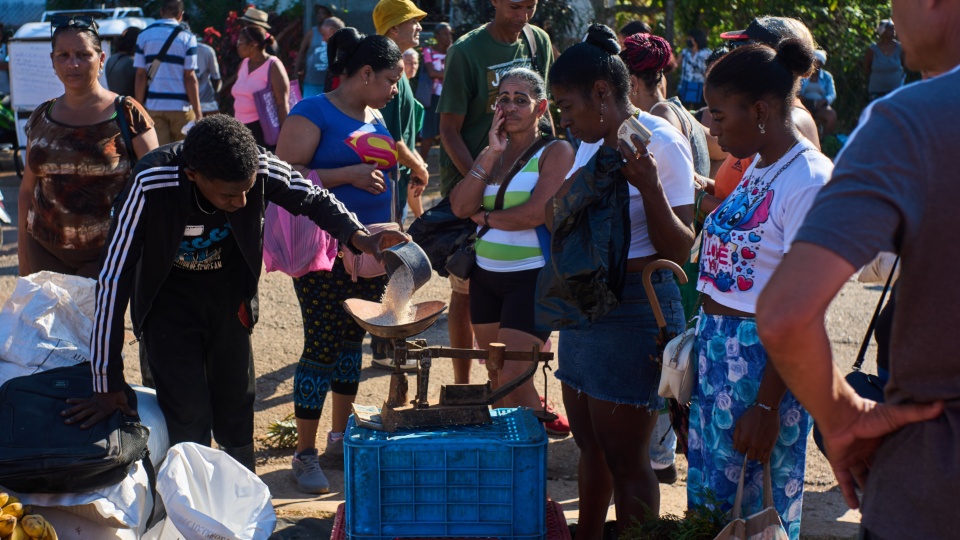
The context for these reforms is unmistakable. Cuba’s GDP has contracted by at least 15% since 2020, and the United Nations’ Economic Commission for Latin America and the Caribbean (ECLAC) projects a further 6.5% contraction by end of 2026, making Cuba the worst-performing economy in the region for the second straight year.
Power blackouts lasting more than 30 hours have become routine. Food, fuel, medicine, and drinking water are in chronically short supply. The UN High Commissioner for Human Rights, Volker Türk, has warned that “children are dying” because doctors lack access to basic medical supplies.

The cause of the immediate crisis is the Trump administration’s oil blockade—along with the 66-year old U.S. economic blockade generally. Following the U.S. kidnapping of Venezuelan President Nicolás Maduro in January 2026, the Trump administration cut off Venezuela’s oil exports to Cuba—a supply that had provided as much as 50% of its fuel needs.
Trump then signed an executive order threatening tariffs on any country that ships oil to Cuba, effectively extending the blockade globally. Only a single Russian oil tanker has reached Cuba since late January. The administration has also sanctioned Cuba’s national oil company and GAESA, the military-linked conglomerate with ties to nearly every sector of the Cuban economy, and pressured Visa and Mastercard to cut off payment services in Cuba in order to choke off international tourism revenue.
Speaking to the National Assembly just before the vote, President Miguel Díaz-Canel was pointed about what Cuba is up against: “What is being debated here is the dilemma of how to continue the process of socialist construction, which has suffered the longest blockade in history from the world’s greatest power.”

Yet Díaz-Canel also insisted the reforms were not simply a capitulation. “We are not doing this because of pressure from the Yankees,” he told lawmakers, stressing that Cuba was acting “sovereignly.”
“Had to be done anyway”
He acknowledged that many of these proposals had been debated internally for years—since at least the 2011 Communist Party congress—and that the government had been “postponing decisions it now deems essential for over 15 years.” The president said, “I believe this had to be done anyway, whether we were living this moment or not.”
Sounding like Deng Xiaoping circa 1984, Díaz-Canel repeatedly emphasized the need for the economy to grow, for the Cuban people’s material living standards to rapidly improve, and for socialism to take a hard, fresh look at its principles.
“Without wealth, there is nothing to distribute,” he said, highlighting that fact that achieving social justice requires the creation of material abundance first if it is to have any meaning. Almost 40 years ago, when China was in the early stages of market reforms, Deng made a similar point, saying that common poverty is not equal to socialism.
“The challenge is to produce in these conditions, create wealth, and then distribute with social justice and fairness, not egalitarianism,” Díaz-Canel said, declaring that the Cuban economy had to get rid of its flat wage system.
With only the smallest of pay differences between workers of different qualifications and responsibilities, the president said there was not enough material incentive to encourage people to exert more effort or strive to advance themselves or their workplaces. His message was that harder work has not come with a reward, and moral incentives alone are not enough to keep people motivated long term.
Acknowledging that paying workers flat wages supplemented by rations and subsidies was an inherently bad practice, Díaz-Canel admitted that these were distortions of socialism and have to be changed regardless of the external pressures Cuba faces.

“There are obstacles that don’t stem from outside or from blockades. There’s sluggishness, bureaucracy, regulations that stifle those who want to produce, and decisions we’ve delayed. What depends on us must be changed by us, and we need to change it now,” he asserted.
Marrero echoed that the reforms “do not constitute a deviation from our socialist project; on the contrary, they respond to its development” and attempt to improve it. He mentioned the efforts of former President Raúl Castro to update Cuba’s economic and social model: “not to be dogmatic or inflexible, to banish the mechanical association between socialism and egalitarianism, and to recognize that socialist planning does not exclude, but must incorporate and regulate the rules of the market.”
Castro, facing a U.S. criminal indictment for the 1996 downing of a Brothers to the Rescue plane, participated in the session via video conference and sent a written letter to the Communist Party Politburo and the National Assembly calling the measures “beneficial” and urging their rapid implementation.
More like Lenin?
Some commentators—including Cuban opposition leader Manuel Cuesta Morúa, who called the package “belated Chinese reforms”—will be quick to compare these changes to China’s post-1978 “socialist market economy” or Vietnam’s Đổi Mới (“renovation”) of the 1980s. Those comparisons have some surface validity: In each case, a Communist Party-led government introduced market mechanisms, private ownership of capital, and foreign investment while maintaining political control and limiting capitalist participation in the affairs of state.
But a more apt historical parallel may be Lenin’s New Economic Policy (NEP), launched in Soviet Russia in 1921. Then as now, the situation involved a state with a severely underdeveloped industrial base, cut off from the world economy by hostile powers actively working to strangle it. Lenin was explicit that the NEP was a retreat into “state capitalism”—allowing private trade, foreign concessions, and market mechanisms—as a necessary survival measure to rebuild the material base from which socialism could eventually advance.

The difference, and it is a crucial one, is that Lenin had already beaten back foreign military invasions and domestic counter-revolution (largely) before launching the NEP. Cuba is being forced to make these concessions precisely while under a brutal external assault.
The Trump administration has been explicit that its goal is regime change, with Secretary of State Marco Rubio openly stating that removing Cuba’s socialist government is a precondition for lifting the embargo under the 1996 Helms-Burton Act. Cuba is not experimenting with state capitalism from a position of stability; it is doing so with a gun to its head.
Who will invest—and at what cost?
This raises the central uncertainty hanging over the entire reform package. The U.S. controls much of the world’s financial system and has demonstrated willingness to sanction any third party that does business with Cuba. Even a partial relaxation of restrictions would likely require either China or the U.S. to make a major move on investment.
The most optimistic scenario for Havana likely involves Chinese companies investing in substantial portions of the Cuban economy—in mining, energy, tourism infrastructure, and agriculture. China has long-term strategic interests in strengthening its relationships with Cuba and in the Caribbean region and has some experience navigating around U.S. sanctions.
But this approach would not lift the U.S. blockade, and whether the government of China would be willing to absorb the financial and diplomatic costs of even deeper engagement with Cuba in the current climate remains to be seen.
The other scenario—and arguably the more likely one given Washington’s leverage—is that these concessions become a lever for Trump to extract political and economic gains. That could mean waiving portions of the blockade in exchange for allowing U.S. corporations to begin acquiring companies, resources, mines, hotels, and resorts.
In some cases, this would effectively allow descendants or successors of pre-revolutionary owners to repurchase assets nationalized after 1959—a backdoor restoration that the Cuban government has long resisted as a matter of principle and that many Cubans would regard as a betrayal of the revolution itself.

Many U.S. corporations and wealthy Cuban exiles in Florida are no doubt hoping for a USSR-style collapse in Cuba—the complete overthrow of socialism, including mass privatizations and sell-offs of public property. The leadership of the Cuban government and the ruling Communist Party, however, have made clear that they intend no such outcome.
An early look
Nothing is settled yet, though, and it will take time for reforms to play out and yield results. Díaz-Canel himself warned that “equally or more important than the approval of these transformations is their proper and timely implementation,” acknowledging the gap between legislative approval and real-world change.
It is not yet clear through what mechanisms, or on what timetable, the 176 measures will take effect. Many questions remain unanswered. The session ended, though, with Díaz-Canel turning to Fidel Castro’s iconic slogan: “¡Socialismo o muerte!”—“Socialism or death!”
What is clear is that Cuba is betting that measured doses of capitalism can save socialism—a wager Lenin made over a century ago under very different circumstances. Whether the Cuban leadership can navigate the profound contradictions that bet involves, while resisting the pressures that could turn a tactical retreat into a permanent transformation, is the defining question of the months ahead.
We hope you appreciated this article. At People’s World, we believe news and information should be free and accessible to all, but we need your help. Our journalism is free of corporate influence and paywalls because we are totally reader-supported. Only you, our readers and supporters, make this possible. If you enjoy reading People’s World and the stories we bring you, please support our work by donating or becoming a monthly sustainer today. Thank you!
CONTRIBUTOR