The tide may at last be turning in Cuba’s favor. Newly announced plans of the government there point to the beginning of rescue from the terrible humanitarian crisis currently weighing on the Cuban people. Prompting the crisis are the long U.S. economic blockade of the island and the U.S.-imposed oil blockade that began on Jan. 28.
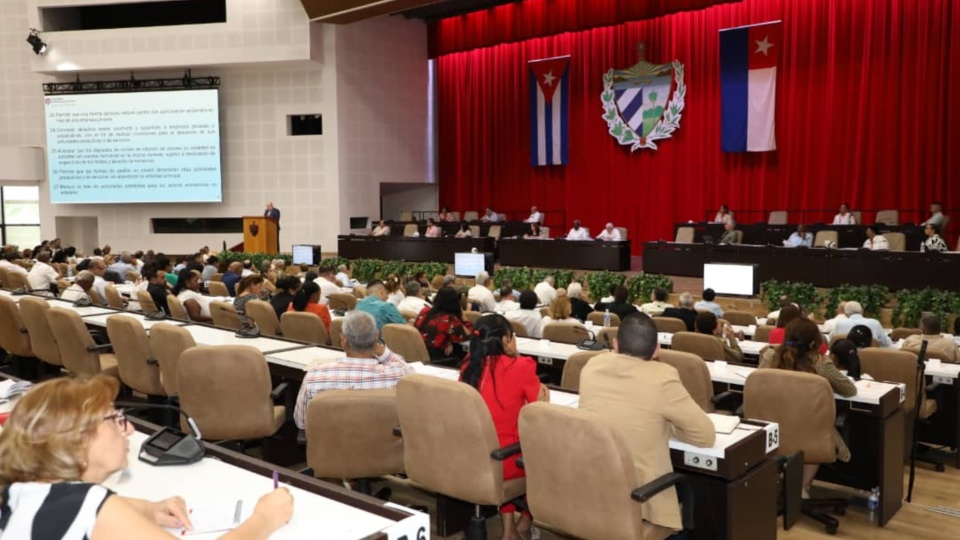
Changes approved on June 19 at a special session of Cuba’s National Assembly had multiple purposes, among them: increasing production and generating wealth for the sake of economic development, securing financial resources to pay for humanitarian relief, establishing guarantees of social well-being for Cuba’s beleaguered population, and achieving full utilization of Cuba’s farm land in order to build agricultural production.
Throughout the discussions leading to these changes, government leaders testified to their common purpose of protecting and strengthening Cuba’s socialist model.
President Miguel Díaz-Canel, speaking at a special plenum of the Cuba’s Communist Party, offered these major goals: “Macroeconomic stabilization and the recovery of foreign revenue, transformation of the economic and social model, stimulation and recovery of the agricultural sector, strengthening of accounting and cost management, and anticipating and mitigating the social costs associated with the necessary transformations of the economic and social model.”
The rapid-fire developments of recent days follow media reports over months of horrendous grief throughout the island, mounting U.S. economic sanctions, threats of U.S. military attack, and Cuba’s own preparations for a U.S. invasion. Remarkably enough, only a rare word about Cuba’s military defense appears in the statements and speeches accompanying these proceedings.
RELATED ARTICLES:
> Socialism under siege: Cuba embarks on emergency reforms to survive
> Can the Cuban revolution survive?
> A revolution in trouble: Cuba’s government analyzes and responds to economic woes
Consultations and planning sessions had been ongoing for weeks. The process yielded result 390 proposals to be evaluated by the National Assembly, of which 66.7% were accepted.
On June 12, Díaz-Canel held a press conference to introduce the government’s strategic response to the unfolding disaster. The Central Committee of the Communist Party held an extraordinary plenum session on June 17 to consider the plan, and the National Assembly of 400 elected deputies met on June 18 and 19 to deliberate and give final approval.
One big reform, presumably relating to bureaucratic excesses, centers on governmental re-organization and re-distribution of governmental authority. The number of ministries is being halved, with work being distributed among those that remain. Much of the national government’s decision-making authority will eventually end up with the governments of municipalities.
These will soon be making arrangements for imports and exports, for pricing, for making supplies available to producers, for securing investments from abroad, and for establishing production goals. They will be accountable as regards financial transactions.
The concept of local autonomy, which is not new, encompasses strategic planning, land-use management, food sovereignty, community services, and promotion of local development. Local authorities will be supervising projects belonging to Cubans abroad.
State-owned enterprises get a boost in the form of “expansion of their powers and managerial autonomy.” They are free to “engage in any lawful activity,” set prices, and distribute profits. They will be paying increased wages and offering more generous pension benefits. Provincial and municipal governments will be able to merge or dissolve state-owned enterprises. Individuals and other “legal entities” are allowed to purchase shares in state enterprises.
The agricultural sector gets renewed attention, in line with Cuba’s need for greater domestic food production, which has lagged. Now farmers and cooperatives gain usufruct rights for an indefinite period. Usufruct, instituted in 2008, is the means by which farmers secure the legal right to use state-owned land.
Allocation of land will depend on production needs. Cooperatives may now arrange for their own marketing, food exports, and imports of supplies. They may themselves secure loans and establish foreign currency accounts. According to Díaz-Canel, “There is no sovereignty with empty plates. The Cuban people’s food will be treated for what it is: a matter of national security.”
The government offered plans for social rescue. Wages and pensions will be increasing, and employment guaranteed. Social protection will depend in part on cooperation between state and private employers and the banking system. There will be “discounts or quotas for people at social risk.”
Cubans will be receiving support in the form of medical transportation, sanitation improvements, and monthly deliveries of food packages to vulnerable individuals and families. From now on, there will be more priority given to services for individuals in trouble and less to assistance provided for everyone, equally.
The new order of affairs features energy transformation. Chinese-assisted transition to solar power, and wind power too, has advanced in the past year. Cubans on their own initiative will be free to buy imported electric vehicles of all kinds. Plans call for the role of private and foreign capital in financing the purchases of electric vehicles and small solar power systems. State-owned companies will be free to use “international platforms” to buy fuels and vehicles associated with the energy transition.
There will be new support for Cuba’s tourist industry, which historically has provided the state with significant income. The COVID-19 pandemic and U.S. sanctions led to its deterioration. Among market mechanisms taking effect are reliance on foreign investors, the aforementioned land arrangements, and sales of real estate to Cubans on the island and abroad. Other innovations include the use of joint ventures and private real estate management services to operate car rental agencies, marinas, and tourist agencies.
Banking reform is a big part of the new order. Changes will include formation of a private banking sector to be supervised by the state’s central bank. Non-banking financial entities are on the way. Bank restrictions on Cubans’ use of foreign currencies, the U.S. dollar included, for the purchase of imported goods will disappear.
Private currency-exchange bureaus and a digital foreign exchange market are anticipated. By way of removing bureaucratic obstacles, banks will use digital technologies, new software products, and artificial intelligence to enable access to funds. Financial and legal accountability will be strengthened. Market forces will determine pricing.
The overall goal of these reforms is that of promoting the flow of money so as to enhance production. Díaz-Canel declared that, “Every unit of foreign currency that enters the country must be channeled to finance production, imports, investment, wages, and infrastructure.” And further: “Without wealth, there is nothing to distribute; we would be speaking of social justice in the abstract.”
Díaz-Canel, speaking before the National Assembly, echoed remarks heard earlier in these several days of deliberation. Referring to “the longest, most criminal, most perverse, most unjust blockade in history,” he declared that, “We are not giving up on socialism.”
He added that, “Our discussion is about how, with our own skills, and our own effort, we are going to be capable of building socialism in a sustainable way.… We are not doing this because of pressure from the Yankees. We are acting in a sovereign manner, because we have arrived at a moment of maturity and reflection.… The first thing we have to do is produce. If we do not produce, if we do not generate wealth, what kind of social justice will we be defending?”
The president mentioned the largely unsuccessful attempts by Cuba’s government in the past to institute economic reforms. Acknowledging implementation lapses and bureaucratic impediments, he insisted that, “Cuba does not need further delays; it needs solutions. It is not a matter of creating more offices or holding more meetings, but of achieving concrete results.”
Indeed, the present moment is different. The current threat to Cuba’s socialist revolution is as serious as was the U.S.-organized Bay of Pigs attack in 1961 and the fall of the Eastern European socialist bloc in 1991. Is the U.S.-imposed humanitarian crisis so dangerous now that Cuba’s government is relenting on socialist methods and socialist purposes? Many of Cuba’s supporters think not.
In fact, the grim realities and the suffering that Cubans have been enduring have left them little choice but to take action, now. What’s happening perhaps amounts to a holding action in anticipation of new circumstances allowing, eventually, for a socialist future.
Cuba’s socialist government, it seems here, deserves enormous praise for making rational changes that may enable humanitarian relief and that may also permit survival of both the government and Cuba’s evolving form of socialism. Moreover, the U.S. government, Cuba’s enemy, surely is learning that Cubans and their government are unified, resourceful, and full of resistance.
As with all op-eds published by People’s World, the views presented here are those of the author.
We hope you appreciated this article. At People’s World, we believe news and information should be free and accessible to all, but we need your help. Our journalism is free of corporate influence and paywalls because we are totally reader-supported. Only you, our readers and supporters, make this possible. If you enjoy reading People’s World and the stories we bring you, please support our work by donating or becoming a monthly sustainer today. Thank you!
CONTRIBUTOR