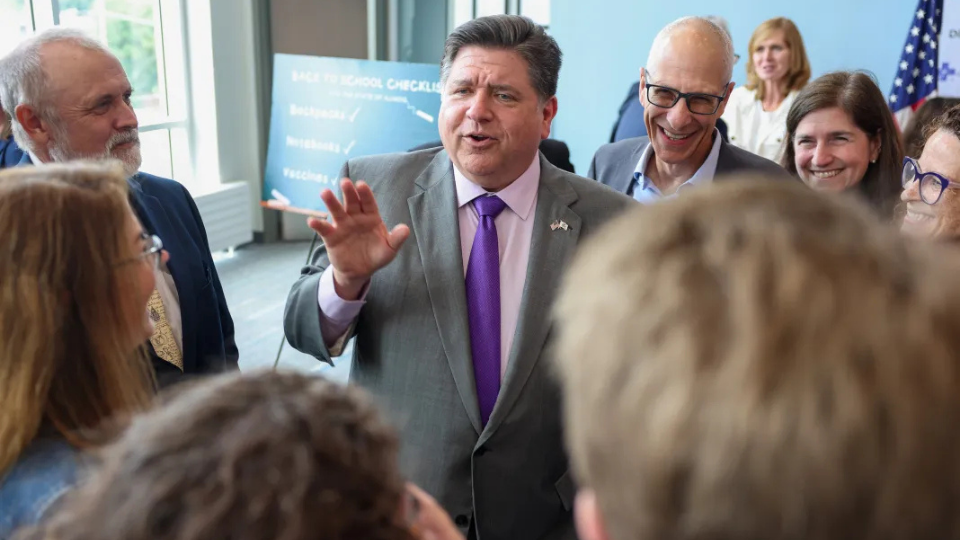
CHICAGO—When it comes to his own presidential prospects, Illinois Democratic Gov. J.B. Pritzker is coy. He won’t say “yes,” yet. He won’t say “no.” But he knows he’s mentioned in the media for the Democratic nod in 2028.
“You’re encouraging something I’m not talking about,” Pritzker told Politico chief correspondent Jonathan Martin during a two-hour interview in a famous Chicago deli. The two talked so much that they barely picked at their food at the end.
But if Pritzker is denying presidential ambitions, he has taken steps to raise his political profile nationwide, including in key early primary states. He addressed a Democratic state dinner in New Hampshire, host of the traditional first-in-the-nation primary, for example.
He also made a surprise appearance at the National Consumer League’s annual Trumpeter Awards dinner last year in D.C., and got a rousing ovation from the crowd, though his remarks were mild. The Trumpeters honor consumer champions, and two of them that night were retiring Sen. Dick Durbin and Rep. Jan Schakowsky, both Illinois Democrats.
And Pritzker has demonstrated his political coattails by encouraging his Lieutenant Governor, Juliana Stratton, to run for Durbin’s open seat. Pritzker’s campaign finance committee provided most of the money, independently, for her run. She won over two better-financed foes in the March 17 primary.
Stratton didn’t take corporate campaign contributions. Both Pritzker and Stratton are heavily favored to win in November in deep-blue Illinois.
“She’ll fight for us in Washington, D.C.,” the governor declares—especially against Donald Trump.
And Pritzker proclaims he’s successfully battled Trump, with help from leaders in his native Chicago. The governor pulls no punches. Trump, Pritzker declares, shows all the signs of having dementia.
“I think the man has dementia, but I don’t really understand how it works up there with him,” Pritzker said, indicating his own head. But the president, the governor noted, often sharply slams him “completely out of the blue.”
When Martin asked if Trump had dementia during his first White House term, Pritzker replied, “Oh my goodness, I don’t know. But this time it’s much more pronounced—and I felt that from Day 1 during the [2024] campaign.
“It’s a sad state of affairs, because when someone’s suffering from dementia, they genuinely need help.”
Trump, of course, denies he has dementia, as do members of his administration and his White House staff. His physicians call him remarkably fit for an 80-year-old, though outside observers, including many journalists who cover the Trump White House, are skeptical of that diagnosis.
Pritzker also called Trump “a bully” before adding, “If you push back on a bully, oftentimes they do take a step back.”
That observation could easily be said of the supposed settlement Trump has inked with Iran to end U.S. participation in that war. The interview took place a week before the agreement.
Pritzker used the interview to tout his own record of pulling Illinois back “from a fiscal cliff” his right-wing GOP predecessor, Bruce Rauner, left the state in. Pritzker beat Rauner by 16 percentage points in 2018. “There was $17 billion in unpaid bills,” Pritzker noted. Illinois bonds were at junk status.
Rauner couldn’t get budgets through the legislature. He constantly battled his own public workers and tried to make Illinois a right-to-work state and destroy its unions.
There have been eight consecutive balanced budgets during Pritzker’s time in office, but he admits “there’s more to do. That’s why I’m running for a third [gubernatorial] term,” and ignoring presidential chatter, Pritzker explained.
“When I ran” against Rauner, “I said we’ve gotta put Springfield,” the state capital, “back on the side of working families.”
That includes raising the Illinois minimum wage to $15/hourly, in a law passed in 2019, and legalizing cannabis sales for both tax purposes and for equitable justice, Pritzker said. When cannabis—marijuana—was a felony, “too many people of color were getting arrested” for possession or distribution, “and too many people who were white were not.”
“People want fiscal responsibility. They want a government that works for them. And they want someone who punches back against Donald Trump,” the governor explained.
The punching actually began in Trump’s first term, from January 2017 to January 2021, and the biggest evidence was the coronavirus pandemic. Trump first shrugged it off.
When Trump grudgingly admitted the depth of the modern-day plague, he declared a national emergency and assertively tried to seize medical supplies that states obtained. Trump wanted to control the distribution of the supplies, such as K95 masks, and send them to red states.
Pritzker and Maryland Republican Gov. Larry Hogan—another Trump critic—were the two most successful resisters, evading the troops Trump sent to airports to grab the garb. Hogan had the Maryland plane land in Pennsylvania, not Baltimore. Maryland, which, like Illinois, is deep blue.
Pritzker, who is almost as rich as Trump, chartered two planes for $1.77 million of his own money in early 2020, and had them fly masks, gloves, ventilators, and sanitizers from Shanghai to undisclosed locations in Illinois.
Pritzker told Martin that he’s still battling Trump, only this time around it’s over the fiscal hole—estimated at $4 billion-$8 billion—that Trump’s “big beautiful bill” last year blew in the state budget starting this July 1. “We’ll be addressing the overreach of the Trump administration.” Congressional Democratic leaders should forcefully do so, too, Pritzker said.
Pritzker’s answer to the budget hole was to decouple the Illinois income tax code from the federal code, so Trump’s tax cuts for the rich wouldn’t be automatic in Illinois. He also got lawmakers to enact a larger state tax credit for child care, taxes on various business enterprises, and a gas tax increase.
That’ll go for improving mass transit statewide and a multibillion-dollar multi-year road-building program to make Illinois more attractive to business, the governor explained.
Despite occasional bumps in the road—over public funding for a new stadium for the Chicago Bears football team, which the Building Trades favor, and over more money for public schools—Pritzker’s had a positive relationship with organized labor.
Together with Stratton, they successfully got voters to insert the right to organize and a ban on state and local right-to-work laws into the state constitution, for example. Pritzker and lawmakers also reformed the mass transit agencies in metro Chicago to make them more efficient and coordinated, in return for dedicated gas tax dollars to pull the transit system out of a large financial hole.
That, too, he told Martin, is in direct contrast to the massive amounts of red ink and other chaos Trump has created, especially with his massive union-busting during his current four-year term.
Though Pritzker fended off repeated questions about running for president, he had some decided opinions about what Democrats should concentrate on in this year’s campaign, and in the future, given that Trump will still be in the White House after the November election.
“If you knock on 100 doors and ask people, ‘What’s the most important issue for you?’ only five people will say ‘democracy,’” he told Martin. “Ninety-five people will say, ‘I can’t pay my electric bill. I can’t pay my rent. I can’t pay the bills on my kitchen table. I need help.’”
“We gotta focus on both. When you’re out campaigning, you’re campaigning to put more money in people’s pockets.”
That means raising the federal minimum wage, which has been $7.25 an hour since 2009. States and cities, including Illinois and Chicago, have done so. But not all, especially in the South and on the Great Plains.
“But you also need to lower the cost of things,” Pritzker says, without being specific on how. That ties in with the “affordability theme the party is pushing this year. Trump promised such decreases in his 2024 campaign and has failed to deliver. Just the opposite: Inflation has increased.
But you also need to do so “to preserve democracy or, for goodness sake, we’re never going to take back the country from this authoritarian, unless we all show up and vote.”
Pritzker was cautious on a developing cause among progressive voters, expanding the U.S. Supreme Court. Its anti-abortion decision, its ruling that presidents are virtually immune from criminal prosecution, its emasculation of voting rights—not to mention its anti-worker rulings—have sunk the justices to new lows in esteem.
The last president who tried to expand the court, FDR in 1937, got clobbered and lost a working majority in Congress as a result of a coalition of right-wing Republicans and segregationist Southern Democrats. The Court eventually changed as FDR was able to replace individual pro-corporate justices with progressive New Dealers.
The justices themselves saw the light, realizing people needed help during the Great Depression. The result was a changing voting pattern: “The switch in time that saved nine.”
But if Supreme Court expansion “is what is necessary to restore our republic to what it was before Donald Trump, which is standing up for individual rights, then that way may be what we need to do,” Pritzker said.
The governor also denounced the “creative cartography” resulting from the justices’ emasculation of the Voting Rights Act, and advocated both its restoration and strengthening and non-partisan redistricting commissions in every state. Illinois is one of the Democratic-run states that engaged in such “creative cartography” after the 2020 census, but hasn’t done so since.
Pritzker and the legislature are resisting further gerrymandering. But the governor said they’ll change their minds if deep-red Indiana next door uses it to eliminate its two Democratic U.S. representatives in an 11-person delegation. Despite Trump’s pressure and later political retaliation, Indiana refused. The Illinois U.S. House delegation is now 13-4 Democratic.
Stratton’s win in the March 17 primary shows another sea change in Illinois politics, and Pritzker cheerfully admitted it to Martin: The governor—him—and not the Chicago Mayor, is now the state kingpin, and Pritzker likes that.
The old Chicago Democratic Machine, which took control in the early 1930s, is now fractured. Parts of it remain, but it doesn’t control the whole city or state politics anymore.
The dominant state lawmaker, longtime Assembly Speaker Mike Madigan, a Machine remnant, started serving a 7-1/2-year federal prison sentence for public corruption on October 14. Edward Burke, who was a 54-year Machine veteran of the City Council, was released to court supervision last July 8 after serving 10 months of a 2-year sentence for conspiracy, racketeering, and extortion.
And over the years since the death of “The Mayor,” Richard J. Daley, in 1976, more than a dozen other Chicago councilmembers have gone to jail for various forms of corruption. So have four governors: Machine Democrats Otto Kerner in 1974, and Rod Blagojevich, anti-Machine Democrat Dan Walker—after his term ended—and Republican George Ryan. In his first term, Trump pardoned Blagojevich.
We hope you appreciated this article. At People’s World, we believe news and information should be free and accessible to all, but we need your help. Our journalism is free of corporate influence and paywalls because we are totally reader-supported. Only you, our readers and supporters, make this possible. If you enjoy reading People’s World and the stories we bring you, please support our work by donating or becoming a monthly sustainer today. Thank you!
CONTRIBUTOR