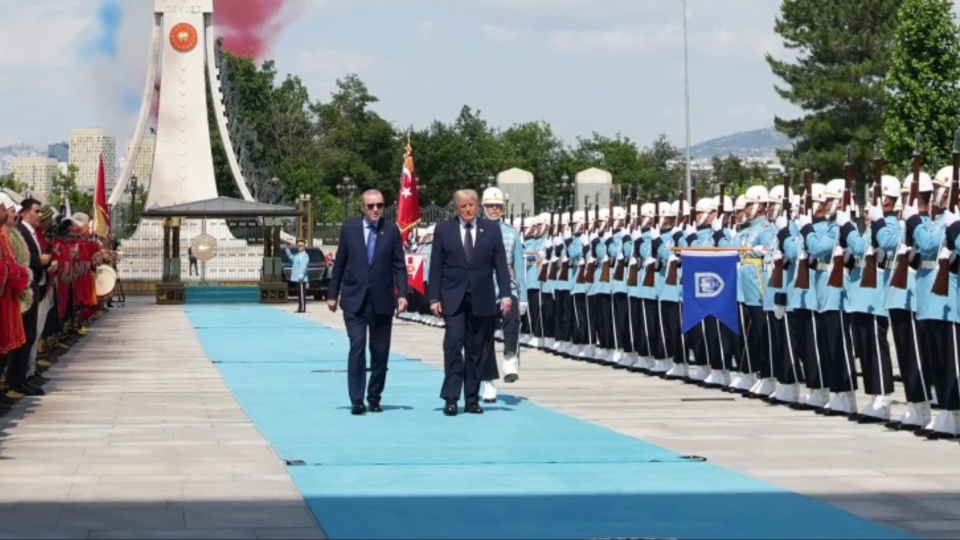
President Donald Trump arrived in Ankara, Turkey, on Tuesday afternoon for the latest NATO summit just as the transatlantic military alliance was announcing billions in arms deals in an attempt to appease the U.S. leader.
Trump, who has often complained that European allies have not spent enough on weapons of war, first sat down with Turkish leader Recep Tayyip Erdoğan, a close ally who is hosting this year’s gathering and who warmly greeted the U.S. president at a local air base and then whisked him to an elaborate welcome ceremony.
“Sometimes you get along with the toughest people, like him,” Trump said, gesturing to Erdoğan as the two sat down for their meeting.
Trump repeatedly praised Turkey for its loyalty to the U.S., particularly during the U.S. and Israel’s unprovoked war on Iran.
Neither leader mentioned the intense political repression in Turkey under Erdoğan’s autocratic rule nor the fact that demonstrations against NATO had broken out in cities across the country before the summit.
Earlier in the day, NATO showcased a series of military projects worth billions of dollars—a splurge that the alliance’s secretary-general, Mark Rutte, called “money well spent.”

Some of the projects will be paid for with funds from a system of cheap loans for “defense” purposes set up by the European Union, comprising up to $170 billion USD raised on capital markets.
“We need to ensure that we are translating our economic might into military capabilities, putting the cash to work from defense plans to drones, from money to missiles and interceptors,” Rutte said.
Israel upset over jet sales
Meanwhile, Trump also said that the U.S. will lift sanctions on Turkey that were issued after Erdoğan’s government purchased a Russian missile defense system in 2019. The country was kicked out of the U.S.’ F-35 fighter jet program for that.
When asked about Turkey’s return to the F-35 system, Trump said as he sat next to Erdoğan that “it’s certainly something we will consider.” The move angered Israeli Prime Minister Benjamin Netanyahu, who is, of course, still wanted by the International Criminal Court for potential war crimes and crimes against humanity in Gaza.
Speaking to Fox News Israel on Monday, Netanyahu urged the U.S. not to sell F-35 fighter jets to Turkey, claiming that Erdoğan “calls openly for the annihilation of Israel.”
He said selling the fighter jets to Turkey would “upset the power balance in the Middle East, which is ultimately guaranteed by Israeli air superiority and also, I think, by America’s posture in the Middle East.”
Billions more for NATO arsenals
The Ankara summit’s arms deals are only the latest chapter in a spending spree that has reshaped military budgets across the alliance over the past year.
According to figures NATO Secretary General Mark Rutte presented in March, European allies and Canada increased their collective defense expenditure by nearly 20% in real terms in 2025 compared to 2024, marking the first year in which every member state met or exceeded the alliance’s 2% of GDP spending target.
That growth builds on the pledge NATO leaders made at last year’s summit in The Hague, where allies committed to raising defense investment to 5% of GDP annually by 2035, split between a 3.5% “core” military component and a 1.5% allowance for broader security-related spending.
The Stockholm International Peace Research Institute (SIPRI) found that the buildup is not confined to a handful of countries. Global military spending reached $2.887 trillion in 2025—an 11th consecutive year of increases—driven in large part by a 14% surge in European military spending to $864 billion.
Germany, historically a laggard on defense outlays, has emerged as the biggest driver of that growth. Its military budget grew 18% in real terms in 2025 to reach €95 billion (about $107 billion), according to the International Institute for Strategic Studies, pushing Germany’s military burden above 2% of GDP for the first time since the end of the Cold War in 1990.

Poland remains the alliance’s most aggressive spender by share of GDP. Warsaw’s 2026 budget earmarks roughly 200 billion zloty for the military, a sum that would put Polish defense spending at around 4.8% of GDP—the highest ratio in NATO.
That spending has been supercharged by outside financing. In May, Polish Prime Minister Donald Tusk signed a deal with the European Union to receive €43.7 billion in loans under the bloc’s new “SAFE” defense financing program, the first country to draw on the fund.
The Baltic states have posted similarly steep increases, with Lithuania, Latvia, and Estonia all spending between roughly 3.4% and 4% of GDP on their militaries, according to the European Parliament’s research service.
Britain, long one of NATO’s largest spenders in absolute terms, has also ramped up outlays. Outgoing Prime Minister Keir Starmer announced spending last week of £15 billion ($20 billion). The government confirmed the figure will rise further in the future, coming to 3% of gross domestic product in the next parliament, and to 3.5% by 2035.
France’s defense allocation, meanwhile, rose to €68.5 billion for 2026, or about 2.25% of GDP, even as the government faces pressure over its wider budget deficit.
USA remains biggest spender
Trump’s own government has driven the sharpest single increase of all. In April, the administration formally requested $1.5 trillion for the Pentagon for fiscal year 2027—a roughly 44% jump and the largest defense budget in U.S. history, with the request split between $1.1 trillion in base discretionary spending and another $350 billion routed through the reconciliation process that Republicans can pass without Democratic votes.
The Center for American Progress has calculated that the increase amounts to the largest one-year defense spending jump, in inflation-adjusted dollars, since the Korean War. Budget Director Russell Vought framed the request as fulfilling Trump’s promise to “reinvest in America’s national security infrastructure”” while the White House has proposed paying for part of the increase by cutting roughly 10% from non-defense programs, including health research, K-12 and higher education, renewable energy grants, and low-income housing assistance.
The plan does not even account for the cost of the U.S. war on Iran, which has added a trillion or more dollars on top of the topline request.
“Money well spent”
All of this forms the backdrop against which Erdoğan welcomed Trump to Ankara this week. As host of a summit built around “money well spent,” Erdoğan has positioned himself as an indispensable broker for Washington at the very moment NATO’s members—and the U.S. government most of all—are pouring record sums into their militaries.
The prospective end of sanctions and the possible return of Turkey to the F-35 program are part of the same arms-industry logic Rutte championed at the summit, in which loans, weapons contracts, and diplomatic favor-trading move in lockstep.
That the alliance’s most autocratic host in years can stage a celebration of “collective defense” while cracking down on protesters back home, even as Washington slashes health and housing programs to help pay for a $1.5 trillion military budget, says as much about NATO’s priorities in 2026 as any of the figures themselves.
This article features reporting from Morning Star, People’s World, and other international sources.
We hope you appreciated this article. At People’s World, we believe news and information should be free and accessible to all, but we need your help. Our journalism is free of corporate influence and paywalls because we are totally reader-supported. Only you, our readers and supporters, make this possible. If you enjoy reading People’s World and the stories we bring you, please support our work by donating or becoming a monthly sustainer today. Thank you!
CONTRIBUTOR