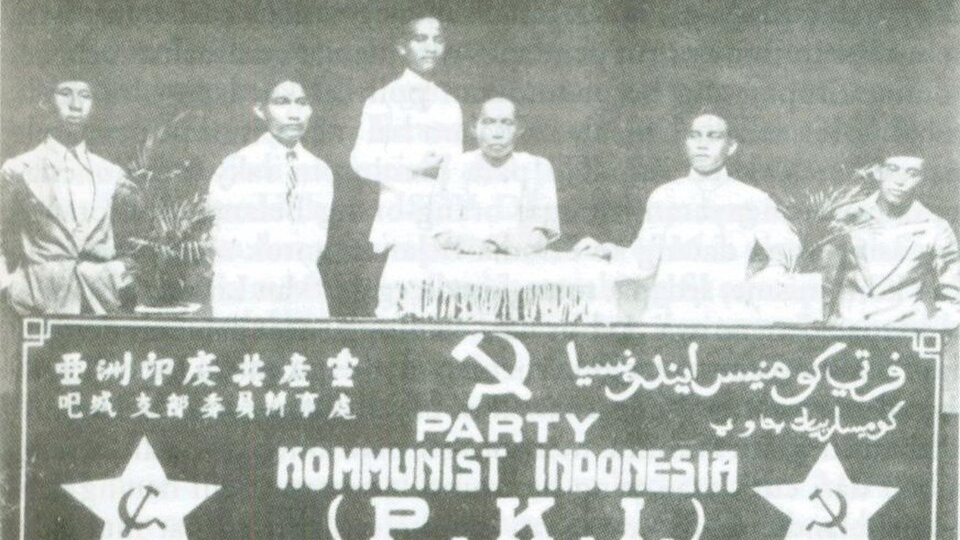
There are historical crimes much of the world has agreed to half-remember. Indonesia’s anti-communist massacres of 1965–66, when the Indonesian military and its civilian collaborators murdered somewhere between 500,000 and a million people—trade unionists, peasant organizers, ethnic Chinese, schoolteachers, and anyone denounced as a sympathizer of the Partai Komunis Indonesia (PKI)—belong on that shameful list. Washington cheered the slaughter on. The CIA and the State Department, we now know from declassified cables, supplied the new Suharto regime with lists of names. And speaking of names, we’re talking President Gerald Ford and his Secretary of State Henry Kissinger. American diplomats congratulated themselves on a Cold War victory. Time magazine called it “the West’s best news for years in Asia.” The PKI had been the third-largest Communist Party in the world outside of countries with Communists holding state power. For decades afterward, the Indonesian state built a mythology of “salvation” around the coup, and many in the world outside were only too happy to look away.
Tari Lang was there, and she was fourteen. In her 2026 memoir, My Neighbor, the Dictator: Coming of Age in the Shadow of Indonesia’s 1965 Military Coup, which I picked up in an airport bookstore on a recent trip to her country, she recalls those events from a deeply personal perspective. Her parents were KPI members, both employed at high levels of influence under the preceding Sukarno government. She grew up in relative upper-middle-class privilege, with loyal family house servants, participating in activities of the IPPI (Ikatan Pemuda Pelajar Indonesia, or Indonesian Students’ and Youth Association), a high school student and youth organization set up by the PKI.
My Neighbor, the Dictator is her account of watching her city, and her family, come apart in real time. Lang’s father, Javanese, and her mother, British and Jewish, met in Prague in the late 1940s, signaling their attraction to the post-war turn toward socialism in Eastern Europe. Carmel worked at the International Union of Students. In fact, Tari was born in Prague. As left intellectuals, Carmel and Bud threw in their lot with Sukarno’s turbulent experiment in postcolonial nation-building. The famous Bandung Conference of 1955 signaled Indonesia’s leading role in promoting solidarity among the Asian and African nations, many of them newly independent.
A decade later—the imperial powers having eyed this potential threat from the Global South with apprehension—Tari’s parents were swept up and jailed without charge as General Suharto consolidated power, elbowing Sukarno aside, over the bodies of the murdered. The girl who is left behind has to grow up overnight, ferrying messages for a secretive resistance network, learning which neighbors can be trusted and which have already turned informer, discovering that curfews and love affairs, new dresses and adolescent friendships can occupy the same terrifying week. 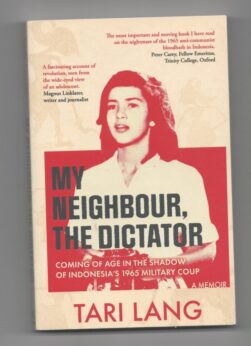
“Something happens to you when your world goes underground. You learn to keep secrets: big secrets, little secrets. You learn to block out things you don’t like. You learn to look at things that are good and happy and make those your main story.”
In terms that political activists around the world can probably relate to at some level, Tari describes the attitude many comrades felt they had to adopt. Her friend Nila’s mother happened to be attending a conference in China when the coup took place:
“Like mine, Nila’s is a political family, so the cause takes priority. Often, abandoning the family is perfectly understandable if it is for the sake of furthering the political principle. The country, the world, the oppressed and the poor need to be saved, and that is the only thing that matters. Don’t let trivial details like family, relationships or emotions get in the way. Stay upright. Stay focused. After all, we wouldn’t be able to have any family life at all, if we were oppressed or imprisoned, or starving hangry.”
Though Tari Lang might have written a chronicle of misery and trauma recounted for self-pity’s sake, this is not her purpose. To her credit, she reaches for another, more subsuming level. The historian Peter Carey, who has spent a scholarly lifetime on Indonesia, considers her book the most affecting account he has encountered of that era’s horror; and the framing device—a teenager’s eye, still capable of noticing a boy’s smile or a stolen afternoon even as tanks roll down the street—is precisely what gives the book its power. Perhaps one could say that this is how fascism is actually experienced by the people living under it: not as an abstraction in a policy paper or manifesto, but as the particular cruelty of a particular soldier at a particular checkpoint, on the same corner where you used to buy sweets.
“For three and a half years, since that fateful night on 30 September 1965, when the tanks on our peaceful roundabout ushered in a different, brutal, uncertain and horrifying world, I have learned a new way of living, which balances lives I like, enjoy and believe in with lives of survival, negotiation, stealth, juggling priorities and keeping my emotions under control.”
What a reader will come away with here is the international dimension that Lang’s personal story points toward, even as the book itself stays close to the ground of one family’s suffering and that of their immediate friends and comrades. The 1965 coup did not happen in a vacuum. It happened because Sukarno’s independent, nonaligned path—his tilt toward the Non-Aligned Movement, his tolerance of the PKI—was intolerable to American planners who had already demonstrated, in Guatemala, Iran, and Vietnam, exactly how far they would go to reverse an inconvenient national government. Indonesia’s killings remain, by body count, one of the great atrocities of the twentieth century, and one of the least prosecuted, least apologized for, least taught in Western classrooms. A book that puts a human face, a teenager’s face, on that catastrophe does something no diplomatic history can: it makes the abstraction unavoidable.
Lang left Indonesia for London in 1969, and built a highly successful career for herself. Her mother, still deemed a British citizen, also transferred to London, where she campaigned ceaselessly for justice and the release of political prisoners in Indonesia. The silent mass graves of Java and Bali are not metaphorical. Most of the men and women Tari Lang’s parents worked alongside never got a “coming of age” story. They got a dirt pit.
Tari Lang offers her personal testimony, precise and unsentimental, from a period that still shapes Indonesian politics and society today. The perpetrator class in Jakarta has never been made to answer for their crimes in any court. Reading it in 2026, with military coups, mass detentions, summary executions, and the manufacture of enemies-of-the-state still very much the powerful tools of statecraft around the world, it’s hard not to hear the echo. In so many countries across the globe, there is a version of that Jakarta street outside your own door, and a fourteen-year-old contemplating in real time what kind of adult the crisis is going to make of her. A welcome Postscript updates the book’s characters and what became of them in later years.
My Neighbor, the Dictator: Coming of Age in the Shadow of Indonesia’s 1965 Military Coup
Monsoon Books (UK), 2026, 288 pp.
Paperback ISBN: 9781915319668
ebook ISBN: 9781915310675
We hope you appreciated this article. At People’s World, we believe news and information should be free and accessible to all, but we need your help. Our journalism is free of corporate influence and paywalls because we are totally reader-supported. Only you, our readers and supporters, make this possible. If you enjoy reading People’s World and the stories we bring you, please support our work by donating or becoming a monthly sustainer today. Thank you!
CONTRIBUTOR