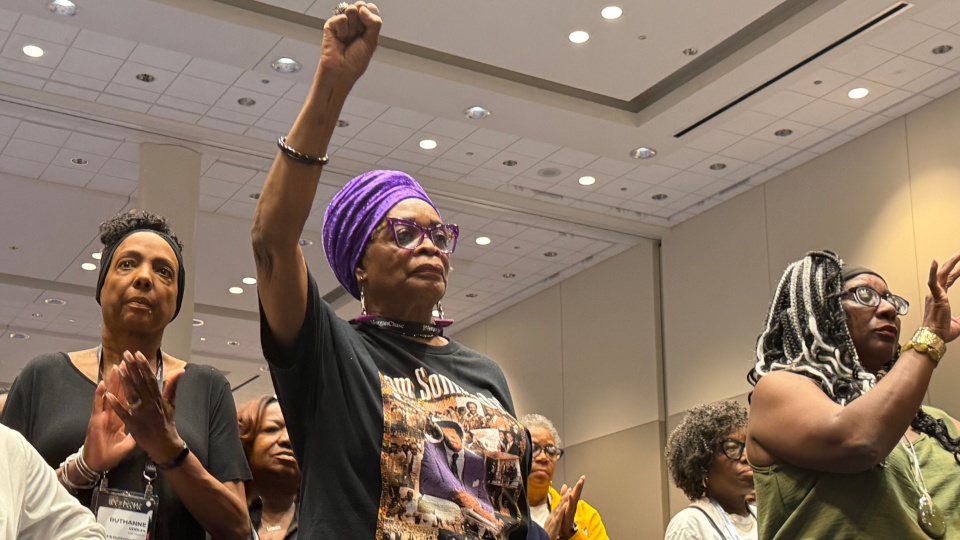
CHICAGO—The looming losses this November due to Republican-engineered congressional redistricting nationwide emphasize the importance of voting for progressive and pro-worker candidates for down-ballot offices, especially state legislators, a panel of political pros says.
And since the U.S. Supreme Court has gutted the federal Voting Rights Act as well as the majority-minority districts it once encouraged, states that “flip” could step in with their own versions of the historic 1965 legislation, the group added. Some already have.
The panel during the NAACP convention in Chicago last week addressed the redistricting issue, which arose thanks to GOP-engineered gerrymandering, especially in states like Florida and Texas, but also in North Carolina, Missouri, Alabama, Tennessee, and Louisiana.
All those states—already heavily GOP-gerrymandered on the state level—produced new congressional maps that will cost a net reduction of at least three members of the Congressional Black Caucus, the group of lawmakers who have been the strongest supporters of pro-worker legislation on Capitol Hill.
And the carnage could have been worse for people of color and for workers, if not for counter-action in other states. Californians, pushed by organized labor and communities of color, redrew their congressional map to offset the loss of five pro-worker lawmakers in Texas.
The congressional losses originated more than a decade ago, the panel’s moderator, podcaster Bakari Sellers, pointed out. In the 2010 midterm elections, during Democratic President Barack Obama’s first term, civil rights organizations concentrated on senatorial and gubernatorial races. So did the AFL-CIO. That was an incomplete strategy, she argued.
“We lost 1,000 state legislators and 12 governors” nationwide, Sellers noted. And after the 2010 census, it was the winners—the racists and the Republicans—who drew new state legislative and congressional district lines. Those gerrymandered majorities have been cemented in since.
The John Lewis Voting Rights Advancement Act would restore the federal Voting Rights Act’s clout, which the right-wing GOP-named U.S. Supreme Court majority has eliminated. And congressional Democrats also pushed the For the People Act, a comprehensive pro-voting rights plan, which included a ban on gerrymandering. It went nowhere.
The current ruling Republicans are countering with their so-called “Save America Act, “designed to impose the most-onerous voting restrictions since the heyday of Jim Crow. The House passed it, but the Senate hasn’t. So Speaker Mike Johnson, R-La., is trying to sneak pieces of it into other legislation, including pending budget, military, and money bills.
With all that in mind, the panel of Sellers, Virginia’s first-ever Black State Assembly Speaker, Don Scott, D-Portsmouth, and NAACP counsel Kristin Clarke delved into what Scott called “a conspiracy.” But, he said, “we recognize what they are up to.”
So did Virginia voters. In their own referendum, they redrew the Old Dominion’s map to give progressives and Democrats eight U.S. House seats, leave a ninth as leaning Democratic, and the GOP two. The Virginia U.S. House delegation is now 6-5 Democratic. But the state Supreme Court, on a 4-3 party-line vote, sided with complaining Republicans and tossed the results out.
“In Virginia, because of Texas, we made a decision to do mid-decade redistricting,” Scott elaborated. That was possible only because in the prior state legislative elections, progressives and Democrats went from narrow to overwhelming majorities.
“This was Han Solo winning but then The Empire struck back,” Scott said, using a Star Wars analogy.
Fighting state by state and lower office by lower office becomes even more important, Clarke pointed out, because in its last redistricting ruling, where Republicans successfully challenged Louisiana’s second majority-Black district, the court also closed off most private challenges to gerrymandered maps. Only challenges to maps crafted with racist intent survive, and those districts are unconstitutional.
That leaves challenges in the hands of a Trump Justice Department hostile to minorities, and by implication, to workers—or in the hands of voters, whose massive turnout could evict hostile state lawmakers from their seats.
Another key weapon, Clarke added, is publicity, by “convening emergency town halls” to expose the racist intent of such gerrymandered maps.
That can put enough pressure on lawmakers even in some deep-red states to halt the remaps. It did, Clarke noted, in South Carolina and Georgia. It also worked in deep-red Indiana, where GOP state senators revolted against Trump’s pressure. It didn’t work in Tennessee, the panelists admitted.
There, the state’s sole majority-minority district—and its sole Democratic-held seat, out of nine—was split into thirds, drowning Memphis’s Black majority in a sea of rural Republican white votes. The NAACP is challenging that gerrymander in court as unconstitutionally racist, Clarke said.
Nonpartisan analysts call the Tennessee legislature, with GOP supermajorities, the most-gerrymandered in the U.S. A solution Clarke pushed: “Turning out this fall and voting like hell.”
Advocates for honest redistricting, rather than gerrymandering, should also campaign for U.S. Supreme Court reform, she said. Clarke suggested term limits for justices. That would force the oldest justice, far-right Clarence Thomas—who succeeded civil rights icon Thurgood Marshall—off the court.
Clarke also warned against racist fear-mongering from the right “with false myths to keep us at home” and not vote. “Are we going to see ICE at the polls?” she asked, of reports that Trump’s violent and vicious Immigration and Customs Enforcement agents would “monitor” the elections.
“We should resist that,” Clarke added. “The only thing louder and more powerful than them is us.”
We hope you appreciated this article. At People’s World, we believe news and information should be free and accessible to all, but we need your help. Our journalism is free of corporate influence and paywalls because we are totally reader-supported. Only you, our readers and supporters, make this possible. If you enjoy reading People’s World and the stories we bring you, please support our work by donating or becoming a monthly sustainer today. Thank you!
CONTRIBUTOR