A curb cut on a sidewalk, a ramp into a public building, closed captions on a video, or a workplace accommodation that allows someone to do their job—these are not small conveniences. They are the result of decades of disability rights advocacy that transformed everyday life for millions of people. For many, these changes mean the difference between isolation and participation, dependence and independence, exclusion and opportunity.
Every July, we celebrate Disability Pride Month, a time to recognize the history, achievements, and contributions of people with disabilities. It is also the month we commemorate the anniversary of the Americans with Disabilities Act (ADA), which was signed into law on July 26, 1990. The ADA is one of the most significant civil rights laws in American history because it guarantees equal rights and protections for people with disabilities.
While Disability Pride Month is a time for celebration, it is also a time to remember the struggles and sacrifices of those who came before us. The freedoms and opportunities many of us enjoy today did not happen overnight. They were earned through decades of determination, protests, and advocacy by people with disabilities who refused to accept discrimination and exclusion.
Life before the ADA
Before disability rights laws existed, people with disabilities faced enormous barriers. Many children were denied the opportunity to attend public schools. Adults were routinely denied employment simply because they had a disability. Public transportation, restaurants, stores, and government buildings were often inaccessible. Many people could not even enter a building because there were no ramps, elevators, or curb cuts.
Perhaps even more heartbreaking was the widespread use of institutions. Thousands of people with disabilities were separated from their families and communities and placed into institutions, where many spent years or even their entire lives. Society often viewed disability with fear, pity, or shame instead of recognizing the dignity and potential of every individual.
The Disability Rights Movement
The disability rights movement gained momentum during the 1960s and 1970s alongside other civil rights movements. Disabled veterans returning from the Vietnam War advocated for better services, rehabilitation, and equal opportunities after serving their country. At the same time, disabled activists from across the nation began demanding the same civil rights enjoyed by everyone else.
One of the movement’s greatest achievements was the passage of Section 504 of the Rehabilitation Act of 1973, the first federal civil rights law protecting people with disabilities from discrimination in federally funded programs. Although the law was passed in 1973, the federal government delayed issuing regulations needed to enforce it.
That delay led to one of the most important protests in disability history.
The 504 Sit-In
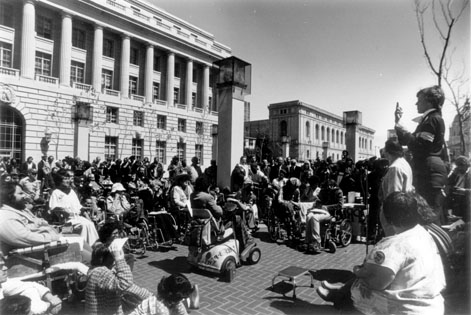
In 1977, disability rights activists organized peaceful demonstrations across the country demanding that the government implement Section 504. The most famous protest became known as the 504 Sit-In in San Francisco, where more than 100 disabled protesters occupied a federal building for nearly a month.
The protest lasted 26 days, making it one of the longest nonviolent occupations of a federal building in U.S. history. Protesters faced tremendous challenges, but they remained united. Community organizations, labor unions, churches, and other civil rights groups provided food, medical supplies, and support.

The Capitol Crawl
Another defining moment occurred in March 1990, just months before the ADA was passed.
Hundreds of disability advocates gathered in Washington, D.C., urging Congress to pass the Americans with Disabilities Act. During the demonstration, dozens of activists left their wheelchairs, walkers, and crutches and crawled up the 83 steps of the U.S. Capitol.
This powerful protest became known as the Capitol Crawl. It showed lawmakers and the American public the physical barriers people with disabilities faced every day. Images of children and adults crawling up the Capitol steps became symbols of determination and equality.
The protest helped build public support for the ADA and demonstrated that accessibility is not a luxury—it is a civil right.
The Americans with Disabilities Act
On July 26, 1990, President George H. W. Bush signed the Americans with Disabilities Act into law.
The ADA prohibits discrimination against qualified individuals with disabilities in employment, state and local government services, public accommodations, transportation, telecommunications, and many other areas of public life.
Since its passage, the ADA has transformed our communities by making them more accessible. We now see curb cuts on sidewalks, wheelchair-accessible entrances, elevators, accessible restrooms, closed captioning, accessible public transportation, interpreters, workplace accommodations, and many other improvements that benefit millions of people—not only those with disabilities.

These changes have made it possible for people with disabilities to work, attend school, travel, participate in community life, and live more independently than ever before.
Disability Pride
Disability Pride Month is about recognizing that disability is a natural part of human diversity. Every person deserves respect, dignity, and equal opportunity.
Being proud of having a disability does not mean we celebrate the challenges we face. Instead, we celebrate our resilience, our accomplishments, and the communities we have built together. We recognize that disability is one aspect of who we are—not something that defines our worth.
Disability Pride is also about challenging stereotypes and changing how society views disability. Rather than focusing on limitations, we should recognize the talents, leadership, creativity, and contributions of people with disabilities.
Our work is not finished
Although the ADA has changed countless lives, many barriers still exist.
People with disabilities continue to face challenges in employment, affordable and accessible housing, healthcare, transportation, education, emergency preparedness, and community inclusion. Many individuals still struggle to find personal care services, accessible housing, and adequate support to live independently.
Programs such as California’s In-Home Supportive Services (IHSS) are essential because they allow people with disabilities and older adults to remain safely in their homes instead of being forced into institutions. Protecting these services is critical to preserving independence and dignity.
As a disability advocate, I believe we must continue educating our communities, speaking out against discrimination, and ensuring that disability rights remain a priority at every level of government.
Looking ahead
As someone who has been involved in disability advocacy for many years, I have learned that lasting change happens when people come together with a shared vision and a commitment to justice. The disability rights movement has shown us that progress is possible when our voices are heard and when we work collectively to create a more inclusive society.
One of the guiding principles of our movement is the powerful slogan, “Nothing About Us Without Us.” It reminds us that people with disabilities must have a seat at the table whenever policies, programs, services, or laws are being developed. Decisions that affect our lives should never be made without our meaningful participation. We bring lived experience, knowledge, and perspectives that are essential to creating policies that truly meet the needs of our communities.
As we look toward the future, we must continue advocating at the local, regional, state, and federal levels to ensure that accessibility, inclusion, and independence remain priorities. We must invest in accessible housing, reliable transportation, quality healthcare, employment opportunities, emergency preparedness, and the services that allow people with disabilities to live independently in their own communities.
I also believe that accessibility must become a fundamental principle in every aspect of planning and design. Whether we are building sidewalks, housing, public transportation systems, parks, schools, businesses, or digital technology, accessibility should never be treated as an afterthought.

If it’s not accessible, it’s not complete.
Accessibility, safety, and sustainability go hand in hand. When we design communities that are accessible for people with disabilities, we create communities that are safer and more welcoming for everyone. Universal design benefits parents pushing strollers, older adults, veterans, travelers with luggage, and countless others—not just people with disabilities.
Our work is far from over. We must continue protecting vital programs that support independent living while pushing for new opportunities that promote equality, innovation, and full community participation. Every generation has a responsibility to build upon the progress made by those who came before us.
During Disability Pride Month, let us honor the pioneers whose courage changed history—from the activists of the 504 Sit-In to those who participated in the Capitol Crawl, and the countless advocates whose names may never appear in history books but whose efforts helped move our nation forward.
Their legacy reminds us that our voices matter, our experiences matter, and our lives matter.
The Americans with Disabilities Act transformed America, but it was never meant to be the finish line. It was the foundation for a more inclusive future.
Together, let us continue building a world where every person, regardless of ability, has equal access, equal opportunity, and the freedom to live independently with dignity, respect, and pride.
Rise up: One voice can make a difference.
As a woman with a disability and a lifelong disability rights advocate, I have learned that education and advocacy are among the most important tools we have. Knowing your rights is only the beginning. We must also be willing to think creatively, step outside the box, and ask ourselves: How do we get people to pay attention?
History has shown us that ordinary people can accomplish extraordinary things when they come together for a common cause. Dr. Martin Luther King Jr. demonstrated the power of peaceful civil disobedience, courage, and collective action. His legacy reminds us that lasting change happens when people are willing to stand up—or in my case, crawl—for what is right.
More than 20 years ago, while I was attending De Anza College, I was involved with a Students for Justice group. At the time, lawmakers were proposing cuts to critical student services, including programs that supported students with disabilities. We knew those cuts would have devastating consequences, so we decided to take action.
Our group traveled to the California State Capitol in Sacramento to advocate for restoring the funding. When we arrived, we noticed there was no accessible ramp leading to the front entrance of the Capitol. Instead of allowing that barrier to silence me, my friends carefully lifted me out of my wheelchair and placed me at the bottom of the Capitol steps.
I crawled up every step to the top.
It was not planned. It was not rehearsed. It was simply what needed to be done.
When I reached the top, my friends helped me stand at the podium, where I spoke before thousands of people. I shared why these services mattered—not just to me, but to countless students with disabilities whose futures depended on them.
Our voices were heard.
Because of our advocacy, our determination, and our willingness to be seen, funding for our student services program at De Anza College was restored. The victory also benefited students at other community colleges throughout California.
That experience changed my life. It taught me that advocacy is not about having the loudest voice. It is about having the courage to speak when it matters most. It is about refusing to accept barriers as permanent and believing that one person’s actions can inspire many others.
Every movement begins with someone willing to take the first step—or crawl the first step.
If there is one lesson I hope others take from my story, it is this: Never underestimate the power of your voice. You do not have to be famous, wealthy, or hold public office to create change. You simply have to care enough to act.
So, rise up. Learn your rights. Organize. Educate. Advocate. Think outside the box. Stand together for justice, inclusion, and equality.
Because even one courageous act can change lives—and sometimes, it can change history.
Happy Disability Pride Month!
We hope you appreciated this article. At People’s World, we believe news and information should be free and accessible to all, but we need your help. Our journalism is free of corporate influence and paywalls because we are totally reader-supported. Only you, our readers and supporters, make this possible. If you enjoy reading People’s World and the stories we bring you, please support our work by donating or becoming a monthly sustainer today. Thank you!
CONTRIBUTOR