The corporate media is making much of the battles between so-called “establishment” Democrats and others who are identified with the organization Democratic Socialists of America. While the divisions are real enough, reliance on such broad categories sometimes cloud the facts.
Similarly, too many commentators seem intent on pitting Black voters against white progressive voters in the Democratic Party, underemphasizing the determination of both to make major changes in November.
Last night, voters selected candidates they see as seriously addressing affordability and the crisis of democracy. In all the primaries, Democratic turnout was huge, outpacing the GOP and portending good results for opponents of MAGA.
A Democratic U.S. Senate primary in Minnesota turned into a progressive rout for Lt. Gov. Peggy Flanagan. An expected win in the gubernatorial primary in next-door Wisconsin for Democratic Socialist Francesca Hong turned into a narrow loss to David Crowley.
Nevertheless, results show that, even with a candidate like Hong losing narrowly to Crowley, Democratic voters are not always happy with so-called establishment politicians. Connecticut voters in the Hartford-based 1st Congressional District, for example, reinforced this point: Incumbent Rep. John Larson, 78, first elected in 1998, lost to his top challenger, former Hartford Mayor Luke Bronin, 47, by a wide margin.
First, the winners in Minnesota:
Flanagan, a progressive who campaigned on Medicare for All, taxing billionaires and millionaires more, and who shunned corporate campaign cash, had slim polling leads over her foe, self-described “moderate” U.S. Rep. Angie Craig. Voters chose Flanagan by 19 percentage points (59% to 40%) and 136,907 votes.
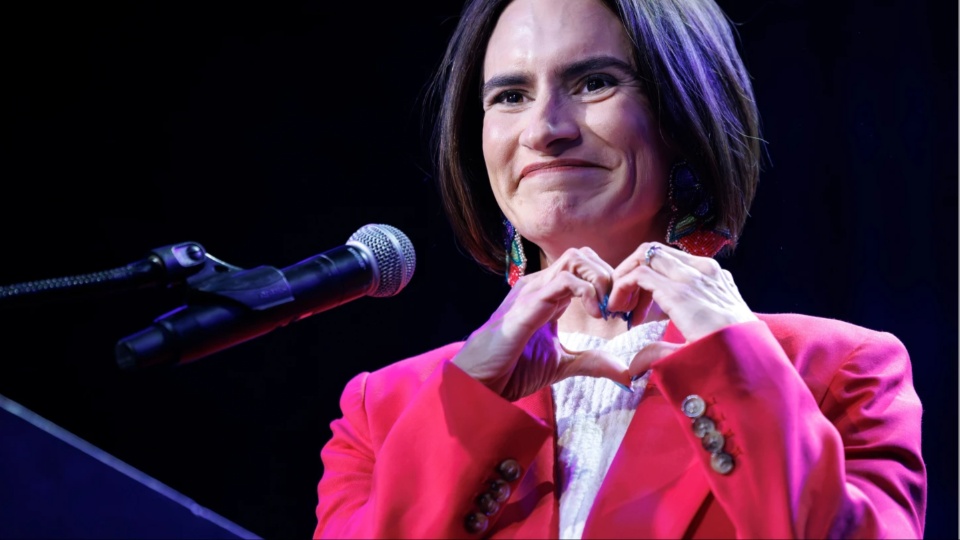
If she wins the fall election to the U.S. Senate against the GOP nominee—former NFL sideline broadcaster Michele Tafoya—Flanagan will be the first-ever Native American woman elected to the U.S. Senate.
Flanagan had widespread progressive support, and the foot soldiers for her showed it. Sen. Bernie Sanders, Ind-Vt., supported her but stayed silent about the race in Wisconsin, as did retiring Democratic-Farmer-Labor (DFL) Sen. Tina Smith, whom Flanagan hopes to succeed, and Rep. Ilhan Omar, DFL-Minn., an outspoken foe of President Donald Trump.
“Peggy campaigned on…the idea that one good job should be enough to pay your bills—and she did it without taking corporate PAC money,” the Progressive Change Campaign Committee said in a fundraising letter for her and the rest of its Senate slate.
“She has credibility with voters because she’s already delivered paid family and medical leave, free school meals, lower prescription drug costs, and historic investments in affordable housing,” PCCC said.
In the open 2nd Congressional District, which Craig is vacating, State Sen. Matt Little, DFL-Lakeville, its former mayor and a backer of Medicare for All and foe of corporate financing of elections, easily won the Democratic nomination in a four-way race. He’ll now run for Craig’s open seat, which leans Democratic.
One of his foes, State Rep. Kaela Berg, an Association of Flight Attendants-CWA member who finished third, had to take leave from her full-time job as an airline cabin attendant to campaign. She, too, emphasized progressive stands and accountability.
In the Minneapolis-based 5th Congressional District, Omar got endorsements from both the Minneapolis and St. Paul Regional Labor Federations and easily won. She’s expected to romp in the fall.
State Attorney General Keith Ellison, a leader among Attorneys General nationwide in opposing Trump’s racism, won 85% to 15%. After months of legal wrestling with Trump’s ICE troops, Ellison and his staff finally won access to the federal evidence—which may now be legally “contaminated”—from their killings of peaceful protest observers Renee Nicole Good and Alex Pretti, an RN and American Federation of Government Employees (AFGE) member.
Including outside spending, Craig outspent Flanagan by an enormous margin. But in a state where 94% of Democrats oppose Trump and his fatal “Operation Metro Surge” in the Twin Cities, Craig’s support for prior Trump/GOP legislation to turn ICE loose and the Laken Riley Act hurt her. The rest of the state’s Democrats opposed ICE and that law, too.
Flanagan’s stand against ICE and its sweep energized many Twin Cities voters. Andrea Gaitan, a St. Paul voter, exclaimed “Peggy!” when the St. Paul Pioneer Press asked who she voted for. Gaitan explained Craig’s stand on ICE had “pissed her off.” Susan Landis of the suburb of Cottage Grove said Craig’s shifts showed her the congresswoman didn’t really know what she stands for.
Even Minnesota Republicans got into the upset act on Aug. 11, in their gubernatorial primary. They turned away from Trump extremist, election conspiracy spouter Mike Lindell, who had the president’s backing and—as CEO of MyPillow—plenty of corporate campaign cash.
Moderate-conservative Lisa Demuth, the state House Speaker, won that three-way race with 43% of the vote. She’ll face the state’s other DFL U.S. senator, Amy Klobuchar, for the right to enter the governor’s mansion. Incumbent DFL Gov. Tim Walz, a union teacher scarred by scandals in state aid, is retiring.
Unlike Lindell, Demuth does not believe in outsourcing the jobs of 40% of the state’s workers, abolishing most aid to education, and eliminating the state income tax in favor of sales taxes, which fall most heavily on poor and middle-income people, while barely bothering the 1%.
Back in Wisconsin, the usual rule if you’re a progressive and you want to win the Democratic Party primary, sweep the college towns. But as Hong learned on primary day, you need a little bit more than that.
Hong, who is a state representative, part-time bartender, single mother, and DSA member, accomplished the collegiate sweep in her gubernatorial race against Crowley, the Milwaukee County Executive, but it wasn’t enough.

Hong beat Crowley in Dane County, home of the University of Wisconsin’s 30,000-plus student main campus in Madison, by approximately 10,000 votes. She lost Crowley’s home Milwaukee County—which includes the city and a University of Wisconsin commuter campus—by 2,400.
Everywhere else there was a big college in Wisconsin—Green Bay and its suburbs, Appleton, Eau Claire in the west, Racine in the southeast, Menominee County in the northeast, and so on—Hong won.
With 95%+ of the vote counted, however, Crowley had a 3,885-vote lead (39.9% to 39.4%) out of 783,112 ballots cast. State Sen. Kelda Roys, the former director of Wisconsin Planned Parenthood, took 58,610 votes (7.5%). The New York Times election team said Roys may have siphoned vital votes from Hong in Dane County (Madison), which Hong represents in the statehouse. Roys got 16,100 votes there.
Hong favored fully funding the state share of school spending. She campaigned against taxpayer-paid vouchers for parents of private school kids. She said she wants to limit the impact of artificial intelligence in hiring and firing workers and ban data centers. She backed universal child care.
Hong picked up endorsements from young city, town, and county leaders and state legislators, from a Teachers/AFT local, from the Progressive Democrats of America and Our Revolution, and from the Service Employees.
Crowley ran on electability, pointing out he had carried Milwaukee County, the state’s most-populous, three times. He had significant labor backing, securing the support of the Professional Firefighters, the Wisconsin Laborers’ District Council, the state Electrical Workers council, the Midwest regional body of the Carpenters, and locals of the Operating Engineers and Plumbers unions.
Gov. Tony Evers, U.S. Rep. Gwen Moore, and dozens of state lawmakers, mayors, and other officials also gave him their endorsements.
His platform focuses on reforming the tax system rather than the more significant overhaul proposed by Hong, tighter regulation of data centers (but not an outright ban on their construction), more funding for special education, and expanding the public healthcare program.
Crowley is expected, if he wins the governorship in November, to continue his policy of opposing the Trump agenda. He will face U.S. Rep. Tom Tiffany, a Trump backer and vice-chair of the far-right House Freedom Caucus. Tiffany beat an unknown foe, taking 95% of the GOP primary vote.
We hope you appreciated this article. At People’s World, we believe news and information should be free and accessible to all, but we need your help. Our journalism is free of corporate influence and paywalls because we are totally reader-supported. Only you, our readers and supporters, make this possible. If you enjoy reading People’s World and the stories we bring you, please support our work by donating or becoming a monthly sustainer today. Thank you!
CONTRIBUTOR