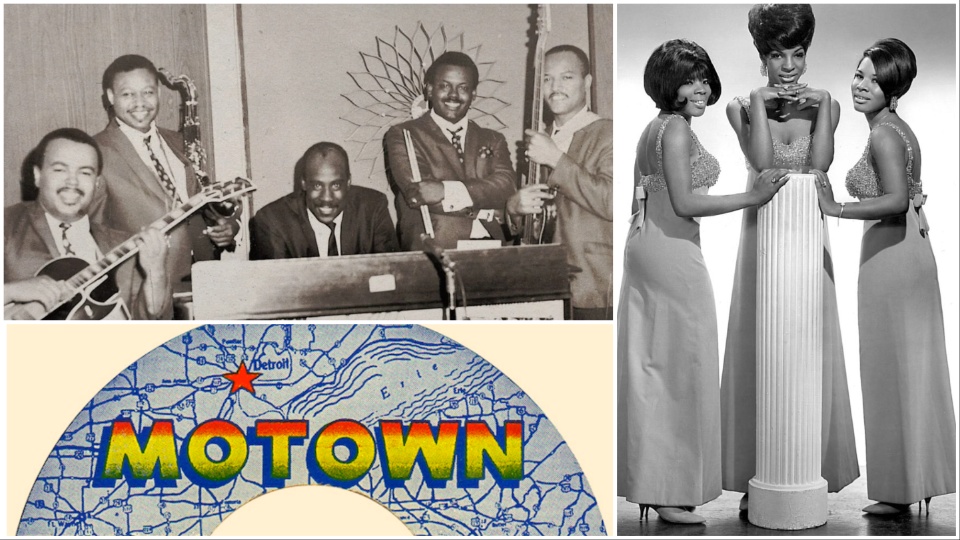
I hear the familiar beat. And it is summer. A tormentingly hot summer day. “Where Did Our Love Go.” A darling (sometimes) young girl dramatically singing to The Supremes while maniacally dancing to every stanza of the song. She has a microphone, and that mouthpiece plays the music while she sings and dances. It plays only Motown music, and she adores it.
My 9-year-old granddaughter loves to entertain. I wonder where she gets that from? Motown will always be summer music to me. We both love those songs.
Most of us, no matter our age, know this music. Along with the auto industry, it put Detroit on the world map. I do Detroit Labor History tours, and one of my favorite stops is the Motown Museum.
Why this series of houses on West Grand Boulevard? A little-known fact: All of the session musicians, the folks who made the music of Motown, were union-represented musicians. They were paid union scale, including overtime pay and benefits. And that is why Motown is included on our Labor History tours.
 Members of the Detroit Federation of Musicians, Local 5, helped create the Motown sound starting in 1959. Union contracts covered the Funk Brothers, the 12 studio musicians who provided the beats to the Motown superstars. For more on the Funk Brothers, check out the documentary “Standing in the Shadows of Motown.” It made my heart crinkle.
Berry Gordy, Jr., the founder of Motown, was not known for his generosity when it came to musicians, and the union was challenged at times to enforce its contract. Sound familiar? Some of the Motown musicians, including owner Gordy had worked at area auto plants and were UAW members. They grew to learn the importance of the union culture.
The Musicians Union has a long and honorable history in Detroit. It was founded 145 years ago, in 1881, as the Detroit Musicians Union. It affiliated in 1903 with the American Federation of Musicians, Local 5. It now has nearly 1,000 members and is the tenth largest local in the union.
It has collective bargaining contracts with the DSO, Michigan Opera Theater, Detroit Opera House, the Fisher and Fox Theaters, and all of the local symphony orchestras. It also makes sure that musicians have contracts for TV, radio, and internet commercials. A great guy, George Troia, Jr., is the current president.
President Troia was able to dig up some old contracts from the Motown days for the Detroit Labor History tours that I conduct. I found one from 1966 quite fascinating. The contract stipulated that studio musicians would be paid $52.50 per three-hour session, with another $52.50 for the next 90 minutes after that, and another $52.50 for the next 30 minutes after that.
For five hours of session work, that comes out to $157.50, or $31.50 per hour. To put that into perspective, that is the equivalent of $327 per hour in today’s money. Funk Brother James Jamerson (one of the greatest badass bass players in music history) reported that he made $100,000 working for Motown in 1966. That would be just over a million dollars in 2026!
And this was at a time when many musicians, particularly Black musicians, were getting screwed over on a regular basis by slimy managers and producers. The power of the union!
Barry Gordy didn’t like the fact that he had to pay his musicians union scale, but he had no choice if he wanted that kind of talent to sell his records. And in the end, it turned out that there was enough money to pay his workers well and for him to become a multi-millionaire.
Funny how that works, and it unfortunately is a lesson that we still need today. Why should anyone be a trillionaire when the Letter Carriers need to have a Food Drive every year because our local food banks have empty shelves? Shameful.
The Funk Brothers, Stevie Wonder, The Temptations, Marvin Gaye, Diana Ross and the Supremes, Martha and the Vandellas, and many more. All members of the Detroit Federation of Musicians, Local 5, at some point in their careers. According to President Troia, Stevie Wonder and Roy Parker, Jr. (“Ghostbusters“) are still dues-paying members even though they live elsewhere.
Martha Reeves is still a proud member and union activist. At a rally organized by Jobs with Justice a few years ago to honor the 1937 sit-down strikers at General Motors in Flint, and the then current sit-down strikers at Republic Windows and Doors in Chicago, Martha came and sang, changing the words of “Dancing in the Street” to “Marching in the Street.” The crowd roared. After having been an unofficial anthem of the 1960s Civil Rights Movement, it became a protest song for a second time.
My pops, a proud UAW man, would often say “God Bless the Union. Ford Motor Company treats me as a number, a cog in a big wheel. The UAW treats me as a man.” I wish he was around to see his granddaughter singing Motown songs. But that is life.
I did get to share this Motown union history with him while he was still alive, and he found it fascinating. “I never knew that.” And, my readers, I hope you learned something new today as well. When your feet start tapping and your throat starts humming to your favorite Motown song, smile and be proud knowing that is union music.
One last little nugget to nibble on: “Please Mister Postman” was Motown’s first number one hit in 1961. But that’s a story for another Dicktation. Stay thirsty, my friends.
We hope you appreciated this article. At People’s World, we believe news and information should be free and accessible to all, but we need your help. Our journalism is free of corporate influence and paywalls because we are totally reader-supported. Only you, our readers and supporters, make this possible. If you enjoy reading People’s World and the stories we bring you, please support our work by donating or becoming a monthly sustainer today. Thank you!
CONTRIBUTOR