NEW HAVEN—Connecticut labor and people’s organizations are gearing up for the November 3 general election following an intensive Democratic primary on August 11 that included races for the governorship, the general assembly and the first Congressional district. Outstanding was the fact that candidates in all races pledged to stand up to Trump and protect people’s needs, providing the foundation for unity going into November.
While there are Democratic majorities in the state House and Senate and a Democratic Governor, the number of working class champions is not large enough to override vetoes on cutting-edge bills like housing relief, school funding, aid to striking workers, and taxing the rich.
The Working Families Party (WFP) endorsed five candidates for state legislature. All five won their primaries as part of an effort to build power “for a government that finally answers to working people, not whoever writes the biggest check.
“This is what happens when working people organize: We knock the doors, we make the calls, we show up for each other, and we win seats nobody thought were winnable,” said the WFP.
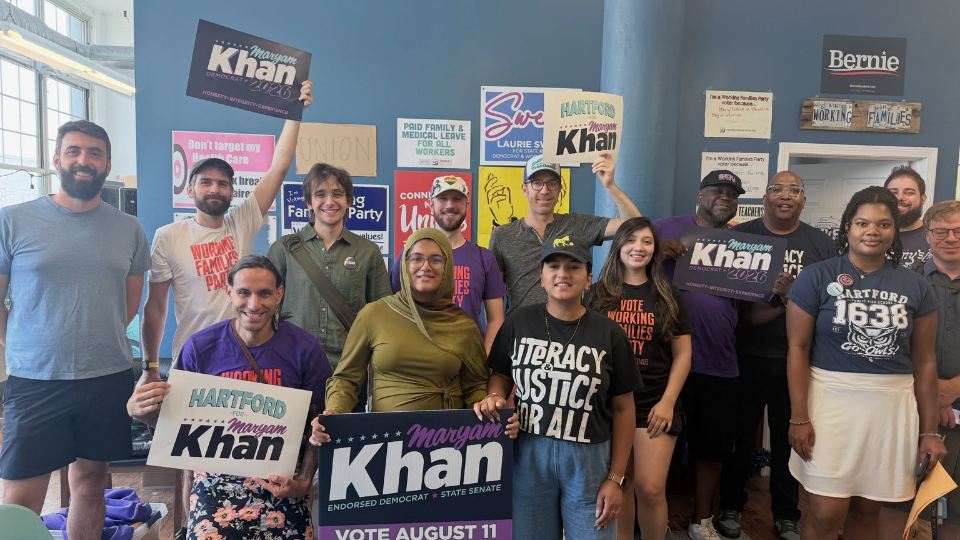
In a Senate district spanning Hartford, Bloomfield and Windsor, Maryam Khan (SD-2), a special education teacher, defeated a charter school-backed incumbent. She was elected to the state House in 2022, running to fight for resources for her students in overcrowded rooms, by a system that decided they should expect less. She is the first Muslim woman elected to the State Senate.
In Glastonbury, Moise Carelus (HD-31) beat a four-term incumbent who voted against school funding, made assault weapons easier to get, and wouldn’t stand up to ICE in our schools and hospitals. “Coach Moses,” who ran to bring working-class values to Glastonbury, is a science teacher who built a youth soccer program from 170 kids to 470
In East Hartford, Angie Parkinson (HD-10), a teacher for 25 years, is now fighting to fund neighborhood schools. Among her priorities, she listed Education Cost Sharing funding, increasing taxes on the wealthy, a public option for healthcare, keeping immigration enforcement agents in check, and protecting reproductive rights and rights for LGBTQ+ people.
In Milford, Toni Lombardi (HD-118), a school secretary, ran for this open seat saying affordable communities and strong public schools are inseparable. Milford voters chose a candidate who believes public schools deserve real investment – not cuts, privatization and more excuses.
In a Senate district including Cheshire, Meriden, Middlefield and Middletown, Jack Fazzino (SD-13) builds on his work in the House judiciary committee, protecting immigrant communities and reducing ICE presence in schools, hospitals, and houses of worship, and helping win $40 million in special education funding.
“We’ve won before by building power, not waiting for permission. $15 minimum wage. Paid family and medical leave. Tonight adds the next chapter,” WFP said.
In New Haven, longtime progressive state representative Pat Dillon was defeated by a young former Alder, Eli Sabin, who moved to the district at the beginning of the year. Also in the race was DSA member Justin Farmer. All three projected programs to address the crisis of the cost of living and the threat of Trump. Dillon was supported by the labor movement for her consistent support, but the wave of change prevailed.
Also in New Haven, an open seat for State Senate was won by Wildaliz Burmudez, who chairs the City’s Fair Rent Commission and ran against labor-backed Leland Moore. New Haven is the largest voter turnout city in the state, and is considered key to the election of any statewide office, including Governor.
In the primary, Governor Ned Lamont faced challenger State Representative Josh Elliott, whose campaign centered on ending the extreme economic and racial inequality in the state by taxing the rich. Lamont, a millionaire from Greenwich, has refused to consider the tax the rich agenda of Connecticut for All and other coalitions. Elliott’s message got solid support with 30% of the vote, which is expected to add to the pressure on Lamont.
The Connecticut AFL CIO endorsed Lamont in recognition of the support that the governor has given during organizing drives, including the highway service workers and strikes, including hotel and food service workers, even though the Governor vetoed (twice) a bill to allow striking workers to receive unemployment compensation. He has now pledged to support the bill.
Lamont featured his opposition to Trump, including bills he signed that came to his desk as a result of long and hard grassroots organizing. As a result, Connecticut has one of the strongest Trust Act language in the country to protect immigrant families.
The Four C’s union representing community college teachers, and the New Haven Federation of Teachers broke with their state affiliates and endorsed Josh Elliott for Governor out of frustration that their budgets were severely underfunded despite large-scale demands. Elliott’s significant vote is expected to give strength to those ongoing demands in the coming legislative session.
The voter turnout in Connecticut was 23% of registered Democrats, down from the 2018 governor primary, which had 29% turnout.
Of greatest national attention were the Democratic primary elections in Connecticut’s First Congressional District, including the capital city of Hartford and 27 surrounding towns. It is a heavily Democratic district. The victor in the Democratic primary is in place to win the general election in November.
Luke Bronin, former mayor of Hartford, defeated Congressman John Larson in a highly funded campaign riding the anti-incumbent wave of “change” and “age.” While Larson is more progressive, the highly funded Bronin, who has been criticized for his anti-labor actions as Mayor, kept moving to the left in his positions in order to win votes.
Bronin had narrowly secured the Democratic Party endorsement and appeared on the same ballot line as Governor Lamont. Their votes were nearly identical in each town.
Larson has been the leading voice in Congress for protecting and expanding Social Security. His Social Security 2100 bill would scrap the cap so that the highest earners would pay taxes on their full income. He is the ranking member of the House Ways and Means Social Security Subcommittee and would have been in a powerful position if the majority in the House flips to Democrat control.
This was one of two races in the country where a more conservative younger candidate challenged a more progressive senior incumbent in a majority Democratic district. The other race is for U.S. Senate in Massachusetts where Rep Seth Moulton is challenging Sen. Ed Markey, an outspoken voice for Medicare for All and opposing ICE and wars.
Both of these challenges are supported by VoteVets, a national PAC chaired by former Congressman Max Rose from Staten Island, NY, dedicated to electing military veterans at all levels of government. Bronin served in the Navy in Afghanistan in 2010. VoteVets spent over one million dollars for Bronin.
Rose lauded Bronin’s victory, noting that “VoteVets was the first organization to get involved in this race, and the biggest outside spender… because he fit within our wider strategy…breaking this old mold of left vs middle, progressive vs moderate.”
Larson’s biggest contributor was the Working Families PAC. He received contributions from various PACs of elected leaders, some of whom took out negative ads. The expenditures and funders are itemized by CT Public.
In addition to Bronin, two more challengers were in the field. West Hartford State Rep. Jillian Gilchrest and Hartford Board of Education member Ruth Fortune. Both criticized the outside money coming into Bronin’s race and also Larson’s calling for campaign finance reform.
Larson was first elected in 1998. He comes from a working-class family, which shaped much of his politics, and in recent years has been very passionate against Project 2025 and, first and foremost, to protect and expand Social Security into the future. He had earned the support of organizations from the majority of unions, the Alliance for Retired Americans, Planned Parenthood, the Human Rights Campaign, and many more. The unexpected challenge from Bronin allowed little time for Larson to change tactics and organize a full-fledged campaign.
Larson’s lack of endorsement by the AFL-CIO, which stayed neutral, meant there were no labor walks to discuss the campaign from union member to union member, while Bronin’s large campaign funding allowed him to conduct a strong door-knocking effort.
On election night, Larson said, “Elections are about people. Tonight the people have spoken. Now is the time for all of us to come together. This fight goes on. Along with our Connecticut delegation, I will continue to wage that war in Washington, D.C., every day that we’re there to stand up to this President.”
The ongoing fight to preserve and expand Social Security for all generations just got even more urgent on its 91st anniversary. Within days of the primary, the corporate Wall Street Journal celebrated Larson’s defeat, using it as an opportunity to call upon Democrats to “re-think Social Security,” and oppose scrapping the cap and increasing benefits.
The national organization Social Security Works, one of Larson’s strongest supporters, responded, “Today, we thank Congressman John Larson for being one of Social Security’s fiercest champions. We will continue your legacy by fighting to protect and expand Americans’ earned benefits. We can’t let billionaires dismantle Social Security and steal from seniors who worked hard their entire lives!”
It will take an ongoing concerted and unified effort by labor and allies to demand that Bronin delivers on his campaign promises to block the fascist MAGA agenda and enact legislation on the side of working people’s needs, not corporate greed and militarism.
November’s general election for Congress, Governor and State Legislature cannot be taken for granted in this challenging political climate. The Republican candidate for Governor, State Sen. Ryan Fazio, is already touring the state and looking to peel off votes from New Haven and elsewhere.
Conversations with voters at their homes and at work will help build support for bold working-class demands, support for the fight against the cruel and brutal MAGA billionaire agenda, and support for the lasting movement people are looking for.
We hope you appreciated this article. At People’s World, we believe news and information should be free and accessible to all, but we need your help. Our journalism is free of corporate influence and paywalls because we are totally reader-supported. Only you, our readers and supporters, make this possible. If you enjoy reading People’s World and the stories we bring you, please support our work by donating or becoming a monthly sustainer today. Thank you!
CONTRIBUTOR