TALLAHASSEE, Fla.—As the political primary season winds down, the battles between some in the so-called Democratic Party establishment who see the left as a threat to their control and progressives who want a strong and hard line pushed against the Trump agenda are very much the focus of coverage by the corporate media.
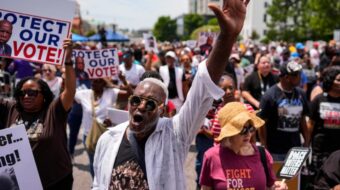
The reality, of course, is that Black lawmakers have almost always been at the forefront of progressive politics. Why else would there be such a concerted effort by the right to gerrymander districts represented by Black lawmakers out of existence? And the victories by strong progressives who often are non-white show that there is a strong current across racial lines for unity in the fight against Trump.
Nowhere is that more obvious than in the biggest August 18 primary state of them all: Florida.
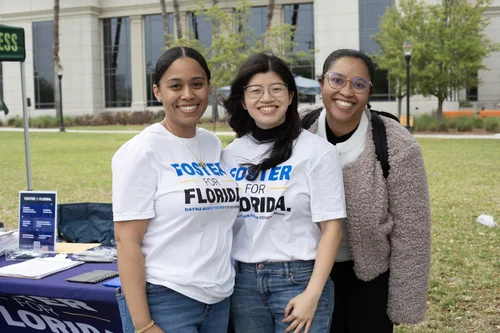
Republican-turned-Democrat David Jolly—who hasn’t held elected office since he left the U.S. House as a GOPer on Jan. 3, 2017—faces several other hopefuls, led by Dayna Foster, a Broward County (Fort Lauderdale) progressive African-American woman.
Jolly started his migration away from the GOP by forming the Forward Party alongside former Democratic presidential candidate Andrew Yang, a corporate executive, and former New Jersey GOP Gov. Christine Todd Whitman. It wanted to attract a coalition of Democrats, Republicans, and Independents “who want to move past the era of divisiveness and do-nothing politicians.”
The party quickly sank from sight. And Jolly, like former Florida GOP Gov. Charlie Crist, migrated eventually to a position as a pro-business Democrat. The two are similar in another way: Crist succeeded Jolly in the House.
Dayna Foster’s key planks include “economic opportunity for working Floridians” by raising the minimum wage and creating pathways to generational wealth. “Working families are the backbone of Florida’s economy, and they deserve an economy that works for them,” her website says.
And while Trump and congressional Republicans cut Medicaid and push to eliminate all reproductive rights, Foster “supports expanding Medicaid, protecting reproductive healthcare access, capping prescription costs, and investing in mental health services,” her platform adds. “Healthcare must be affordable, accessible, and equitable for everyone.”
She also denounces the anti-immigrant hate permeating both the GOP Trump regime and Florida’s Republicans. “IMMIGRANTS MAKE US STRONGER. NO HUMAN IS ILLEGAL,” her website declares in capital letters. She’d not only protect immigrants’ rights and create a clear path to citizenship but also “end inhumane detention practices” by ICE. There would be no “Alligator Alley” detention centers under Foster.
Race has also come to the fore in other contests on the August 18 Florida ballot.
One Democratic establishment candidate, Rep. Debbie Wasserman-Schultz, was redistricted out of her House seat by the GOP remap engineered by right-wing GOP Gov. Ron DeSantis. The map’s objective was to eliminate four of the eight Democrats in the state’s congressional delegation by cramming voters of color into the other four.
Wasserman-Schultz refused to be eliminated by the mapmakers. Preprimary polls suggest the voters may do it. They show her trailing but in a crowded field.
Wasserman-Schultz became infamous among progressives for her role, as the national party chair in 2016, in engineering the primary calendar and other factors to ensure former Secretary of State Hillary Rodham Clinton would win the presidential nomination no matter how well Sen. Bernie Sanders, Ind-Vt., did. She was forced to step out of the party leadership.
If she is elected and the Democrats are in the majority in the House next year, she will be in a position in her committee work to advocate for AIPAC policies toward Israel, a matter of orchestrated genocide in Gaza.
But now, in this race, Wasserman-Schultz has antagonized many members of a key section of African American lawmakers, the Congressional Black Caucus. That’s because she chose to run in the new 20th Congressional District, which includes her home—and which is now majority-minority.
The CBC faces the potential loss through Donald Trump-demanded redistricting nationwide, of up to 19 of its 62 members. So many of its members are upset at Wasserman-Schultz’s decision.
So are other hopefuls, and the leaders among them are people of color: Former Rep. Sheila Cherfilus-McCormick (D), Luther Campbell, Dale Holness and Elijah Manley.
Cherfilus-McCormick was the incumbent in the redrawn 20th District, but she has her own baggage: Last November, the Trump Justice Department indicted her and her brother on charges of stealing $5 million in Federal Emergency Management Agency aid meant for her district after tremendous hurricanes hit it and diverting the money to her campaign.
The House Ethics Committee opened an investigation. On April 21, just days before its planned report, reaffirming the charges, Cherfilus-McCormick, while maintaining her innocence, resigned. The report would have likely led to an expulsion vote. Her trial is scheduled for early next year.
“This was not a fair process,” Cherfilus-McCormick said in a statement. “Rather than play these political games, I choose to step away so that I can devote my time to fighting for my neighbors in Florida’s 20th district. I hereby resign from the 119th Congress, effective immediately.”
Holness, a former Broward County Commissioner, may have the best shot at beating Wasserman-Schultz. He lost to Chefilus-McCormick in a 2021 special Democratic primary election by five votes—11,662-11,657—out of 49,000 cast.
“With over 20 years as an elected official and a lifetime of advocacy, Holness has become a symbol of what effective, principled, and people-first leadership looks like,” his campaign website says.
By contrast, Manley, who calls himself an educator and organizer, has lost three races—one for the Broward school board and two for the state House, from 2018-22. He pitches himself as “from the streets of District 20–this working-class community, and I think that’s why my candidacy is so important. I understand what it’s like to go homeless, or hungry, or struggle, and I’m able to relate to the people in this community who don’t have a voice.”
Race is a factor on the GOP side of the ballot, too, and the test will be an interesting one. Trump, whose base has a large proportion of white nationalists, has endorsed Rep. Byron Donalds, who is giving up his U.S. House seat, for the gubernatorial nomination. Donalds is Black, one of only four current African-American Republican representatives. He’s running as a committed Trump backer.
Donalds also calls himself “a staunch advocate for the Second Amendment, school choice, fiscal sanity, secure borders, law and order, and a limited federal government.” That platform can appeal to the Trumpites in a state whose gerrymandered legislature, with top-heavy GOP majorities, repealed gun control measures enacted after the Marjory Stoneman Douglas school massacre in 2018.
Donalds’s leading foe in the party primary is DeSantis’s lieutenant governor, Jay Collins, a former combat officer in the U.S. Army’s Green Berets who lost a leg during his service overseas. Collins pledges to “protect the DeSantis legacy and keep Florida free, safe and prosperous.”
Donalds refused to debate the other hopefuls, angering DeSantis but not Florida GOP Chair Evan Power. Power said there was “zero interest” in a debate. “Having an open process and having people be able to have their say is always better than trying to engineer an outcome. What the party should be doing is what’s in the best interest of Republican voters,” DeSantis retorted.
Race and the Democratic establishment also combined to play a role in the run-up to the 2028 election. The Democratic National Committee decided recently to rework the party primary calendar again.
The party downgraded the outsized impact of small states with virtually all-white electorates—New Hampshire and Iowa—and elevated states with heavily minority electorates, South Carolina, Nevada and New Mexico.
The primary lineup will be South Carolina on Jan. 22, 2028, after the Iowa caucuses—then Nevada on February 1 and New Hampshire on February 8. New Mexico follows on February 15, followed by Michigan and Virginia on the following two Tuesdays.
Both of those states have heavy shares of African-American voters, in Detroit and Richmond, respectively, plus a growing Latino population in the D.C. suburbs of Northern Virginia.
The stated purpose was to make the early Democratic primary electorate more representative of the party as a whole. African-American voters dominate the South Carolina Democratic Party, and that state replaces New Hampshire as the first-in-the-nation primary state.
African-Americans, especially women, are also the party’s most loyal constituency and the Congressional Black Caucus is closely tied into the party establishment, especially since if Democrats retake the U.S. House, Rep. Hakeem Jeffries of Brooklyn would be set to become Speaker. He would be the first-ever Black lawmaker in that top federal position.
Latinos are a key and large voting bloc in Nevada and New Mexico. They’re also a bloc the party establishment wants to woo back from defections to Trump in 2024.
“Six states, different regions, different communities, different experiences but together as one our road map to the White House,” embattled Democratic National Chairman Ken Martin told the party committee on August 15. He did not mention that the party establishment runs the show in most of those states.
We hope you appreciated this article. At People’s World, we believe news and information should be free and accessible to all, but we need your help. Our journalism is free of corporate influence and paywalls because we are totally reader-supported. Only you, our readers and supporters, make this possible. If you enjoy reading People’s World and the stories we bring you, please support our work by donating or becoming a monthly sustainer today. Thank you!
CONTRIBUTOR