Our friend Robert P. Jones has been thinking about “future regret” as a moral sentiment worth paying attention to in the midst of our present authoritarian crisis. This notion is at the heart of his new book, Backslide: Reclaiming a Faith and a Nation After the Christian Turn Against Democracy, due out just after Labor Day. (You can pre-order a copy now and plan to join us for our live conversation with Robby in early September.) Robby’s attention to the regret we may experience one day, looking back on the decisions we’re making right now, is an intentional effort to learn from those who faced authoritarian crises in our not so distant past. “If one cannot use the past,” James Baldwin taught us, “one cannot function in the present, and so one can never be free.” Like all of us here at Our Moral Moment, Robby is trying to make good use of the past as we struggle for freedom here and now.
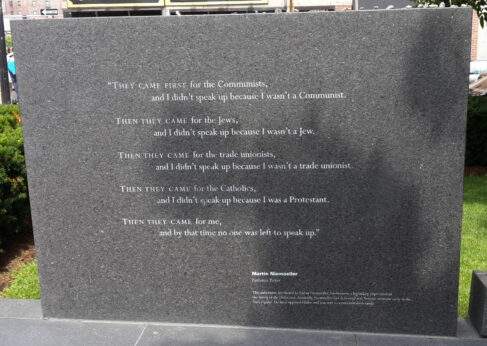
Robby says we are living now in a “Niemöller moment,” referring to the German pastor who famously expressed his regret after the end of the Nazi regime in a poem that is inscribed on the wall of the Holocaust Museum in Washington, DC.
We know Niemöller’s poem (and see yard signs that continue to riff on it up to this day) because Niemöller survived the Nazi regime and lived to tell about it. The list of groups that were targeted by the Nazis was long enough between 1933 and 1945 that Niemöller himself frequently exchanged them in the talks he gave after the end World War II. The Nazis had come for the trade unionists, the Communists, the journalists, the disabled, the Africans, the Roma/Sinti, the Jews. They’d come for the Poles, the Ukrainians, the Russians and anyone else who got in the way of the territory they imagined necessary for their “Third Reich.” They came for almost anyone who resisted and, in the end, even for those Germans who were sane enough to make plans for the what should happen after the Nazi’s inevitable demise. “Defeatism” was a crime the Nazis considered punishable by death – a crime that Hitler apparently considered himself guilty of when he could no longer deny the reality of the Russian troops occupying Germany.
Niemöller escaped the execution that many fellow resistors faced only because the concentration camp where he was held was liberated in May of 1945. He understood that he survived, ironically, for the same reason that so many had perished – because he, a church leader, had done too little, too late. At the first post-war national meeting of the German Protestant Churches in Stuttgart, Niemöller was asked to preach on the opening night. His text was from Jeremiah 14: “Although our sins testify against us, help us for your sake, O Lord.” According to the Stuttgart Newspaper, he declared that “doing nothing, saying nothing, not feeling responsible – that is the guilt of Christianity.” This sermon led the assembly to confess in the official record of its proceedings: “With great pain we say: By us infinite wrong was brought over many peoples and countries…. we accuse ourselves for not standing to our beliefs more courageously.”
Niemöller wasn’t alone. Those who survived the horrors and looked around to assess what remained found themselves overwhelmed by regret. They could not say that they had not known. From the very beginning of the Nazi regime, Niemöller had been a leader of what was known as the “Confessing Church” – the group within German Christianity that did raise a public objection to the Nazis. This is the group that issued the Barmen Declaration and is often celebrated as the “good guys” in the ways we often remember the story. But the Stuttgart confession is clear evidence that the Confessing Church did not understand itself to have been a righteous minority. Yes, they had objected to early efforts by the Nazis to dictate to the church what it could teach the faithful as a matter of doctrine. Still, Hitler understood the impotence of a church that stood up for sound doctrine but didn’t get involved in politics. He granted the Confessing Church its confession so long as their practice of the faith didn’t get in the way of the Nazi program.
This was the compromise Niemöller regretted. He knew that Confessing Church leaders had made a choice to “stay out of politics” when one of their members – a brilliant theologian named Elizabeth Schmitz, wrote her 1935 memo “On the situation of German non-Aryans.” No less theological than the authors of the Barmen declaration, Schmitz had identified the “idolatry of blood and race” that was driving the propaganda and the policy violence of the Nazi regime. She documented the suffering of “non-Aryan” neighbors throughout Germany, focusing especially on the suffering of persecuted Jews, and insisted that it was the church’s responsibility to do something about it.
In the preface to her memo, at least 200 copies of which circulated amongst the Confessing Church in 1935, Schmitz says, “We take comfort in the fact that the Lord of the Church has borne the sin of the world. But can we, who with our eyes open, allow ourselves to be forged anew every day with chains into this sin of our people without defending ourselves? The Church, too, cannot live at any moment other than from the forgiveness of sin. But how can it hope for forgiveness if it abandons its members day after day in this desperate need, if it watches the mockery of all God’s commandments, if it does not even dare to confess its public sin, but remains silent?”
The first action required of any moral leader in a time of lies, Schmitz understood, is to tell the truth – not just the truth about church doctrine, but the truth about what is happening to God’s children and to the body politic that impacts all of us. A cynic might ask, “What difference does it make to risk everything to tell the truth when the people in power do not care about the truth?” But the cynic must also face the reality of history. In 1941, six years after Schmitz began circulating her memo, the Catholic Bishop of Muenster, Bishop Clemens August van Galen, condemned the Nazi policy that killed the most people within Germany during the Nazi regime – the T-4 program designed to exterminate the disabled. He did it from the pulpit on a Sunday morning, and he insisted that copies of his sermon be sent to every parish. In his office as a leader of the Catholic Church, Bishop van Galen named the policy violence that the Nazis were hiding and condemned it. The result: the Nazis officially shut down the program. They did not arrest van Galen or raid the parishes. They demonstrated, albeit in a limited way, that church leaders had a moral power they had failed to use to resist most of the Nazis’ policy violence.
Niemöller knew all of this and had had long days to ponder it before he delivered the sermon that inspired the Stuttgart confession. His regret was real because he could see that a different kind of moral leadership was possible – that it could have made a difference at key moments of turning toward the horrors of the Holocaust. It had not happened all at once. He and others who were charged with leading the church had choices. Looking back, he regretted the choices they made.
“Future regret,” Robby Jones contends, is an exercise of the imagination that allows us to put ourselves in Niemöller’s position in some future where the expressed desires of today’s US authoritarian movement become a reality. Can we imagine a United States where tens of millions of immigrants are “removed”? Can we imagine a single party state where elections are a sham and the wealth of the nation is siphoned off for the sole benefit of oligarchs and political insiders? Can we imagine a Congress that implements “biblical law” based on a the extremist interpretations of Scripture that men like Doug Wilson have already spelled out in their books and podcasts?
Perhaps these scenarios still feel too far removed. Closer to the present, can we imagine a January 3, 2027, when Mike Johnson refuses to seat the 120th Congress, repeating claims of “voter fraud” and “voter machine manipulation” that are already being parroted by the White House?
Three years into the Nazi regime, Elizabeth Schmitz asked fellow moral leaders to imagine the “situation of German non-Aryans” – all those who were othered by the idolatry of race and blood. This did not require time travel, but simply a redirection of attention to communities already under assault. Can we imagine today what it is like to have a family member who was disappeared from their job site “released” to die at home so ICE doesn’t have to count them as a death inside a detention center? Can we imagine the conversations inside the homes of neighbors who’ve lost their health insurance this year? Can we see the child who does not have enough to eat because her mother’s SNAP benefits were cut?
Prophetic imagination, the biblical scholar Walter Brueggemann taught us, always precedes prophetic implementation. Whether the leap is across time or space, we must imagine something new before we can imagine a new way of being. But if we can imagine the real pain the most Americans are now experiencing and the real horrors that are possible for all of us, then we can also imagine the alternative.
It does not have to be this way. We have, in five and half months of an illegal and immoral war, wasted enough money to pay for everything the current Congress told poor and low-income people we could no longer afford just last year. Just five months from now, we can imagine a Congress that holds the executive branch accountable to law, ends an illegal war, claws back the ridiculous sums of money that have been invested in ICE extremism, and confronts the illusions that emerge from the White House. With the real work of a Third Reconstruction in America, we can imagine a country five years from now that looks very different from the one we live in now.
Elizabeth Schmitz’ challenge to the Confessing Church in 1935 “on the situation of German non-Aryans” helps to clarify that the idolatry of our present crisis is about the situation of MOST Americans. If we can imagine the full scope of the crisis, then we can also imagine our collective power. Now is the moment to come together and use it. Any failure to act or narrowing of our scope to exclude “political issues” in this moment is a failure to learn from the past regret that we’ve inscribed on our memorials in the name of “never again.”
Our Moral Moment w/ Bishop William Barber & Jonathan Wilson-Hartgrove
As with all op-eds published by People’s World, the views reflected here are those of the author.
We hope you appreciated this article. At People’s World, we believe news and information should be free and accessible to all, but we need your help. Our journalism is free of corporate influence and paywalls because we are totally reader-supported. Only you, our readers and supporters, make this possible. If you enjoy reading People’s World and the stories we bring you, please support our work by donating or becoming a monthly sustainer today. Thank you!
CONTRIBUTOR