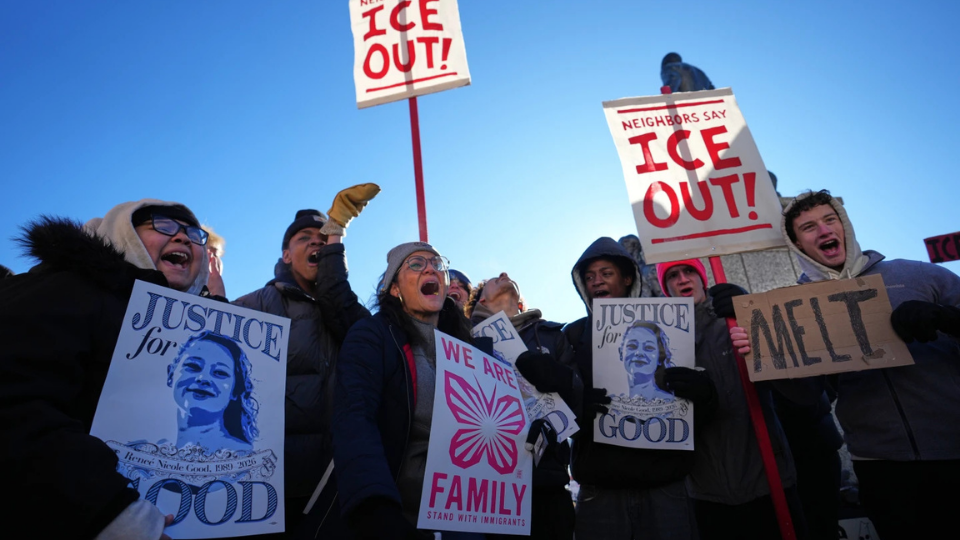
WASHINGTON—With the 2026 mid-term elections fast approaching, activists are hitting the streets to fight the Trump administration and his Republican cohorts. But they’re also converging on the Twin Cities to plan future democracy defense, too.
The National Convergence For Democracy, from August 21-23 at the Minneapolis Convention Center, will bring together labor, civic, civil rights, environmental and other activists and organizers to discuss long-term issues to emphasize and strategy to undertake.
With forces around May Day Strong helping take the lead, the three key themes will be “tax the rich so our families, not their fortunes, come first; No ICE. No war. No private army serving authoritarian power.” and “Expand democracy. Hands off our vote.”
“Now, as state violence and attacks on Black representation and all of our votes escalate, we’re expanding our Solidarity Schools and planning training across the country to be able to act fast and in coordination whenever our communities are threatened,” the convergence sponsors add.
To implement the fight against the Trump tyranny and beyond, the organizers want to train participants in how to implement the organizing lessons of Minneapolis early this year, which brought the Twin Cities to a halt in protest against Trump’s vile, vicious—and lethal—ICE and Border Patrol agents.
The convergence platform goes beyond that. May Day Strong laid it out in a document entitled “The Real Affordability Agenda” earlier this year, around the time that the movement attracted five to seven million people into the streets nationwide on the real May Day.
But given recent revelations about spies and infiltrators in Minneapolis-St. Paul, they may have to train participants in how to smoke them out, too.
“What working people pay more for, those at the top profit from. This crisis has hit Black and brown communities and working families most of all. None of this is an accident: It is the result of a system that prioritized private profit over public well-being,” the agenda declares.
So what the Twin Cities attendees will discuss, in broad terms, is “a comprehensive plan to build a movement for multiracial democracy, change the economic rules of our country, and put the makings of a good life back within everyone’s reach.”
Taxing the rich to pay for programs to help everyone else will be a key cause. “Rising inequality is not an abstract economic theory. It is the root cause of the affordability crisis crushing millions of families,” the agenda document declares.
“Corporations and the ultra-wealthy have worked to rig this system to avoid paying their share of taxes, targeting Black communities and communities of color for the worst impacts, and dismantling the social safety net for everyone. For decades, the rules of our economy have been rewritten to channel wealth and income to a tiny fraction of people at the very top.”
The Trump-GOP so-called One Big Beautiful Bill, which the congressional Republicans approved on party-line votes in 2025 and Trump signed that July 4, only made already staggering inequality worse, the May Day report pointed out. Over 70% of its tax cuts “went to the richest fifth” of the U.S., and the top 1%–those with six-figure incomes and above—got an average $66,000 tax cut.
“Extreme concentration of resources and economic power in the hands of the few has left our public services starved of resources, and it has left tens of millions of households living paycheck to paycheck, unable to save for emergencies, and falling further behind. Understanding the staggering scale of this disparity is the first step toward fixing it.”
Workers’ rights will be one of the specific issues the delegates plan to tackle, and the report demands a massive pro-worker overhaul of basic workplace legislation. That includes raising the federal minimum wage to $25 an hour, living wages beyond that, job guarantees for the unemployed and underemployed, “universal paid leave, repeal of anti-union laws, strong worker organizing protections and curbing employer misclassification” of workers as independent contractors.
Unlike workers considered “employees,” independent contractors can be paid less than the minimum wage, denied overtime, are ineligible for workers’ comp and jobless benefits and—to top it all off, have to pay 14% of their income in Social Security and Medicare payroll taxes, to cover both their share of the levies and their “employers” share, too.
And an expanded social safety net would be much more than Medicare For All.
It would create “universal access to essential services by eliminating cost barriers and corporate profiteering. That means fully funded universal child care with fair provider wages, free school meals and expanded food assistance alongside anti-gouging measures, debt-free public higher education, free comprehensive health care for all, fare-free reliable transit, fully funded equitable public schools, and publicly controlled utilities with progressive pricing and assistance.”
All those are laudable goals. What the delegates to the convergence in the Twin Cities will discuss is how to get from here—a society with rampant inequality, corporate control and a safety net full of holes—to there.
Further details can be found here.
We hope you appreciated this article. At People’s World, we believe news and information should be free and accessible to all, but we need your help. Our journalism is free of corporate influence and paywalls because we are totally reader-supported. Only you, our readers and supporters, make this possible. If you enjoy reading People’s World and the stories we bring you, please support our work by donating or becoming a monthly sustainer today. Thank you!
CONTRIBUTOR