Editor’s Note: Before reading this article, we recommend Tim Wheeler’s earlier story on the life of Mary Metlay Kaufman. It provides informative background on the life of this remarkable lawyer and activist. You can find it here: Mary Metlay Kaufman: Anti-fascist hero.
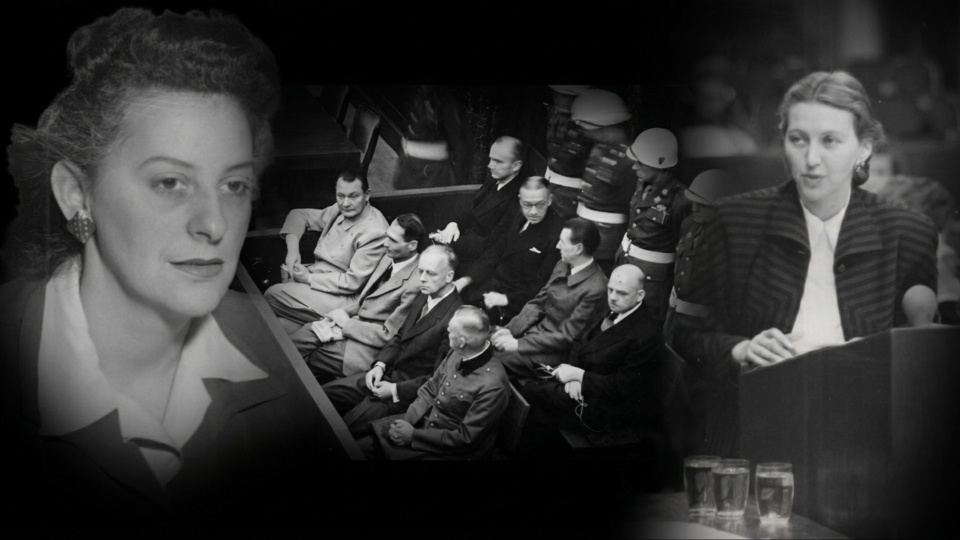
Of the 640 people in Judge Robert Jackson’s team at the Nuremberg War Crimes Tribunal in 1947-48, over 100 were lawyers. But only six of these lawyers were women, among them Mary Metlay Kaufman, one of the chief prosecutors in the trial of 23 top executives of the IG Farben Chemical Trust. It meant that of the 640 personnel, 98% were men.
Naturally, from today’s vantage point, this inequity is seen as a major issue. Visit any of the websites devoted to Nuremberg and you will see apologies for this gross male supremacy. I’m currently doing research at the Smith College Neilson Library’s “Special Collections,” which houses the Mary Metlay Kaufman Papers.
I plan to write a biography of Mary, a woman I knew and heard speak at “Free Angela Davis” mass meetings in New York in the 1970s. She’d gotten her start decades earlier, though, during the Great Depression. In the 1930s, she was a labor lawyer and helped found the progressive National Lawyers’ Guild. She worked at the National Labor Relations Board for a number of years before heading to Nuremberg.
After the war crimes tribunal, she returned to the U.S. and spent much of the early Cold War period serving on the defense teams for Communist Party USA leaders caught up in the Smith Act trials, fighting for the rights of individuals like Claudia Jones and Elizabeth Gurley Flynn. Later, during the Vietnam War, she represented peace movement activists and chaired the Mass Defense Committee, the lawyers’ group formed to defend anti-war protesters.
In my research of Kaufman’s life, I have scoured the websites and databases of many organizations, among them the federal government’s Holocaust Museum.
What struck me is how determined the censors have been to remove Kaufman from the picture, as if she never served as a prosecutor at Nuremberg. And if she was there, she was invisible, insignificant. One hour of reading the documents in Mary’s collection proves that she played an enormous, leading role in preparing the indictment, cross-examining witnesses, and winning conviction of these Nazi war criminals.

Kaufman may be absent from the Holocaust Museum website, but it does feature another woman, Belle Mayer Zeck, who speaks at length in a video interview of her own role at Nuremberg.
She explains her assignment during the war as an attorney in the U.S. Treasury Department Special Counsel office tracking investments in the U.S. and around the world by banks and corporations from “enemy nations,” like Germany, Italy, and Japan. At the top of her list was IG Farben, then the richest, most powerful corporation in Germany, indeed in all of Europe.
When Zeck was ordered to join the Nuremberg prosecution team, she was assigned to help prepare the indictment of IG Farben. I listened to the entire interview, spellbound by her intelligence, the clarity of her understanding of the viciousness of the company’s top executives who connived with Hermann Göring, SS leader Heinrich Himmler, and Adolf Hitler himself.
Zeck denounced IG Farben bosses for bankrolling Hitler’s seizure of power and for reaping hundreds of millions of reichsmarks in profits from the slave labor of Jews, Russians, Poles, and other Europeans. The company helped build the Monowitz concentration camp and supplied the gas used to murder over one million people in the gas chambers at Auschwitz.
She was also merciless in exposing the sudden shift in U.S. foreign policy from “de-Nazification” of the German economy to the “rebuilding” West Germany. The Cold War was on, and the U.S. needed these war criminals in their competition against the Soviets.
Angrily, Zeck denounced the Cold Warriors for acquitting most of the IG Farben executives, imposing “slap on the wrist” penalties on a few and then commuting the sentences of several after they had served less than half their time. She also criticized their red-baiting, for their lies that the Farben Trial was “communist” and that she herself was a communist.
As she spoke, I said to myself: “Belle Mayer Zeck must have known Mary Kaufman. Two young Jewish women lawyers from New York. Both assigned to prepare the indictment of IG Farben. How could they not have known each other?”
Yet Zeck did not mention Kaufman’s name in the interview. And nothing I found in any of the other sources I searched ever indicated that the two women knew each other.

Last week, I was back in the reading room of the “Special Collections,” plowing through 84 boxes of Mary’s personal papers that take up 39 linear feet of the shelves in the library. Just the text of the indictment was so long a legal document that it took up five or six boxes. The pages were in stapled sections, each an inch or two thick. Much of it doubtless was written by Mary.
Yet the question lurked in the back of my mind that there must be some document that proves these two women were co-workers. I came to a box that focused on Mary’s opening of her law practice in Manhattan in 1950. The centerpiece was an engraved invitation to the open house at her new office celebrating the occasion. It was followed by hundreds of cards and letters congratulating her.
I reached in and pulled out a little note addressed to Mary. It was signed by Belle Mayer—Zeck’s maiden name. I share Belle Mayer Zeck’s note here warmly praising Mary for her service to the U.S. government. That brief little note was a victory for the hard slog of research. Both of these women are dead now. But I love them both, determined anti-fascists, defenders of women’s equality! They were working together—a communist and a non-communist—against a common foe!
We hope you appreciated this article. At People’s World, we believe news and information should be free and accessible to all, but we need your help. Our journalism is free of corporate influence and paywalls because we are totally reader-supported. Only you, our readers and supporters, make this possible. If you enjoy reading People’s World and the stories we bring you, please support our work by donating or becoming a monthly sustainer today. Thank you!
CONTRIBUTOR