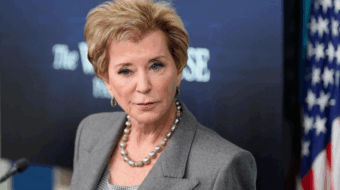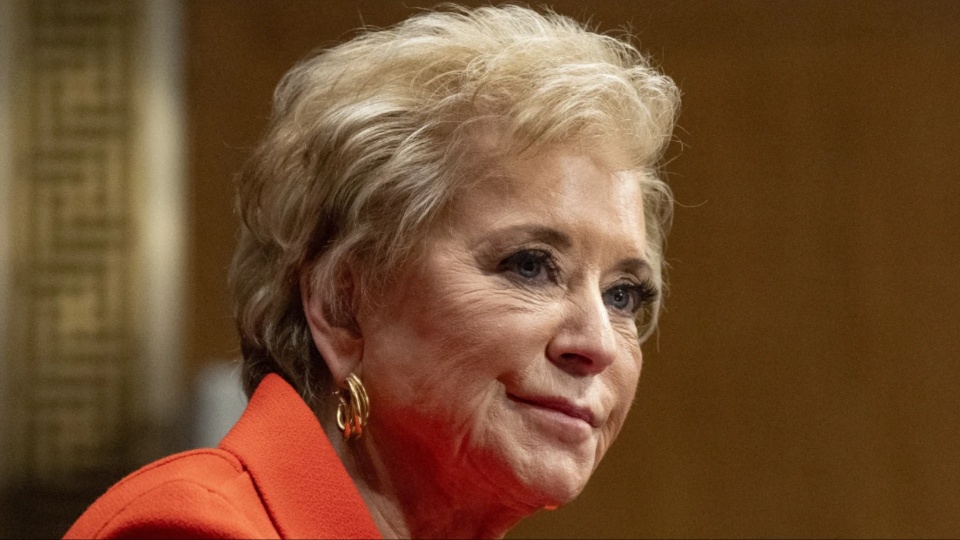
WASHINGTON—Donald Trump and Linda McMahon don’t believe nurses are professionals. Neither are teachers, anesthetists, nor social workers.
To put their proof into black type on white paper, the anti-worker president and his right-wing Education Secretary have cut federal graduate student loan limits in half for those professions and others—even though a federal court ordered them not to do so.
Congress overrode the court, though, with Trump’s “One Big Beautiful Bill,” the $4.5 trillion tax cut for the rich last year. That let the Trump-McMahon regime promulgate their student loan cut plan on April 1, though it won’t really kick in until grad students head back to school in a few weeks. McMahon’s department calculated the student loan changes would save taxpayers $409 billion and reduce student loan debt $224 billion by protecting students from overborrowing.
The unions which represent and defend those workers—the Teachers/AFT, AFSCME, and National Nurses United—marched into federal court in D.C. to stop the so-called “Reimaging and Improving Student Education” rule. AFT’s ranks include K-12 school nurses, AFSCME represented social workers and public health nurses. National Nurses United is the biggest union for registered nurses.
Boiled down to its essentials, the Trump-McMahon “Rise” rule sets maximum student loan limits for students studying for 11 specific professions at $50,000 per year, $200,000 total. Those limits are open only to students of medicine, law, dentistry, pharmacy, veterinary studies, optometry, osteopathy, podiatry, chiropractic students, theology and clinical psychology.
Everybody else in graduate studies, such as teachers, social workers, nurses, firefighters, anesthetists and even architects aren’t “professionals,” Trump and McMahon declare. So, their loan limit is $20,500 per year, $100,000 total.
To put that into perspective, nursecompensation.com reports nursing student loan debt averages $23,000-$185,000, depending on degree level. The low number is for a bachelor’s degree in a two-year program; the high one is for a doctorate.
If colleges and universities don’t lower their tuition rates, that means workers seeking degrees in these categories will either have to come up with extra cash from their own resources, borrow from private banks at higher interest rates to cover the gap, or give up on their career altogether.
The Learning Policy Institute reports 1.3 million teachers (37.2%) are still paying off their student loans—and stressing out about it. One of every nine teachers still owe the entire amount of their loans, and almost two of every ten teachers report still repaying their loans at age 61-plus.
Unions representing the professions outside the Trump-McMahon categories are understandably outraged. What they didn’t say in their suit, but the Learning Policy Institute did, is that the new and lower limit on grad student loans disproportionately slams African-American loan recipients.
Sixty-two percent of Asian-American grad students never borrowed to pay for their schooling and only 6% did and haven’t repaid, the institute reports. Forty percent of white students never borrowed and 9.6% have never repaid. Some 29% of Black students never borrowed, another 12% have repaid it all, 28% still owe some student loan debt, and 32.7% still owe everything. Other groups, including Latinos, fell in between the white and Black contrast.
Put in the new rules, the lawsuit says, and it’ll be even tougher to find funds to go to school. “The administration is making the path to professional public service jobs unaffordable, thereby hurting communities that rely on these workers for critical care and services,” the unions jointly said.
Teachers/AFT President Randi Weingarten, a New York City civics teacher, called the Trump-McMahon student loan limits “one of the most cynical, cruel components of the Trump tax bill.
“By ‘de-professionalizing’ nursing, architecture, social work, teaching, and countless other careers, the Trump administration is eviscerating education access for poor and working-class students and their families and dismantling pathways to the middle class.
“It tells students they aren’t valued and crushes their dreams. And it harms communities across the country who rely on the services these students would provide.”
“The same administration that cut healthcare to give billionaires more tax cuts is now trying to make it impossible for advanced practice nurses, social workers, public health professionals and others to afford the education they need to care for our communities,” said AFSCME President Lee Saunders. “We are already facing staffing crises in too many public service professions, and this rule threatens to make the situation even more dire.”
National Nurses United first raised the warning flag on the student loan cuts late last year and followed it up with both a formal protest in March to McMahon’s department and then this lawsuit. The loan limit rule “is an attack on the nursing profession” and “an insult” to it, said NNU co-President Jamie Brown, RN. The union elaborated in its formal protest to McMahon on February 28.
“This outrageous proposed rule builds on the damage” from the Big Beautiful Bill “to make it harder for nurses who are pursuing graduate degrees to become nurse practitioners (NPs), certified registered nurse anesthetists (CRNA), or other positions requiring an advanced degree,” National Nurses United said then.
“This rule shuts out the next generation of nurses, social workers and public health professionals before they even get started,” said AFL-CIO President Liz Shuler. “The Department of Education may have decided these degrees don’t count as ‘professional,’ but communities that rely on these essential services know this couldn’t be further from the truth.
“After kicking millions of working families off their healthcare, firing federal workers and gutting federal agencies, the administration is making it harder for working people to enter these careers and forcing hospitals, clinics and state and local agencies to do even more with less. The AFL-CIO is in this fight because no worker who dedicates their life to public service should be priced out of it.”
We hope you appreciated this article. At People’s World, we believe news and information should be free and accessible to all, but we need your help. Our journalism is free of corporate influence and paywalls because we are totally reader-supported. Only you, our readers and supporters, make this possible. If you enjoy reading People’s World and the stories we bring you, please support our work by donating or becoming a monthly sustainer today. Thank you!
CONTRIBUTOR