Bart DeLorenzo, one of L.A.’s most prolific, award-winning directors, has adapted Norwegian playwright Henrik Ibsen’s 1882 An Enemy of the People, setting it in contemporary America. As I recall, the contours of the Scandinavian scribe’s play—which he reportedly wasn’t quite sure whether it was a drama or a comedy—remain largely the same in DeLorenzo’s adaptation. However, it is quite different from the freewheeling version of Enemy, which was mounted at the Will Geer Theatricum Botanicum in 2019, that Ellen Geer adapted to have a Civil Rights vibe.
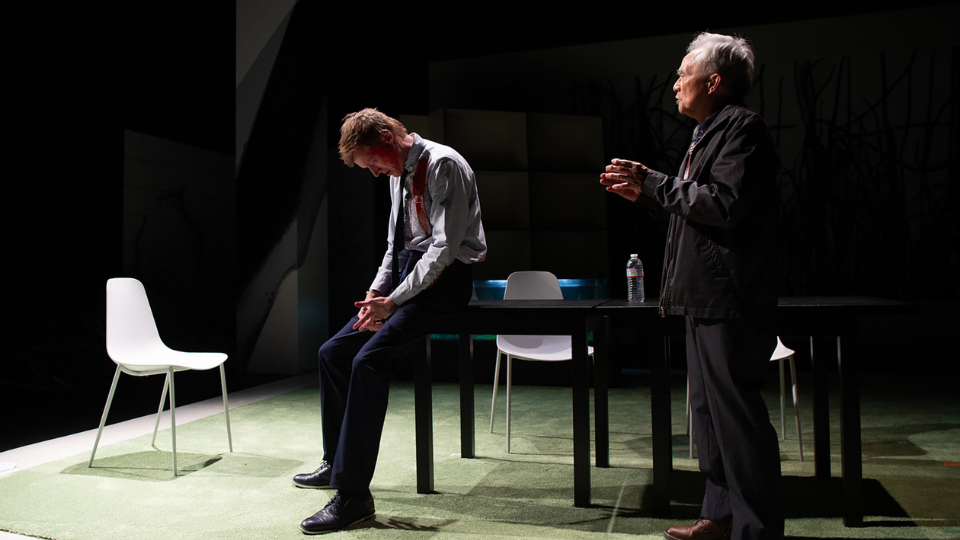
In Enemy, scientist Tom Stockmann (Jay Paulson) uncovers something inimical to the economic interests of the town’s business and political elite, as well as to the townspeople whose main source of gainful employment is placed at risk by Tom’s devastating discovery.
Tom fancies that he’ll be hailed as a hero by his fellow citizens for alerting them to the poisonous hazards lurking in the supposedly healing springs that are the community’s big draw for travelers. But in this battle of the pocketbook versus health, will the townsfolk back him, or does Tom have another thing coming to him? The first to intrude on his fantasy of becoming the man of the hour is Tom’s own brother, Peter Stockmann (Jason McBeth appropriately has a Shakespearean moniker for this role), who, as the mayor clearly sees, poses the threat Tom’s report poses to the powers-that-be, and those they employ.
And what about the community’s reporters? Considering that today, Trump routinely casts and castigates journalists as “enemies of the people,” what role will the fourth estate play in Ibsen’s power struggle? In DeLorenzo’s updated version, at first Hudson (DeJuan Christopher, who was nominated for an NAACP Theatre Award in the Best Supporting Actor category), Billing (Clay Hollander, who has appeared on HBO’s acclaimed The Pitt and the Showtime series Ray Donovan and The Affair), and businesswoman Anna Scalzo (L.A. stage stalwart Lauren Campedelli), who is a feisty investor in The People’s Voice, which Hudson and Billing write for, strongly encourage Tom to publish his damning findings in the online outlet. In Ibsen’s original, Christopher’s character is named Hovstad, and I’m guessing that DeLorenzo Americanized the editor’s name to “Hudson” as a sly reference to the Hudson News, those ubiquitous newsstands and bookshops at airports. Will the journalists remain steadfast, as Tom insists upon informing the citizenry about the dire consequences posed by their “healing” water?
DeLorenzo seems to have amped up the part Tom’s father-in-law—here called Martin Kiel (stage and screen thesp Dennis Dun, who has acted in Bernardo Bertolucci and John Carpenter films)—plays as the story unfolds. Using his financial clout in the form of an inheritance that’s contingent on Tom’s behavior, the conniving Dun pressures his beleaguered (not lionized!) son-in-law. (In Ibsen’s original, the character’s name is Morten Kiil—which may be the Norwegian scribe’s ironic reference to the English language word “Kill.”)
And what about Martin’s daughter, Kate Stockmann (Cara Mitsuko, who had a recurring role on The Man in the High Castle and has appeared on Westworld, Better Call Saul and Grey’s Anatomy)? Will Tom’s wife—who is convinced that her husband is factually correct in his assertions re: water quality—stay the course? Will Kate stand by her man?
And arguably most importantly of all, how will the ordinary townspeople react to the news that might put them out of a job—but spare them from illness? Tom gets an inkling of what’s to come at a riveting town hall meeting, which cleverly deployed audience interaction with the thesps onstage. A few theatergoers are asked to read from cue cards at this critical juncture, as ticket buyers appear to be part of the cast and participate in the town hall tête-à-tête.
Without revealing plot spoilers, Tom reveals himself as quirky and self-righteous in his unyielding crusade to warn his neighbors about the dangers of the “healing” H2O. In doing so, he undermines his cause, taking the spotlight off the urgent issue at hand, and putting the focus on his own erratic self instead. The story becomes about him as the subject shifts away from the health threat he is trying to raise the alarm about. Activists should learn this lesson from Ibsen— it’s not about you; it’s about the important matter at hand. If you’re defending the public interest, you won’t win the eponymous people over to your side by belittling and insulting them (even if they are a pack of MAGA maggots!). And nobody likes a scold.
Ibsen’s classic is arguably among the best Western (Northern?) theatrical works since Shakespeare. It’s redolent with meaning today and remains quite on point and topical, losing none of its bite (or bark). I imagine that during the post-Watergate years of the 1970s, Peter Benchley and Steven Spielberg were well aware of Ibsen’s work when they made the novel and movie Jaws, wherein the town elders initially try to cover up the presence of a great white in the waters at Amity Island, in order not to harm the tourism industry during summer’s busy season.
More recently, consider the recent congressional auto-da-fe of Dr. Fauci, the man of medicine and science who has been pilloried for trying to navigate our way through crises from AIDs to COVID-19, while Donald Trump ruminated about ingesting bleach on live TV and dragged his feet before embarking on Operation Warp Speed (see Bob Woodward’s book Rage), only to successfully have a vaccine developed, which Trump then proceeded to heap doubt and scorn on. While Fauci tried to save lives, Trump’s dithering and lunacy cost hundreds of thousands of Americans their lives during the pandemic.
Trump’s assaults on the First Amendment also make Enemy of the People eminently timely. Will Hudson, Billing and Scalzo, who are supposed to be society’s truthtellers, remain true blue to Tom and the lifesaving story the doctor is trying to tell the people?
DeLorenzo ably helms his ensemble in this 100-or-so-minute show performed without an intermission. For me, the standout performance was delivered by Cara Mitsuko as the besieged wife who has to choose between her husband—who she realizes is factually correct in his scientific assertions—and the competing demands placed on her by family, society, etc. Compounding the complexity of her depiction is, I believe, the understated suggestion that Kate has cheated on her husband with another character. In the end, will Kate be faithful to Tom—and the truth?
Enemy of the People is being performed on Fridays and Saturdays at 8:00 p.m. and Sundays at 3:00 p.m. through September 27 at The Odyssey Theatre, 2055 S. Sepulveda Blvd., West Los Angeles, CA 90025. Scheduled post-performance talkbacks about this thought-provoking production take place on Friday, Aug. 28 with Oliver Jai’Sen Mayer, USC Professor of Playwriting; Friday, Sept. 4 with David Davila, LMU Professor of Playwriting; Sunday, Sept. 6 with Romain Ranciere, USC Professor of Economics; Friday, Sept. 11 with Gary Yeritsyan, UCLA Professor of Sociology; and Wednesday, Sept. 16 with Hajar Yazdiha, USC Professor of Sociology. Reservations: OdysseyTheatre.com; (310)477-2055.
We hope you appreciated this article. At People’s World, we believe news and information should be free and accessible to all, but we need your help. Our journalism is free of corporate influence and paywalls because we are totally reader-supported. Only you, our readers and supporters, make this possible. If you enjoy reading People’s World and the stories we bring you, please support our work by donating or becoming a monthly sustainer today. Thank you!
CONTRIBUTOR