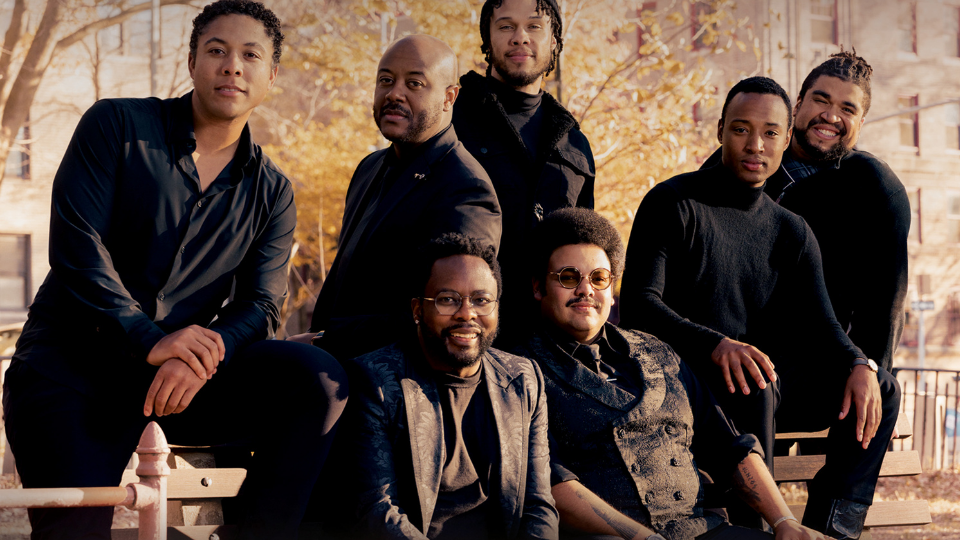
New York Festival of Song Records has come out with yet another stunning vocal album. With a majority of Black composers, these six brothers send their music out into the starry stratosphere. Anyone who loves the sound of men’s voices will be enchanted by this repertoire, which ranges from gospel to jazz to Brahms to contemporary “serious” music to pop to choral, mostly to Steven Blier’s expert piano accompaniment, sometimes joined by a guitar or a second piano.
Blier co-produced the album with mixing engineer Jonathan Estabrooks and baritone Justin Austin, who conceived of the album in a dream but who, owing to the contractual terms of a professional engagement at the time, was unable to join the group for the recording. The six professional singers, all with successful careers that involve leading opera companies throughout the world, are bass-baritone Alan Williams, baritones Will Liverman, Joseph Parrish, and Jorell Williams, and tenors Joshua Blue and Chaz’men Williams-Ali. Jorell Williams, Liverman, and Parrish also play piano.
My Brother’s Keeper features a wide range of numbers by the Black men’s vocal ensemble Take 6, Jorell Williams, Margaret Bonds, William Grant Still, Leadbelly (Huddie Ledbetter), Rachel J. Peters, Steven Lutvak, Johannes Brahms, the duo of Bobby Scott and Bob Russell, Harry Revel and Noble Sissle, and Broadway composer Richard Rodgers. The album was recorded live in New York City’s Merkin Hall in November 2024, and although the audience was no doubt asked not to interrupt the recording in progress, there are several moments when laughter and applause could simply not be suppressed. Listening at home, you’ll likely be joining that audience in your own spontaneous, joyful reaction. The album has 15 tracks; the duration is 56 mins.
Co-producer Austin aimed with his team “to showcase our mutual love and support,” hoping “to encourage all who witness our journey—regardless of race or creed—to embrace the profound importance of selfless love for one another.” The songs take us through any number of emotional states ranging from silent rage and resentment to jealousy, companionship, longing, romantic love, solidarity, faith, and humor.
A modified text from the Book of Matthew opens up the album, a Biblical source that resonates deeply with the African-American experience and with all whose lives are characterized by hard, physical work. “Come unto me, all ye that labor / And I will give you rest / Take my yoke upon you and learn from me / For I am meek and lowly of heart / And ye shall find rest unto your souls.” Take 6’s a cappella arrangement mixes doo-wop with atmospheric, shape-shifting barbershop harmonies. (As a side note, whenever I encounter the Four Gospels of the New Testament, I am reminded of a childhood mnemonic to recite their names that composer Earl Robinson taught me: “Matthew, Mark, Luke and John, saddle a horse and all get on.”)
We proceed to Margaret Bonds’ Three Dream Portraits, to texts by Langston Hughes, which in his solo album Dreams of a New Day: Songs by Black Composers Will Liverman also covered convincingly. Here “Minstrel Man” is given to Liverman, a familiar but never old story (think Pagliacci) of a stage performer in a stereotyped role that can barely disguise the pain of racism. Joseph Parrish picks up the middle song of the triptych, “Dream Variation,” a meditation on the poet’s naturally exuberant nature and the repressive environment of “the white day” he lives in. Jorell Williams winds up with “I, Too (Sing America),” at under 2 minutes, the shortest song on the album, where he’s confident that “Tomorrow, / I’ll be at the table / When company comes.”
William Grant Still’s 1959 song “A Black Pierrot” is also set to Langston Hughes’ poetry. Bass Alan Williams owns this one. Pierrot is a character from the commedia dell’arte genre, a lovesick sad sack lamenting the loss of a lover, so now he will go out “to seek a new brown love” (the published lyric in the online liner notes is unfortunately incomplete). The singer lends simultaneous notes both of pathos and of hope.
“Americana” is a novelty by Jorell Williams in that it’s not a vocal piece, but a two-piano score, with Blier joined by the composer. It’s a set of variations on the spiritual “Go Down, Moses,” which is a plea for freedom (“Let my people go”). He wrote it in the aftermath of the George Floyd murder in 2020. The composer can’t help but juxtapose this familiar song with another well-known and contrasting item, “My Country ’Tis of Thee” (“Sweet land of liberty”). Both speak powerfully of America but in profoundly distinct tones—critical and celebratory—intimating the confounded feelings many Americans hold about our homeland. An appropriate contribution to our culture in the 250th year of American Independence, it stands out, in the composer’s words, as “a powerful juxtaposition that mirrors both the fractures in my own spirit and those in our nation’s fabric.”
A real winner is Steve Lutvak’s “Beware the Anger of Soft-Spoken Men” from 2002. He wrote both the text and the music. It’s sung by a quartet in the style of a mildly doo-wop collegiate choir. The composer writes of men who are taught to always suppress themselves behind too-wide smiles of acquiescence and servitude. “Nice is nice, but nevertheless / Where does the anger go? / Beware the anger of soft-spoken men / They’re like the bull with his eyes on the lock of the pen / If you should open it, better stand back and then / Beware the anger of soft-spoken men.”
“Sence you went away,” from H. Leslie Adams’s cycle Nightsongs, with a lyric by James Weldon Johnson, addresses loss through imprisonment with forlorn emptiness. Tenor Joshua Blue dedicates it to the imprisoned men he’s worked with. Blue’s vocal projection is strong here, leading to some vibrato.
I promised you Brahms. The well-padded German set a poem by Eduard Mörike, “Die Schwestern,” about two identical twin sisters who have always shared everything in life. But then they fall in love—both with the same young man! Here, in the renamed “Die Brüder,” Brahms’ two female singers are replaced by Chaz’men Williams-Ali and Alan Williams, whose blended brother voices are thrillingly conjoined, first in symmetry and then in jealousy. It’s a cute conceit (that the audience delightedly applauded). But curious minds want to know: What pronouns did the love object prefer?
Back in 1928, Tin Pan Alley songwriter Harry Revel and lyricist Noble Sissle came up with “Guiding Me Back Home,” a lively, sentimental paean to Mother who will lead me home after a long career of vagabondage. Steven Blier, who knows just about every song ever written, likes to point out that this one stands out as an early collaboration between a Jewish immigrant (Revel) and a Black lyricist (Sissle). Chaz’men Williams-Ali and Joseph Parrish knock the hell out of this number.
The whole ensemble meets up for Leadbelly’s famous work song “Sylvie,” which many singers have covered. Here, though accompanied only by Alan Williams’ guitar, it’s as if a whole underworld has opened up, a dramatic short with almost identifiable characters. Laughter broke out from the audience after these lines: “She brought me a little coffee / She brought me a little tea / Well, she brought me nearly every damned thing / But she didn’t bring the jailhouse key.”
Rachel J. Peters wrote Sondheimian music and lyrics for a hilariously comedic romp, “Santa Ain’t Black,” one of the top two or three true highlights of the album (though honestly it’s all delicious). It’s a “woke” experience for a Black man who gets a Black Friday job in a Jersey City mall, when he takes on a nine-year-old white girl who believes he can’t be Santa “’cause Santa ain’t black!” The song’s a tour de force of shaping a vocal character, done to perfection by Jorell Williams. Worth the price of admission!
Will Liverman takes on Richard Rodgers’ hit song from South Pacific, “Some Enchanted Evening.” He assumes the persona of a “song stylist” in a pricey nightclub, entitled to bend, digress, and soar, reimagine and remake into his own a standard that can sound corny and dated if rendered simply as written. Bravo for his bravery!
Chaz’men Williams-Ali’s bright, confidently high-flying tenor shines in his extended arrangement (at 7:27, the longest cut) of “He Ain’t Heavy, He’s My Brother.” Many readers will be familiar with its empathic lyrics: “It’s a long, long road / From which there is no return / While we’re on the way to there / Why not share? / And the load / Doesn’t weigh me down at all / He ain’t heavy, he’s my brother.” (An echo, perhaps, of “From those with the ability to those with the need?”) The song gathers gospel steam until about halfway through the soloist says, “Brothers, help me sing,” and the whole cast joins in with a Handelian repetition of “Amen” over and over. Of course we also (are meant to) hear “Ah, men!” for this is at the same time a celebration of the glory of the trained male voice. Animated applause on this one.
On a personal note, I remember singing that song with the New York City Gay Men’s Chorus back in the 1980s in the early years of the AIDS holocaust. At one rehearsal in 1980, our first sign language interpreter was introduced, a darling young deaf man named Bruce Hlibok. He would follow the score, sense the rhythm and volume by the trembling reverberations on the floor and off the walls. He’d watch our mouths as we pronounced the words and paid attention to which section of the chorus was coming in. From all that information, he would sculpt his elegant hand language performance so that the hearing-impaired in our audience would finally have a visual interpreter. We began rehearsal that night with “He Ain’t Heavy, He’s My Brother.” I happened to be seated right behind him, and the weight of it all—the context, the unstinting devotion of lovers and friends, the suffering from hostile families, the poignant coming-out stories, and this one man’s ability to achieve his dreams despite a major disability—just overpowered me. I couldn’t sing while my chest was heaving and tears emptied down my cheeks. Bruce was with us about four years, a beloved member of our community, and retired to get on with his playwriting and acting career. The New York Times published his obituary in 1995 after his death at 34. Yet another good man down. The men of My Brother’s Keeper surely created this stunning album in that spirit.
The final “bonus track,” Jorell Williams’ arrangement for the whole ensemble of Langston’s “Hold Fast To Dreams,” leaves us poised with tentative hope: “Hold fast to dreams / For if dreams die / Life is a broken-winged bird / That cannot fly. / Hold fast to dreams / For when dreams go / Life is a barren field / Frozen with snow.” It’s memorable choral writing.
More information, such as expanded liner notes and the “making of” video, can be found here, along with the Digital Liner Notes, extensive comments by the artists, and the full texts of the songs (although “Sence You Went Away” seems missing, and Brahms’ German text appears twice, with no English translation).
Bonus review: John Holiday’s ‘Over My Head’
Worthy of note is Over My Head, an exceptional new album by countertenor John Holiday. This amazing performer, whose voice register is the highest in the male range, such that it easily could be mistaken for a female voice, takes his title from the gospel phrase “Over my head I hear music in the air.” The title might suggest that his chosen repertory is beyond his capacity (as the higher math would be for this writer, for example); but only a track or two convinces the listeners that this is demonstrably not the case. He succeeds brilliantly in all he endeavors.
I have actually had the pleasure of hearing Mr. Holiday twice at the Los Angeles Opera: first in February 2020, when he sang the echo voice of Orpheus in the world premiere of Matthew Aucoin’s Eurydice, which he recapitulated for his Metropolitan Opera the following year; and in the title role of Philip Glass’s Akhnaten earlier this year.
The anticipated roles for the countertenor center in the Baroque period. Composers such as Händel featured this voice range in leading operatic roles, except that in his day those parts were given over to castrati, gelded males who could sing the high-flying music written especially for them. Holiday has indeed mastered several of those roles, but in his debut album he focuses on gospel music, poem settings by Black composers, and familiar American songs, including Gershwin’s “Summertime,” Bart Howard’s “Fly Me to the Moon,” and the Abel Meeropol (no longer ID’ed by his pen name Lewis Allan) classic, “Strange Fruit.” In short, the album represents Holiday’s “authentic self,” music “carefully chosen for its powerful messages of hope, love, and resilience,” each piece “a piece of my heart.” Among his credits, he acknowledges his husband, DeMario Adams-Holiday, and, of course, his accompanist on the piano, Kevin Miller.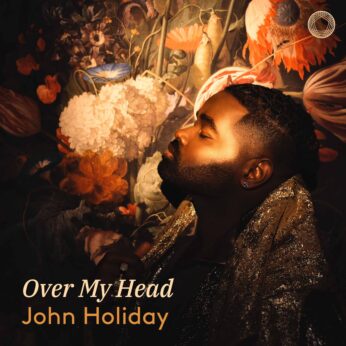
Baroque music, and indeed the stylizations of much Black music, involves invention and decoration, and this album is full of such features. Why perform a standard without putting your own characteristic mark on it (think the spine-tingling interpretations of the fluttering national anthem we have heard from Black performers)? Much of Holiday’s repertory here, however, consists of song cycles, such as Theo Morrison’s five evocative settings of James Joyce poems, three traditional spirituals from Robert L. Morris’s Lyric Suite, four settings by H. Leslie Adams of African-American poetry (by Langston Hughes, Georgia Douglas Johnson, Clarissa Scott Delany and James Weldon Johnson, whose “Sence You Went Away” also appears in the NYFOS album above); and a set of three wordless Vocalise songs by Carlos Simon distributed at separate places on the album (inevitably calling to mind the well-known Rachmaninoff Vocalise as well as a concerto for coloratura soprano by another Russian, Reinhold Glière). The Simon and Adams pieces receive their first recordings here.
One memorable aspect of Holiday’s delivery that pokes through from time to time is his use of the baritone register if the tessitura descends below the countertenor range. This highly personal album reveals just about everything the singer believes (“There’s a God,” for example), and every facet of his vocal anatomy.
John Holiday is a major American voice not to be pigeonholed into an obscure niche, but to be celebrated by any and all who admire the miracle of human expression.
My Brother’s Keeper
NYFOS Records 2026
John Holiday
Over My Head
Pentatone PTC 5187 583
We hope you appreciated this article. At People’s World, we believe news and information should be free and accessible to all, but we need your help. Our journalism is free of corporate influence and paywalls because we are totally reader-supported. Only you, our readers and supporters, make this possible. If you enjoy reading People’s World and the stories we bring you, please support our work by donating or becoming a monthly sustainer today. Thank you!
CONTRIBUTOR