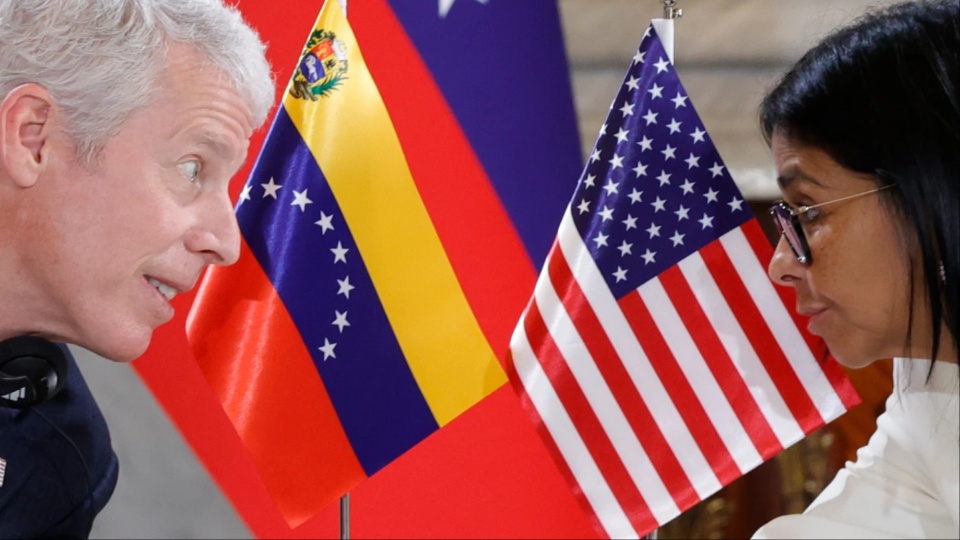
President Donald Trump on Aug. 28 announced via social media an agreement with Venezuela that puts a sizable portion of that country’s oil production and oil reserves under U.S. control. In a six-minute television address the next day, acting Venezuelan President Delcy Rodríguez commented on Trump’s remarks. Two days later, the text of the agreement had still not been communicated.
Trump indicated Secretary of State Marco Rubio and Secretary of Defense Pete Hegseth had negotiated with Rodríguez. They “secured U.S. majority control over more than 65 billion barrels of proven oil reserves in Venezuela …[plus] U.S. majority control over 17 oil fields, at no cost to the American taxpayer.”
The agreement, in force for 25 years, calls for U.S. partnership with private companies to exploit the resources. It “increases our oil supply, and will substantially lower the price of gasoline for all Americans for many years to come,” according to Trump.
In her remarks, Rodríguez emphasized that the agreement entails U.S. “investment of more than $100 billion, and more than $209 billion in tax revenue for the government.” She claimed that Venezuela, in exchange for its oil, industry, and workers’ expertise, will receive “production, jobs, investment in infrastructure, increased revenue for the government, and productive linkages for domestic industry.”
The deal will produce more funding for health care, education, and infrastructure, she claimed.
The agreement stems from the brief but deadly U.S. military invasion of Venezuela on Jan. 3. U.S. troops kidnapped Venezuelan President Nicolás Maduro and National Assembly delegate Celia Flores, Maduro’s wife. They remain incarcerated in a New York prison.
Anticipating the agreement, Venezuela’s National Assembly almost immediately approved a reformed version of the 2001 Hydrocarbon Law, with final passage happening on Jan. 30. It “roll[ed] back the state’s role in the energy sector in favor of private capital,” according to venezuelanalysis.com. U.S. Energy Secretary Chris Wright then promptly visited Venezuela Feb. 11-12.
The New York Times states that, “To tap into the Venezuelan reserves, the United States plans to collaborate with an influential and polarizing Venezuelan businessman, Alejandro Betancourt López.” His family “controls Venezuela’s second-largest private oil producer, North American Blue Energy Partners.”
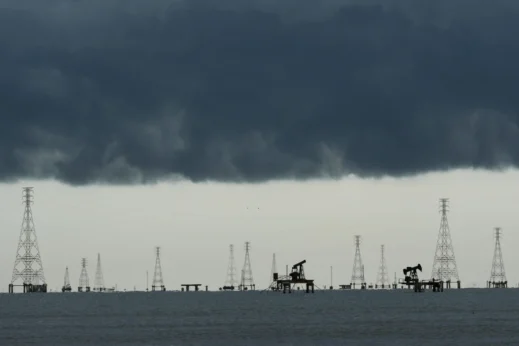
An Associated Press report indicates Rodríguez “granted the company 100-year rights to develop the oil fields.” In her television presentation, the acting president referred to the “signing of other important agreements that include major companies such as Chevron, Repsol, Eni, Shell, BP, among others.”
The oil coming under U.S. control represents 21.5% of Venezuela’s proven reserves, widely regarded as the largest among nations in the world. They amount to 141% of the United States’ own oil reserves.
The ruling United Socialist Party of Venezuela issued a statement, which said in part:
“We support mechanisms for productive recovery that prioritize national interests and enable us to overcome the impact of more than a decade of economic sanctions, unilateral coercive measures, and unjust blockades.… We support the leadership of the President, who is…aware that the country requires real solutions for economic revitalization.… The goal is to make use of every possible tool, within the constitutional framework, to put our immense hydrocarbon reserves at the service of national development.”
Analyst Lois Pérez Leira attributes the lack of both street action opposing the agreement and mobilization against foreign aggression to “socioeconomic strain and political demobilization.” He cautions that, “surrender of these strategic assets undermines the pillars of the nationalization drive spearheaded by Hugo Chávez.”
Indeed, the “Chavismo movement has begun to articulate a bluntly critical stance. Prominent figures within the original movement, such as Elías Jaua (former academic and vice president under Chávez), are leading this sector [and] denouncing foreign interference and economic concessions.”
Omar Marcano, labor activist and writer for Aporrea.org, sees troubles ahead, among them:
- Loss of sovereignty: “By ceding control of the subsoil to corporations allied with Washington, it mitigates pressure from the Trump administration and ensures that Chavista personnel remain in power.”
- Violating the constitution: “The government is…violating the long-standing principle of absolute state control over hydrocarbons. Article 303 of the Constitution…establishes the State’s obligation to retain full ownership of Petróleos de Venezuela (the state-owned oil company).… The schemes proposed in the negotiations—such as the lease or direct concession of entire oil fields under majority U.S. control for up to 100 years—directly conflict with the constitutional reservation of the oil industry as a core activity of the State.”
- Dependency on foreign entities: “The government will depend on private companies to carry out the promised investments (estimated at up to $100 billion)…thereby losing its autonomy in managing its primary source of revenue.
- Disrupted political transition: “This agreement deals a severe blow to the traditional opposition, which had hoped for a transition toward full democracy following Maduro’s ouster.”
- Risk for investors: “[I]ndustry experts warn that the lack of legal certainty, chronic structural failures in basic services (electricity and ports), and violations of the Venezuelan Constitution pose an extremely high risk of future litigation.
- Political apathy: “For the general population, the pact makes it clear that the country’s fate is determined by considerations of transactional geopolitics and control over resources.”
- China and its loans: “China views this as a direct affront to its long-term investments and the lines of credit it has extended to Venezuela for decades.”
Venezuela’s government is considering the possibility of leaving the Organization of Petroleum Exporting Countries (OPEC). It had been one of the five oil-producing countries that founded the group in 1960. According to one report, “Some U.S. officials envision an oil powerhouse built on an alliance between the U.S. and Venezuela that would significantly reduce OPEC’s influence.”
That a large portion of Venezuelan oil production and reserves are being transferred to U.S. control—that is to say, being stolen under U.S. auspices—should come as no surprise. What happened conforms with plans coming to light in November 2025 with the publication of the U.S. government’s latest National Security Strategy. This excerpt testifies to U.S. intent:
“After years of neglect, the United States will reassert and enforce the Monroe Doctrine to restore American preeminence in the Western Hemisphere, and to protect our homeland and our access to key geographies throughout the region. We will deny non-Hemispheric competitors the ability to position forces or other threatening capabilities, or to own or control strategically vital assets, in our Hemisphere.”
We hope you appreciated this article. At People’s World, we believe news and information should be free and accessible to all, but we need your help. Our journalism is free of corporate influence and paywalls because we are totally reader-supported. Only you, our readers and supporters, make this possible. If you enjoy reading People’s World and the stories we bring you, please support our work by donating or becoming a monthly sustainer today. Thank you!
CONTRIBUTOR