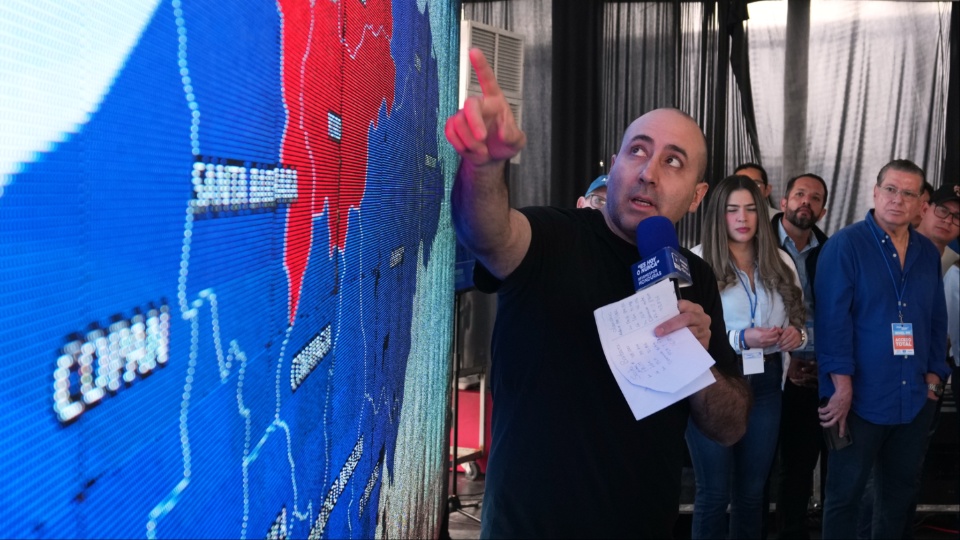
The sound of gunfire erupted outside a hotel in Santa Cruz de la Sierra, the epicenter of right-wing politics in Bolivia, on the evening of Aug. 17. By the time the commotion was over, a woman lay on the ground with three bullets in her, and within hours, the entire country was plunged into political scandal.
Two hitmen disguised as delivery drivers shot and nearly killed lawyer Nadia Beller, but they failed to finish the job. Hospitalized, she talked with reporters and police—and what she revealed triggered the arrest, the very next day, of her partner, political operative Fernando Cerimedo.
Beller, a former parliamentary candidate, had worked in the socialist MAS government of Evo Morales (2007-19). Recently, though, she served as an advisor in the conservative, U.S.-supported government of President Rodrigo Paz, elected on Nov. 8, 2025.
Beller described Cerimedo as angry “about her pregnancy.” However, it was what she said next that set off an avalanche of investigations.
Cerimedo, accord to Beller, was “concerned about her knowledge of illegal activities he was carrying out…[in various] countries, to promote conservative politicians and attack progressives.”
Quickly, it became apparent that her accusations lined up with messages on Cerimedo’s phone reviewed by investigators. They found at his residence “hundreds of thousands of dollars” and computer equipment used to run a “bot farm.”
A massive criminal inquiry is now underway, but the charges so far include attempted murder, domestic abuse, illicit enrichment, and narcotrafficking. The attack on Beller, however, pulled back the curtain on a far larger story.

It’s now apparent that Cerimedo and several associates have been engaged in an extended campaign of media disinformation that helped drive the recent election victories of extreme right-wing presidential candidates across Latin America.
Cerimedo took the lead, serving the wealthy and politically powerful across the region and farther afield in a massive digital communications and deception operation. U.S. influence, it seems, was lurking in the background during it all.
Bolivian bots
Under interrogation, Cerimedo claimed he worked as an unpaid adviser in Paz’s government. His office adjoined that of the president. He told investigators that “outside consulting work” provides him with $1 million per year, or per month; his accounts varied.
His importance to Paz shows in a photo of Secretary of State Marco Rubio conferring with president at the Shield of the Americas Summit in Miami in March—with Cerimedo at his side.
Cerimedo’s value went beyond the role of adviser, though, as it now looks as though his bot farm was working overtime to shape Bolivian opinion prior to Paz’s electoral victory in 2025.
A bot farm, as described by journalist Miguel Ángel San Martín, “is a network of many accounts or devices controlled automatically to generate fake likes, followers, comments, or views; to post or amplify messages en masse on social media; to click on ads or manipulate polls; to automatically create accounts; and to engage in spamming, fraud, or attempts to overwhelm [electronic] services. They are…extremely difficult to detect.”
It wasn’t only in his home country of Bolivia, however, that he put his operation to work.
Voting undermined in Honduras
Cerimedo’s central role in determining the outcome of Honduras’s recent presidential election came to light in August following his arrest. There, the social democratic Libre Party held power prior to presidential voting on Nov. 30, 2025.
Shortly before the election, Marlon Ochoa, Libre’s representative on the National Election Council, publicized leaked audio recordings of conversations of the National and Liberal Parties’ representatives. They were insisting that delivery of ballots and the count should be delayed but simultaneously called for the announcement of victory for their preferred candidates well before all votes were tallied.
That’s precisely what happened; hundreds of thousands of votes were never counted. In the meantime, millions of text messages lit up phones across the country warning that remittances would not arrive from the U.S. if the Libre Party’s Rixi Moncada won.
Prior to the voting, President Donald Trump released Juan Orlando Hernández, Honduras’s former president for the National Party, from a U.S. prison where he had been serving 43 years for drug trafficking. National Party candidate Nasry Asfura had placed third in opinion polls, but suddenly he was Honduras’s new president.
On Aug. 26, Marlon Ochoa, the former national election councilor currently living in exile, reported that Fernando Cerimedo’s voice was heard on the leaked audio recordings he delivered to the attorney general’s office in December 2025. There, Cerimedo talked about stuffing votes for Asfura into ballot boxes, discarding votes, and not accepting a “vote-by-vote recount.”
In Chile
Cerimedo tried to disrupt the 2020 Chilean referendum on a new constitution that would have replaced one inherited from the Pinochet dictatorship. Socialist parliamentarian Juan Santana claimed recently that Cerimedo’s own consultancy firm had staged an opinion poll aimed at falsely showing that the “Yes” vote was losing ground. (It passed by 78%.) Cerimedo supported the “Reject” option.

Santana accuses three officials in the government of current right-wing President José Antonio Kast of cooperating with Cerimedo in that endeavor. He claims that bots let loose by Cerimedo eased candidate Kast’s path to electoral victory in 2025 and also that “artificial accounts and trolls” disparaged progressive presidential candidate Evelyn Matthei.
In Peru
The results of second-round presidential voting in Peru on June 7 were close. According to elciudadano.com, right-wing candidate Keiko Fujimori had included “Cerimedo as one of her main electoral campaign advisors.” In the first round of voting, “Cerimedo’s network…began to operate covertly in the country through bots, trolls, and false content.” He “launched a disinformation campaign against progressive candidate Roberto Sánchez,” who was ahead in the polls. Ultimately, “the dirty work of Cerimedo” was decisive in overcoming Sánchez’s lead.
To be able to intervene in Peru, Cerimedo and Spanish journalist Javier Negre (see below) built a relationship with Carlos Díaz-Rosillo, who has served in two Trump administrations, in the White House and then the Department of Defense. The Department’s website proclaims that Díaz-Rosillo advises Secretary of Defense Pete Hegseth “in all matters related to defense policy and strategy in the Western Hemisphere.”
Díaz-Rosillo and Keiko Fujimori are acquainted. In 2025, Díaz-Rosillo honored her at the Florida-based Adam Smith Center, which he founded and directed. Fujimori must have been appreciative; she had only recently emerged from a failed prosecution on money-laundering charges. Accepting Díaz-Rosillo’s recommendation of Cerimedo, she might have been returning the favor.
In Colombia
Following the June 21 election victory of Colombia’s new reactionary President Abelardo de la Espriella, outgoing President Gustavo Petro attributed leftist candidate Ivan Cepeda’s defeat to a plague of bots and internet-borne disinformation. The source, he suggested, was the Israeli cyber-intelligence company BlackCore.
Now, however, Petro relies on the forensic analysis of Fernando Cerimedo’s phone. It suggests he collaborated with Colombian electoral officials. Cerimedo refers to “more than two million bots and fake profiles managed by automated farms operating from abroad and the city of Medellín.”
Petro called for annulment of the election results and recently repeated the accusations in an interview with Mexico’s La Jornada newspaper.
In Argentina and Brazil
Cerimedo also meddled in elections in Argentina. According to Beller, President Javier Milei paid Cerimedo $800,000 USD per month to carry out online disinformation.

Serving as chief technology and communications officer for Milei’s successful campaign in 2023, he secured large donations and expanded his social media capabilities. Cerimedo admitted to La Nación newspaper that year that, “He controls ‘farms’ of thousands of trolls, bot accounts, and other digital tools put into service for Milei’s party.”
He exercised his technical and digital capabilities, and his scheming, in Brazil, too. Cerimedo joined Jair Bolsonaro’s presidential campaigns and provided assistance to Bolsonaro’s failed coup attempt that ended in January 2023.
Bolsonaro’s son, Eduardo, now living in Florida, in February 2026 hosted the “Hispanic Prosperity Gala” held at Trump’s Mar-a-Lago resort. Argentine President Milei delivered the keynote address, and Eduardo Bolsonaro presented Cerimedo with an award honoring him as the “Hispanic Political Consultant of the Year.”
Cast of characters
On being honored at the Mar-a-Lago Gala, Cerimedo began by saying that, “I want to say something in English; thank you to Brad Parscale!” U.S. operative Parscale had tutored Cerimedo in the uses of social media, trolls, bots, and algorithms for electioneering purposes. The latter told The New York Times that, “Brad set up all the infrastructure that I work with.” Their partnership continued.
Parscale worked for Trump, serving as digital media director for his 2016 presidential campaign and campaign manager for part of his 2020 re-election effort. Cerimedo’s collaboration with the well-connected Parscale may have allowed him to make connections of his own.
Cerimedo partnered with the Argentinian-American Damián Merlo. This lobbyist owner of the Miami-based Latin America Advisory Group (LAAG) had worked at the U.S. Interests Section in Havana and as program officer at the interventionist International Republican Institute.
Cerimedo’s connection to Merlo’s LAAG lobbying group provided him with indirect access to the Florida congressional delegation and to executive branch officials responsible for Latin America.

The duo formed the Numen publicity company, which undertook efforts to generate U.S. support for Milei’s presidential campaign in Argentina in 2023. They shaped publicity for the U.S. and advocated for Milei among members of the U.S. Congress and the media.
As noted by the Cubadebate Media Observatory, “Cerimedo built a corporate base in Miami and a transnational media network. The U.S. would be its center of operations. It benefited from privileged links with the top power structures within the Trump administration, in particular with Marco Rubio.”
After Milei’s electoral win, the Numen organization, helped along by Parscale’s technical help and his travel to Bolivia, played important roles in the 2025 electoral victories of Paz in Bolivia and Asfura in Honduras. Numen also appears as an “academy” offering “digital and political marketing courses” in the region.
Cerimedo and two Argentinian journalists formed La Derecho Diario (Daily of the Right) prior to 2020. It’s a widely-read, pan-Hispanic source of news and views with a reactionary slant; there’s an English-language version. A recent story titled “Wave of Moroccan immigrants arrives in Brazil thanks to Lula” typifies its deceptive content.
The Spanish impresario Javier Negre, a “megaphone” for the far-right Vox political party, owns his own far-right media conglomerate, and in 2024, he purchased 50% interest in Cerimedo’s La Derecho Diario and took over as director. With Cerimedo now in trouble, though, he’s abandoned the platform.
Loose ends
On his digital rampage across Latin America, Cerimedo was a prominent soldier in a war being carried out by Latin America’s extreme right wing. He and others built a network of media and digital communications to serve the wealthy and politically powerful in Latin America. Cerimedo found friends and supporters in Washington and in southern Florida, hotbed of emigre agitation.
The U.S. government has likely provided more substantial support for his activities, but further details are so far scarce. Evo Morales, the former Bolivian president ousted in a U.S.-supported coup in 2019, claims Cerimedo was working for the CIA. Cerimedo’s former partner Beller says likewise.
Lots of money cropped up along his path, as noted above, that may signal official U.S. involvement. The U.S. government directs vast sums to “national security,” a category that historically included undercover activities of all kinds. It’s conceivable that some of Cerimedo’s projects could have been classified as such.
A report appearing on ciudadano.com on Aug. 27 is relevant in this regard. Investigators looking at Cerimedo’s mobile phone found “codes linked to a network of digital wallets.” The report refers to a “cold wallet” allowing for “the discreet transfer of large sums of money.”
Investigators discovered “transactions totaling $44,100…over the last six months.” More shocking, though? They “uncovered accounts handling staggering sums, including one that holds $132 million.”
We hope you appreciated this article. At People’s World, we believe news and information should be free and accessible to all, but we need your help. Our journalism is free of corporate influence and paywalls because we are totally reader-supported. Only you, our readers and supporters, make this possible. If you enjoy reading People’s World and the stories we bring you, please support our work by donating or becoming a monthly sustainer today. Thank you!
CONTRIBUTOR