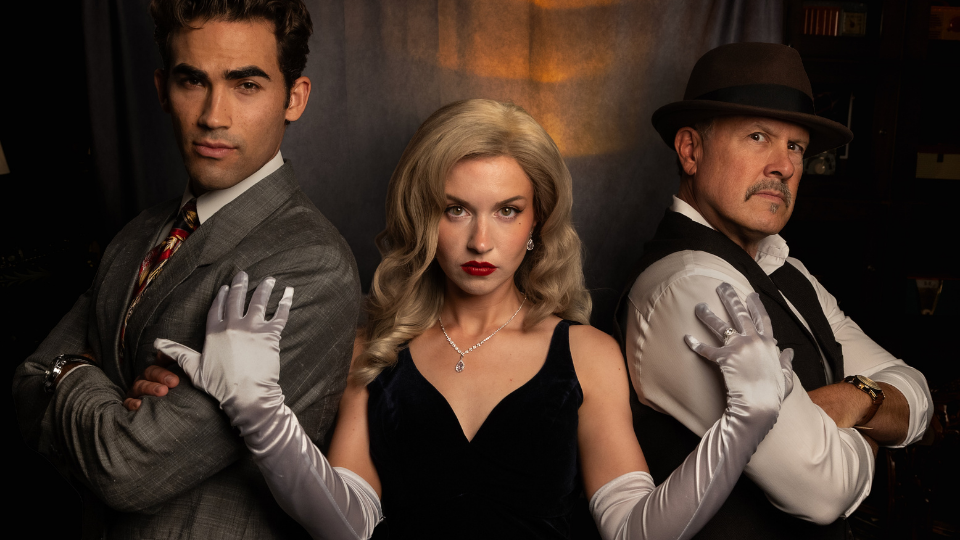
Sometimes when a journalist sets out to cover a story, the ink-stained wretch has absolutely no idea what he/she is getting himself into. As I approached Vitello’s in Studio City, a reporter for L.A.’s CBS news affiliate with a cameraman asked to interview me—I believe it was Laurie Perez. In any case, she wanted to know what I thought about the controversy re: the play I was about to cover, A Killer Night in Studio City. When I confessed I had no idea there was a dispute regarding the dinner theater show, the CBS TV-journo illuminated me:
Members of the family of the slain Bonny Lee Bakley were opposing the production of A Killer Night in Studio City because it was being mounted at Vitello’s—where Ms. Bakley dined shortly before she was murdered right nearby—and, to make matters even more problematic in their eyes, the play was being directed by and co-starred Noah Blake, whose late father, actor Robert Blake, was suspected of being implicated in the shooting of Bonny.
More on this below. But having said all this, at this point allow your conflicted reviewer to just focus on the theatrical and dining experience per se. A Killer Night in Studio City is a comedy-drama with live music set in the Hollywood milieu of 1958. The story has a Film Noir-ish vibe, sort of a cross between Otto Preminger’s 1944 classic Laura and Billy Wilder’s 1950 Sunset Boulevard. The story, by playwrights Kevin Allen Jackson and Kristine Dickson, has more twists and turns than the road to Hana.
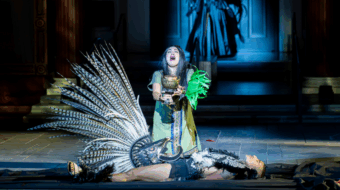
In Killer, an emerging movie starlet, blonde bombshell Sophia Vance (Brittany Pirozzoli), is reportedly murdered. The news is broken to the theatergoing crowd initially assembled outside of the Italian restaurant by the Hedda Hopper-like Edith Sinclair—Sarah Wolter, who is a scene-stealing hoot as the gossip columnist who lives to break cinematic scoops. The audience members are then led into Vitello’s and eventually upstairs to their assigned tables in the Velvet Martini Lounge, where, accompanied by live pianist Johnny Perl tickling the ivories, the murder mystery unravels in two acts—and over the course of an extremely delicious, filling Italian buffet with pasta, meatballs, chicken parmigiana, garlic bread, and, of course, cannolis.
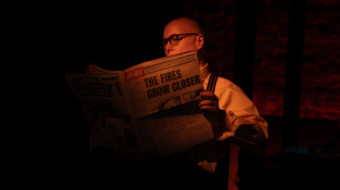
In addition to playing the drums (or what he calls “the skins”), Noah Blake portrays a B-actor named Ronnie Bennett, who plays a sort of Baretta-like TV detective not dissimilar to the character Noah’s father, Robert Blake, won the Emmy for Outstanding Lead Actor in a Drama Series for in 1975. Noah also directs this at times farcical show and send-up of Tinseltown, which includes a film-within-the-play entitled The Road to Hana, with Vance and Johnny Turner (Anthony Carro) superimposed over actual Maui footage via greenscreen, as Blake told me. The motion picture was projected onto a screen that was lowered over a brassy version of the old RKO Pictures logo. Blake added that the mini-movie was thusly monikered as a homage to the Bob Hope, Bing Crosby and Dorothy Lamour “Road picture” comedies.
Onstage and offstage, the real star of A Killer in Studio City is Vitello’s, the kitschy, ambiance-imbued almost 60-year-old eatery with period décor including juke boxes, cigarette vending machines, headshots of celeb patrons like Frank Sinatra et al., and, of course, offering scrumptious Italian cuisine and drinks. Staging this immersive piece of theater in the restaurant and bar is really what makes what might otherwise have been a trite, tedious, over-the-top production work.
Vitello’s is also the protagonist of A Killer in Studio City because of the real-life role it played in one of the most infamous murders in Hollywood history. At the end of the opening night performance, actor/director Noah Blake briefly addressed what he described as “an Internet kerfuffle.” I did a deep Baretta-like investigation to research the historical background of this controversy (in other words, I googled it, and this is what Wikipedia revealed):
“On May 4, 2001, Robert Blake took Bonny Lee Bakley to dinner at Vitello’s Restaurant on Tujunga Avenue in Studio City, Los Angeles. Afterward, Bakley was killed by a gunshot wound to the head while sitting in the passenger seat of Blake’s black 1991 Dodge Stealth, which was parked on a side street around the corner from the restaurant. Blake claimed that he had returned to the restaurant to collect a gun which he had left there, and was not present when the shooting occurred. The gun that Blake said he had left in the restaurant was later determined not to have fired the shots that killed Bakley…
“On March 16, 2005, Blake was found not guilty of the murder of Bakley, and of one of the two counts of soliciting a former stuntman to murder her. The other count of solicitation was dropped after it was revealed that the jury was deadlocked 11–1 in favor of an acquittal…
“On November 18, 2005, Blake was found liable for the wrongful death of his wife in a civil trial. Bakley’s three eldest children had sued him, asserting that he was responsible for their mother’s death… The jury ordered Blake to pay $30 million…” And so on.
As in A Killer in Studio City, Vitello’s played a lead role in the above offstage true crime tragedy. Rose Lenore, who identifies herself as the biological daughter of Bonny Lee Bakley and Robert Blake and half-sister of Noah Blake, took to TikTok to protest the murder mystery show at, of all places, Vitello’s, asking: “What the fuck?”
In his remarks after the drop of the proverbial curtain, Noah insisted that the production “has an important personal history to me” and that it is never “right to tell artists what they can do and where.” He told me that he’d never met Bonny. Blake has acted in many B-pictures and action movies, including the 2012 horror-action flick Piranhaconda shot on location in Kaua‘i.
Robert Blake had quite a career on the big and little screen, stretching back to 1939 when he co-starred in Our Gang comedies, then selling a lottery ticket as a Mexican boy in John Huston’s 1948 classic The Treasure of Sierra Madre. In addition to winning an Emmy and a Golden Globe Award for Baretta, Blake co-starred in the 1967 screen adaptation of Truman Capote’s In Cold Blood and played the title character in Abe Polonsky’s stellar Western 1969 Tell Them Willie Boy Is Here about Indigenous rights.
To tell the truth, during Killer I enjoyed myself very much, and the food was “bellissimo.” But the more I thought about the creepy backstory, the more it killed my appetite and gave me a case of indigestion…
A Killer in Studio City is scheduled to play through October 31 at The Velvet Martini Lounge, Upstairs at Vitello’s, located at 4349 Tujunga Ave., Studio City, CA 91604. For tickets, see here.
No paywalls at People’s World
We hope you appreciated this article. At People’s World, we believe news and information should be free and accessible to all, but we need your help. Our journalism is free of corporate influence and paywalls because we are totally reader-supported. Only you, our readers and supporters, make this possible. If you enjoy reading People’s World and the stories we bring you, please support our work by donating or becoming a monthly sustainer today. Thank you!
CONTRIBUTOR