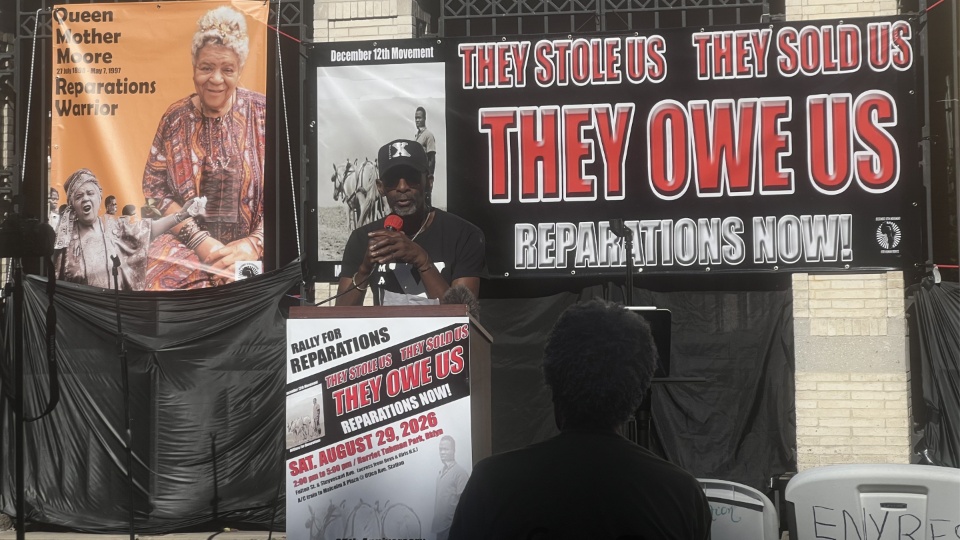
BROOKLYN, N.Y.—A crowd of a few hundred people gathered at Fulton Park in Bedford-Stuyvesant on Aug. 29 to attend a reparations rally being coordinated by the December 12th Movement, a Pan-African human rights organization based in New York City.
The rally was held to commemorate the 25th anniversary of the United Nations World Conference Against Racism (WCAR) held in Durban, South Africa in 2001. The conference produced the historically significant Durban Declaration and Programme of Action (DDPA).
The DDPA formally acknowledged the long-term effects of colonialism, declared slavery as a crime against humanity for the first time, and served as a practical guide for states to take action against racism. In addition, the DDPA acknowledges the need of states to address past crimes, saying that it “urges States to adopt the necessary measures, as provided by national law, to ensure the right of victims to seek just and adequate reparation and satisfaction to redress acts of racism, racial discrimination, xenophobia and related intolerance, and to design effective measures to prevent the repetition of such acts.”
The Fulton Park rally received 76 endorsements from organizations across the city, including the Brooklyn chapter of the NAACP’s Justice Reform Committee, the Brooklyn Club of the Communist Party, and the New York Civil Liberties Union, among others.

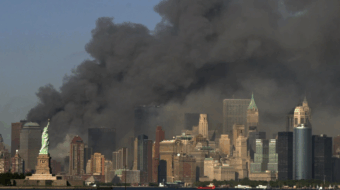
The demand for reparations has been in and out of mainstream discourse over the last 25 years. Just days after the Durban conference ended, the Sept. 11 attacks occurred, stalling mobilization efforts and shifting state energy and attention towards the “War on Terror.”
In the U.S., the war energized patriotic nationalism at a time when the country had just begun to face pressure to atone for its past crimes. But even before the events of 9/11, the United States, under the George W. Bush administration, was hostile to the Durban conference. It, along with Israel, boycotted the event, upset that the actions of the Israeli state against Palestinians would be identified as racist.
People’s World spoke with Roger Wareham, founding member of the December 12th movement and one of the Durban 400 members who lobbied around reparations at the WCAR. Wareham detailed the United States’ withdrawal from the conference.
“They didn’t want to leave saying they were against reparations. So, the narrative they had and you know the one they run till this day, is that the Durban World Conference was antisemitic,” Wareham explained.
“The Palestinian delegation took the position that they were not going to push the whole issue of Israel, because they wanted to support this demand around the declaration of the Trans-Atlantic Slave Trade and reparations. When you look at the Durban declaration, it actually recognizes the existence of the state of Israel while recognizing the Palestinians’ right to self-determination. There’s nothing that they can point to that is antisemitic.”
Indeed, the U.S. government to this day condemns the international consensus reached at the 2001 WCAR, and the Trump administration unlike previous administrations, doesn’t feel the need to hide its disapproval of the idea of reparations. Just this month, at the Republican Midterm Convention in Dallas on Sept. 9, the president said people asking for reparations “hate the country.”
Further, Jeff Bartos, a member of the U.S. Mission to the United Nations Representative, posting a video to X stating:
“Durban’s radicals weren’t only obsessed with Israel. They also demanded reparations from the United States and other Western countries for slavery and colonialism. They conveniently and lazily reduced history to oppressors versus victims, treated Western prosperity as evidence of exploitation, and attempted to permanently indict America and the West.”
Criticism of the United States has been a touchy endeavor for activists and scholars navigating through the white supremacist policies, practices, and pressures of the far-right. Critical Race Theory (CRT), Diversity Equity, and Inclusion (DEI), and affirmative action have all been under assault by far-right figures, who claim that measures taken to address and acknowledge systemic racism and inequality are discriminatory against white people.
Bartos emphasized his disgust with the World Conference Against Racism further, saying:
“As we now know, what happened in Durban did not stay in Durban, and perhaps that was the point all along. Much of the woke ideological vocabulary that erupted across America and the West in 2020 was rehearsed there. Systemic guilt, reparations, settler colonialism, capitalism as oppression, immigration enforcement as xenophobia, and discrimination in the name of anti-racism.”
Bartos’ statement encapsulates the fascist far-right’s resentment towards popular mass movements that threaten systems of oppression.
Proponents of reparations for Black Americans argue that the idea has historical precedent. In fact, the U.S. paid reparations to some Japanese-Americans for its criminal incarceration of Japanese-Americans in concentration camps during World War II. These facts were noted by a speaker from an organization called Tsuru for Solidarity, a Japanese-American group “working to end detention sites and support directly impacted immigrant and refugee communities.”
Tsuru for Solidarity also carries on a reparations campaign aiming to help Black Americans receive reparations and to build solidarity between Japanese and Black communities.
Interestingly enough, there is another historical form of “reparations” to be found in U.S. history: Many former slave owners were compensated for freeing their slaves after the Civil War.
“If you study your history, you know that in 1862 in Washington, D.C., they passed legislation to give reparations for slave owners for freeing their slaves—$300 a piece.” New York State Sen. and DSA member Jabari Brisport said as he spoke to the crowd at the rally.

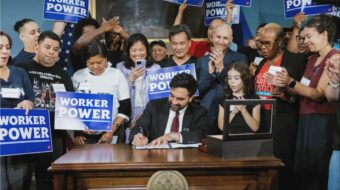
Brisport has been involved in trying to pass reparations legislation in the New York Senate since 2021 and was the prime sponsor of the Reparations and Remedies Community Act, which passed in 2023 and established a commission on reparations remedies. Brisport says it was no easy feat.
“It was because of the work being done by the December 12th movement, by all the organizers here, that we were indeed able to pass that reparations commission in the New York State legislature a few years ago.
“Now, it was a fight to do it. There were deep arguments and debates over whether or not there should be a commission. I had white Democrats telling me behind the scenes, ‘Oh, I don’t know, that’s kind of controversial,’ or…‘It sets a bad precedent.’ And even on the last day when we were voting on it, we still had white Republicans on the floor, I remember one of them saying ‘Well, can I get reparations?’”
The idea that reparations are unfair is one that many opponents cling to. But Black community members, leaders, and representatives contend that they aren’t asking for handouts; rather, they’re demanding what they are rightfully owed.
New York Public Advocate Jumaane D. Williams was also present at the rally, saying, “They owe us. Some people act like you’re trying to ask for something. We’re just trying to get what we’re owed.”
The federal government doesn’t agree. President Trump and his Justice Department, headed by Todd Blanche, are joining a lawsuit against the city of Evanston, Ill., for passing legislation that gave some 300 Black residents $25,000 to address historical housing discrimination. Trump and the DOJ are allying themselves with conservative groups who argue that reparations programs are “reverse racism.”
At the same time, Trump feels he and his allies deserve their own reparations for perceived political persecution. At a press conference this past August, he said, “They went after me. And what they did here was very, frankly, if you talk about reparations or if you talk about payment, what they did to me, I had a very good case against them….”
While some aspects of reparations include direct checks to individuals, like those in Evanston, reparations advocates’ main focus is on addressing institutional and systemic inequality.
When People’s World asked Wareham what reparations might look like in the United States today, he answered:
“Our view of reparations…would be an institutional response to the institutional damage that we suffered. And we don’t envision it so much as somebody getting a check. We think that we suffered collective damage and that the repair has to reflect that.”
Wareham cited a campaign December 12th started during the Biden administration to push the president to sign an executive order for a $50 billion payment that would provide state of the art medical care and facilities in Black communities as an example of institutional repair.
When it comes to reparations, advocates say that while a one-time check might sound nice, addressing racial inequality on a fundamental institutional level would be even better.
No paywalls at People’s World
We hope you appreciated this article. At People’s World, we believe news and information should be free and accessible to all, but we need your help. Our journalism is free of corporate influence and paywalls because we are totally reader-supported. Only you, our readers and supporters, make this possible. If you enjoy reading People’s World and the stories we bring you, please support our work by donating or becoming a monthly sustainer today. Thank you!
CONTRIBUTOR