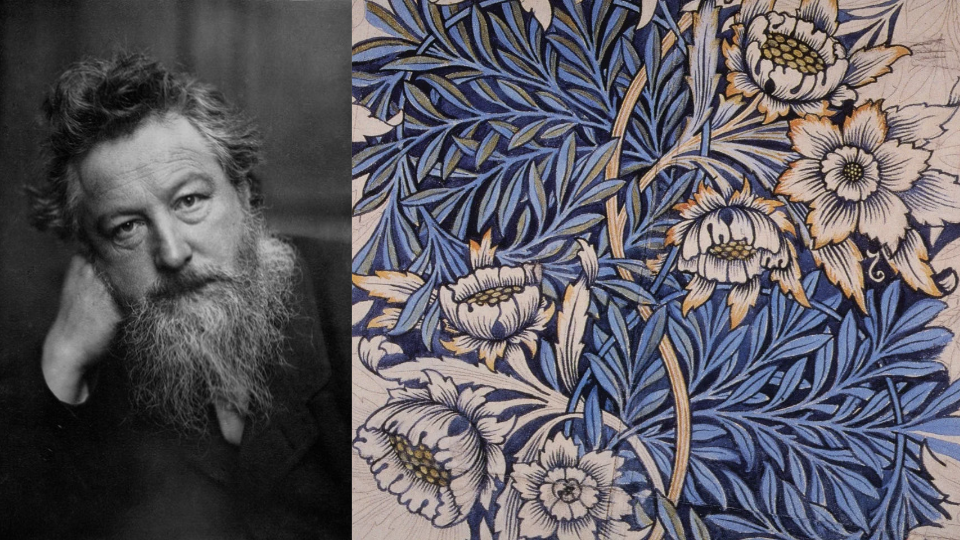
It is 1890. While Britain is aggressively expanding its global empire, its domestic industries are increasingly dominated by mechanized production and growing concentration of capital, and the industrial proletariat is becoming ever more alienated from the products of its labor. In The Commonweal, a remarkable utopia describes London in 2102: the Thames is clean, work is a pleasure, profit and alienation are forgotten. Its author is the socialist William Morris. Its title: News from Nowhere.
Morris is a unique figure in the history of the British left. E.P. Thompson called him a revolutionary romantic for whom beauty and justice belonged together. A.L. Morton described News from Nowhere as the first utopia that is not utopian—rooted instead in a scientific understanding of history and class struggle.
In his lecture “Communism” (1893), Morris defines communism as follows: the resources of nature and the means of production should not be owned in severalty, but by the whole community for the benefit of the whole. Where this is not the case, the owners of the means of production do practically own the workers, since they really dictate to them the kind of life they shall lead, and the workers cannot escape from it unless by themselves becoming owners of the means of production. It is the only reasonable form of society because it abolishes the domination of man over man: any other state of society but Communism is grievous and disgraceful to all belonging to it.
Morris was born in 1834 into a wealthy family and grew up surrounded by the books and objects of the Victorian age. In Oxford he discovered the writings of Ruskin and Carlyle, which opened his eyes to the degradation of labor under industrial capitalism. Ruskin’s The Nature of Gothic saw in the characterful stonework of medieval cathedrals a sign of craft freedom, and in the precision of modern industrial production a sign of enslavement. When Morris later read Marx’s Capital, he commented on a passage about the division of labor: Karl Marx, as Thompson shows, Ruskin’s moral critique of capitalism had prepared the ground for Morris’s engagement with Marx’s economic analysis.
In 1883 Morris joined the Democratic Federation. He gave lectures, sold socialist newspapers, was arrested during the struggle for free speech, and poured his money into the cause. “Apart from the desire to produce beautiful things,” he wrote, “the leading passion of my life has been and is hatred of modern civilization.” Out of this grew the desire to change the world.
A Dream of John Ball
Morris’s first major socialist work, A Dream of John Ball, appeared as a serial in The Commonweal from November 1886 to January 1887. A Victorian socialist awakens in a medieval English village on the eve of the Peasants’ Revolt of 1381. There he meets Will Green, a free peasant, who asks: “Whose man art thou?” When the narrator answers, “No one’s man,” Green replies that this is “not the custom of England,” but that one day it might be. After exchanging a revolutionary password, he recognizes him as an ally: “Well, brother.”
At the village cross, John Ball delivers the central sermon: “Fellowship is heaven, and lack of fellowship is hell.” He explains that the peasants are the true Church and the living body of humanity. The existing social order, however, destroys the bonds between human beings. After a brief fight against the sheriff’s men, Ball and the narrator talk through the entire night about the future of England. Here the dream becomes a dialogue about a possible new social order and is at the same time an illustration of Morris’s materialist conception of history. The narrator tells Ball that the revolt will fail, and describes the world that will follow: wage slavery, industrial capitalism, and a new tyranny in which “free men” possess nothing but their labor power. Morris sums up this dialectic concisely: “Men fight and lose the battle, and the thing they fought for comes about in spite of their defeat.” Morris recognizes that every victory brings forth new contradictions. But Ball does not despair: if coming generations continue to seek a remedy, “then I count my labor not lost.”
The peasants in this tale are active: Will Green and his daughter appear as living, acting subjects. This is different from Morris’s The Pilgrims of Hope, where he was unable to portray the working class of his own time as a bearer of revolutionary energy—a contradiction unresolved in his literary practice. Thompson suggests this is not merely a literary limitation but a historical one: Morris struggled to see the working class of his own time as the actual agent of revolution, even as he theoretically conceived of the working class in precisely that role.
Not only Ball, but also the narrator is changed by the encounter. At parting, he feels “a great pain” and wishes he could stay with the people he has come to know. After returning to Victorian London, he thinks of Ball’s question: “What remedy save that they be set free?” The final exchange— “Thou hast been a dream to me as I to thee,”—encapsulates how past and future illuminate each other. The narrator shows Ball the limits of his revolt; Ball shows him the continuing struggle. As E.P. Thompson notes, Morris’s work makes “the past a part of the present”: the dream opens a different view of freedom, community, and historical possibility. The narrator’s own transformation — his “great pain” at parting, his reluctance to leave the medieval village — dramatizes Morris’s conviction that historical understanding changes the observer as much as the observed: to make the past part of the present is also to be unsettled by it.
News from Nowhere: The Dream of the Future
While A Dream of John Ball looks to the past to draw hope for the future, News from Nowhere imagines that future concretely (the serialized German translation by Natalie Liebknecht and Clara Steinitz appeared as early as 1892/93 in Neue Zeit). A Victorian socialist awakens after a meeting in Hammersmith in a transformed world: the Thames is clean, factories and workshops have disappeared, even the bridges have become works of art. When at the beginning of the dream he offers the ferryman Dick money for his help, Dick rejects it as a “troublesome and roundabout custom.” The old relationship between money, labor, and obligation no longer exists.
Work itself is newly organized. The road-menders “laughed and talked merrily together”: work is useful, communal, and brings joy. Morris’ utopia dissolves the separation between work and life: “work is the highest bliss!” Here his ideal of “the art of making things well” is realized.
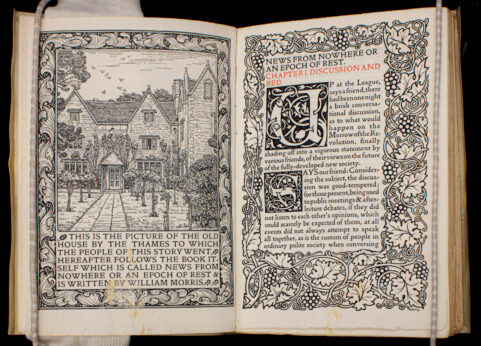
The joy in work is economically grounded: here, production is for use. “Nothing can be made except for genuine use; therefore no inferior goods are made.” Capitalist waste—useless luxury goods and shoddy wares—is eliminated. Without private ownership of the means of production, labor is no longer alienated but becomes creative activity.
Morris’s vision of equality is integrated into the utopia. The women are strong, healthy, and self-confident, working alongside men in the fields or as trained stonemasons. Housework remains predominantly associated with women, but is freed from drudgery and economic dependence. Old Hammond explains the oppression of women as arising from their economic dependence: women had to marry in order to survive. In Nowhere, this necessity falls away; marriage is no longer a legal institution but a free union, motherhood is honored, and material worry about the future of children is eliminated.
Hammond also tells the narrator the story of this transformed society. The revolution was by no means peaceful: it included class conflict, a general strike, the massacre at Trafalgar Square, and civil war— “war from beginning to end; bitter war, till hope and pleasure put an end to it.” The new society emerges through the violent overcoming of the old order. Its happiness is the result of historical struggle.
Morris’s utopia is not a world without suffering. Grief and loss remain, but people no longer live under the “sordid and repellent” constraints of capitalist production. At the center stand freedom, community, craftsmanship, and quality of life. As Morton emphasizes, the strength of the utopia lies less in the persuasiveness of every detail than in its sense of “historical development” and its vision of life in a classless society.
This is also clearly evident on the narrator’s journey up the Thames to Kelmscott, Morris’s home, where his beloved landscape appears freed from the vulgarities of bourgeois profit-seeking. But the narrator cannot stay. Gradually he becomes invisible to his companions; Ellen’s “mournful look” reminds him that he belongs to another time.
Ellen’s farewell gives the dream its political force: the narrator is to return to his own time and “lay stone on stone to the great building of the fellowship of peace and happiness.” The future thus becomes the measure of the present and the driving force of political action. Herein Morris differs from the older utopian tradition: he presents his society as a historically possible future that can emerge from collective struggle.
After Nowhere, Morris did not return to the literary treatment of contemporary class struggles on anything like the same scale; his later prose works lead instead into mythical worlds. The chapter “How the Change Came” remains the only extended depiction of the revolutionary process as a movement of the masses. His aesthetic gaze on the working class of the present remained limited.
Socialism
Morris sharply criticized aspects of the socialist movement: he rejected Hyndman’s authoritarianism, and rejected anarchism as well as parliamentarianism. Reforms such as the eight-hour day were, in his words, “useless,” if they were intended to replace the revolution because they were “but unorganized partial revolts against a vast, wide-spreading, grasping organization.” The ruling class would never relinquish its privileges. Engels respected Morris’ socialist commitment but criticized his political judgment, particularly his initial indulgence toward the anarchist faction of the Socialist League. Thompson is careful to add, however, that this criticism never diminished Engels’ respect for Morris’ commitment.
Morris particularly opposed Bellamy’s vision expressed in his utopia Looking Backward, which he saw as a form of “state communism”— “a huge national centralization, working by a kind of magic for which no one feels himself responsible” – a system in which citizens would be reduced to passive recipients of administrative decrees rather than active participants in shaping their own lives. For Morris, true communism meant decentralization and the dissolution of the state. Art — the joyful, communal making of things well—was not a luxury but an essential expression and instrument of human happiness. Where Bellamy imagined a perfected Boston, Morris imagined a decentralized, art-filled fellowship in which work is “the highest bliss” and the antithesis between town and country is dissolved. Without “pleasure in the work itself,” Morris argued, there could be no communism. Morris’s understanding of Marx’s historical materialism was filtered through Ruskin’s moral critique of industrial capitalism and his own aesthetic sensibilities.
In How I Became a Socialist (1894), Morris reflects on this path. He describes how he, at first “blankly ignorant of economics,” became a critic of civilization through the study of history and his love of art. He read Marx only later and struggled through the “pure economics” of Capital. His conviction grew above all from the immediate experience of the ugliness and injustice of Victorian society and from the insight that another society was possible. “Metaphysics and religion, as well as scientific analysis,” concerned him little, yet he was filled with “a deep love of the earth and the life on it.”
Artistic practice
For Morris, the workshop was a laboratory of socialist practice. Thompson notes, Morris & Co. was founded as a deliberate attempt to “make pleasurable and creative labor” — to restore the conditions of artistic production that capitalism had destroyed. In the Merton Abbey works, Morris organized production on principles that anticipated the communist society he envisioned: wages were raised to the highest the product could bear, piece-work replaced time-work wherever possible so that workers controlled their own pace, gardens were allotted to the craftsmen, and the distinction between designer and executor was systematically blurred.
He insisted that the person who counted the threads should do the greater part of the drawing; he trained apprentices on the assumption that “any intelligent lad had the makings of an artist and craftsman in him.” Thompson records that “no one having worked for Mr. Morris would willingly have joined any other workshop” — because he refused to be an employer at all in the capitalist sense. His wallpapers, textiles, and books were not “beautiful commodities” but the visible evidence of a mode of production that prefigured the abolition of the wage-system. The Firm was, in Thompson’s words, a “practical experiment” in the socialist organization of labor, conducted within the shell of capitalism and against it.
Morris expresses his conviction that work was the essential means by which human beings develop their capacities and transform their world. His patterns embody this conviction: their organic growth—the intertwining of leaf and stem, the sense of abundance and variety—is a deliberate counter to both the utilitarian starvation of the senses and the stunting effects of industrial labor. To make a pattern that grows like nature is to assert that human labor, too, should be free and organic rather than mechanized and dead.
Morris’s “deep love of the earth and the life on it” pervades his entire work: What makes life worth living? His answer links social and aesthetic concerns. In A Dream of John Ball, community and freedom arise from the struggle of working people; in News from Nowhere, they become the foundations of a society in which work brings joy and things are made with care. His critique of “waste and greed” gives this vision an ecological dimension. Both dream visions ultimately ask under what social conditions human beings can work freely, live communally, and find joy in the beauty and usefulness of their world—and how such a society can be realized.
No paywalls at People’s World
We hope you appreciated this article. At People’s World, we believe news and information should be free and accessible to all, but we need your help. Our journalism is free of corporate influence and paywalls because we are totally reader-supported. Only you, our readers and supporters, make this possible. If you enjoy reading People’s World and the stories we bring you, please support our work by donating or becoming a monthly sustainer today. Thank you!
CONTRIBUTOR