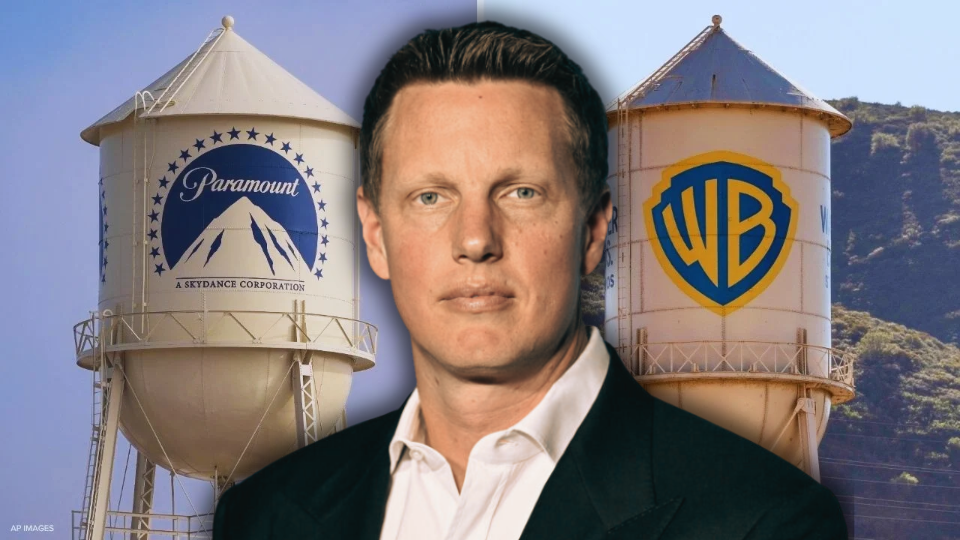
LOS ANGELES—“In years to come, we’ll be able to point to this failure to put consumers over the monied interests of corporate consolidation as the tipping-point moment for media in this country.”
Those were the stark words from the Block the Merger coalition after Judge Martínez-Olguín removed the last roadblock to the Paramount Skydance-Warner Bros. Discovery merger. On Oct. 6, the $110 billion+ merger closed, creating what is now Skydance Corp. Billionaire CEO David Ellison will now control an estimated 17 media entities, including CNN and CBS.
Although many opposed to the merger vow to keep fighting, a dark cloud looms over Hollywood as the newly formed monopoly could cost some 4,500 film and TV jobs in L.A. alone over the next three years.
As previously reported in July, California led a coalition of states to court to stop what they considered a disastrous move for entertainment workers and consumers. A day later, the Writers Guild of America West and the Writers Guild of America East joined, alleging the merger violated federal antitrust law and would specifically harm writers.
Unions and artists spoke out strongly against the consolidation, saying it would mean fewer jobs, less competition, and less diversity. At the time of the suit, California Attorney General Rob Bonta expressed concern about one company controlling so much of the corporate press, asserting, “Combining cable news channels would mean fewer journalists informing our electorate and fewer opportunities for Americans to hear the full breadth of information and opinions on a subject.”
This sentiment carried extra weight given David Ellison and his father Larry Ellison’s close ties to President Donald Trump. The Trump administration has been seen as waging a war on journalism over the years, peaking recently with the president’s attempt to ban several press outlets (including CNN) from White House coverage. Trump’s head of the Department of War, Pete Hegseth, hinted at this closeness at a press conference, saying, “The sooner David Ellison takes over that network [CNN], the better.”
And while the coalition of states’ suit seemed strong, Bonta appeared to buckle when Ellison threatened to have the studios leave California completely. With public support from Gov. Gavin Newsom, the two parties entered talks to settle outside of court.
The settlement includes:
An Annual Film Release Commitment: Paramount has agreed to a five-year term, where the merged company will commit to release:
- 30 films a year—including 20 wide releases—in the first two years.
- 32 films a year—with 21 wide releases—in years three, four, and five.
- Paramount commits to release at least four independent films in each year of the commitment period.
It was stated that if Paramount fails to meet this output requirement in any year, the company will be required to divest Miramax Studios and pay $30 million per missed film toward the healthcare and retirement trust funds associated with the Writers Guild of America (WGA), International Alliance of Theatrical Stage Employees (IATSE), Directors Guild of America (DGA), International Brotherhood of Teamsters (IBT), and other unions, and to the National Association of Attorneys General (NAAG) for more antitrust enforcement.
Domestic Production: Paramount agreed to bolster the merged company’s U.S. film production and spend at least an additional $1.5 billion over five years over its 2025 U.S. spending levels.
Independent Film Fund: The merged company agreed to form and operate a fund to purchase independent films and will make an annual contribution of $5 million, for a total of $25 million.
Protections for Workers: The merged company will commit $47.5 million over five years to a Workforce Fund for training and career development for workers displaced by the merger. The merged company must also honor previously established collective bargaining agreements and bargain in good faith with unions in years to come.
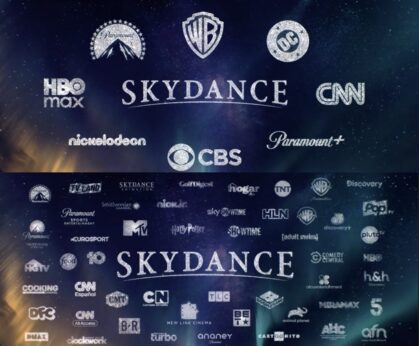
Independent News Editorial Board: The company agrees to a News Editorial Independence Board to help CNN and CBS maintain editorial independence.
Ongoing Monitoring: The company also agreed to appoint an independent monitor to oversee its compliance with this agreement.
While some union leaders, such as IATSE International President Matthew D. Loeb, DGA National Executive Director Russell Hollander, and IBT General President Sean M. O’Brien, have publicly thanked AG Bonta for the settlement, opponents of the merger call the concessions toothless.
That’s because they only push for behavioral remedies instead of structural ones. In antitrust law, structural remedies call for breaking up a company to prevent a monopoly. For example, it could require Paramount to sell specific assets to a competitor to keep the market balanced.
Behavioral remedies allow the company to stay intact, require more oversight, and often—as experts point out—allow companies to find loopholes, making rules difficult and expensive for the government to enforce over time. As former Federal Trade Commission (FTC) Chair Lina Khan explained regarding the merger, behavioral remedies routinely fail.
WGA, which the L.A. Times reports was largely left out of negotiations despite its own suit against the merger, said in a statement, “We continue to believe the merger will cause damage to writers and the industry at large.” Acknowledging that without the backing of the government and the coalition of states, the union noted further that “as a nonprofit, the WGA must contend with the reality of forging ahead alone, with no backing from government enforcers, with a complex antitrust lawsuit that would cost millions of dollars to pursue through trial.”
One concession the WGA did gain was an agreement from Paramount to prohibit writer layoffs at CBS News Broadcast for five years and to pay $17.5 million to the WGA health fund, along with attorneys’ fees in the litigation.
But that prohibition on layoffs at CBS News Broadcast won’t save the estimated 4,500 jobs that may soon be on the chopping block.
As Variety reported, Ellison and Skydance Corp. Co-CEO Ynon Kreiz sent a memo to employees on the day the deal closed, saying layoffs will be part of the process and that “integrating two companies will bring change, including difficult decisions that affect our workforce.”
And while the memo went on to make a lofty statement that “we must never lose sight of what matters most: our people,” with Ellison hiring more multi-millionaires to be in new leadership positions amid talk of laying off the everyday working people who have made up the companies, the sentiment rings hollow for many.
Sen. Cory Booker, ranking member of the Senate Judiciary Subcommittee on Antitrust, Competition Policy, and Consumer Rights, condemned the merger, stating that the Trump administration “picked a winner from the outset and cleared its path.” Booker went on to say, “The workers, artists, and moviegoers…pay the price when studios consolidate, and creative expression…disappears when fewer companies decide what gets made. Past entertainment mergers brought layoffs, shelved projects, and higher prices.”
Sen. Elizabeth Warren, longtime advocate of strong antitrust legislation and regulation, asserted, “Allowing one Trump-aligned, foreign-owned conglomerate to dominate American news and entertainment is a disastrous outcome. After the Trump administration ran an apparently corrupt antitrust review process to wave through a blatantly illegal merger, this settlement greenlights an anti-monopoly disaster that will result in higher prices and fewer jobs, and enables a handful of billionaires to call the shots in the American media.”
The consolidation Warren and Booker describe has been growing in U.S. media and other industries for decades. In 1983, fifty companies owned 90% of all U.S. media. As of last year, that ownership had dwindled to the “Big 6,” which included Warner Bros. Now, with this mega merger, it will be a mere five. One could argue it reflects the larger phenomenon of a majority of the wealth in the United States—and the world over—being concentrated in the hands of a few. Economic reports in recent years noted that the richest one percent have more wealth than the bottom 95 percent of the world’s population put together.
Despite what appears to be a done deal and Ellison carrying on with building what the corporate press calls a media “empire,” many who fought the mega merger vow to keep fighting.
The WGA stated that “though we were not successful in blocking the merger, our advocacy brought more attention to the harms that this merger—and others like it—will cause. We will continue to fight the harms of industry consolidation.”
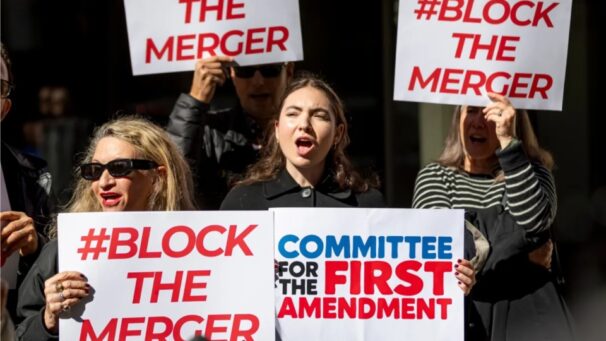
The Block the Merger coalition, led by political activist and movie star Jane Fonda, proclaimed that “the ripples of this merger will be far-reaching, long-lasting, and impossible to contain” but said the silver lining was that people were now “wide awake and paying attention.”
“We are going to build on this movement to stand united as creatives, policy experts, and public advocates to achieve enduring media policy change that funds and diversifies our media and safeguards its independence. We are going to ensure the government protects the interests of everyday people and prevents them from continuing to be bulldozed for those of oligarch billionaires. We are going to continue the fight.”
No paywalls at People’s World
We hope you appreciated this article. At People’s World, we believe news and information should be free and accessible to all, but we need your help. Our journalism is free of corporate influence and paywalls because we are totally reader-supported. Only you, our readers and supporters, make this possible. If you enjoy reading People’s World and the stories we bring you, please support our work by donating or becoming a monthly sustainer today. Thank you!
CONTRIBUTOR