

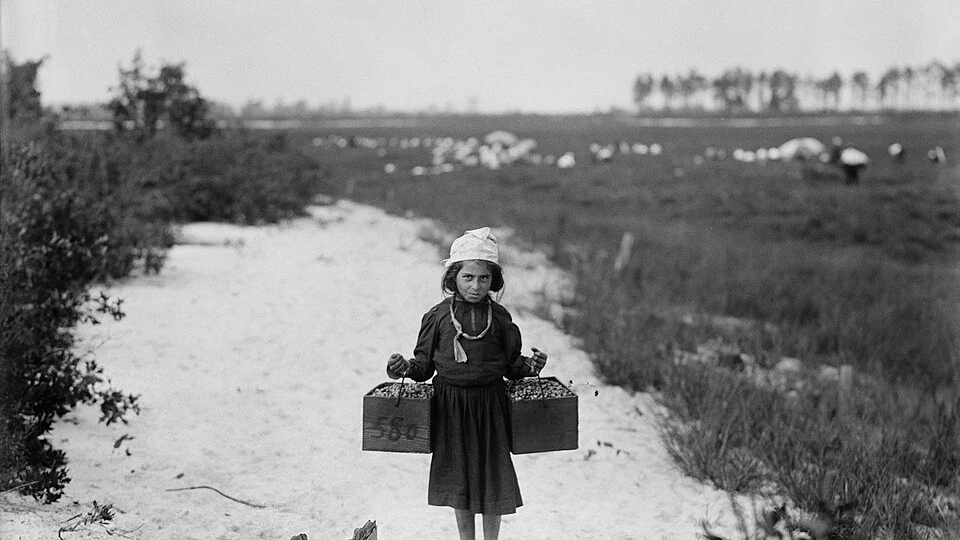
WASHINGTON—Ending child labor worldwide is both a moral imperative and would be an economic boon, says Nobel Peace Prize co-winner Kailash Satyarthi. But though his worldwide campaign against that exploitation has helped cut the number of child laborers around the globe almost in half over the last decade, it’s also run up against both right-wing governments and the profit motive.
The way to overcome that opposition, Satyarthi adds, is for a mass movement to hit the streets and save the world’s kids. Indeed, a film of Satyarthi shown at an October 5 forum on child labor features him speaking to just such a mass movement, in his native India.
The glimmer of hope Satyarthi provided is that there were an estimated 250 million child laborers, most of them in developing nations, a little more than a decade ago, and there are 138 million now, he told the forum, organized by the labor-backed National Consumers League. The league has campaigned against child labor since 1899.
But what Satyarthi did not say is that U.S. child labor enforcement has gone backward, according to the AFL-CIO’s annual Death On The Job report. The retreat has hit children from both the GOP Donald Trump regime and in the states, notably Iowa.
Satyarthi, then 60, shared the 2014 Nobel Peace Prize with the more well-known Malala Yousafzai, then 17, from neighboring Pakistan. Both share the same goal: To free the world’s children from corporate exploitation and to open up and improve their education—moves which will benefit both the children and the world in the long run.
Malala, known worldwide by her first name, concentrates on getting the kids, especially girls, to go to and remain in school, even if their families need them to work, and on finding ways to help families so the kids don’t have to work. Satyarthi concentrates on both improving wages and working conditions in developing nations’ farms and factories and getting the children out of them.
“The world has made remarkable progress in the eradication of child labor,” a cause he has championed for decades, Satyarthi told several hundred people at the forum at D.C.’s American University. “But the ugliest truth is that child labor still exists.”
Child labor still exists because of “deep structural problems” in national economies and their systems, “generational discrimination, deep poverty” which forces children to work to augment total family incomes “and a caste system”—and not just in South Asia.
“If even a single child is bought and sold like an animal, how can we call ourselves civilized?”
But despite a worldwide legal commitment to ending child labor, “The sense of moral responsibility, including moral company leadership” on doing so “is missing.”
That’s even though the commitment is often enshrined in national laws—including the 1938 Fair Labor Standards Act in the U.S.—and in two International Labor Organization conventions, which are non-binding compacts nations sign but don’t have to enforce.
In practical terms, the end of child labor is also missing in the U.S., according to the AFL-CIO’s annual Death On The Job report and other information.
For example, the GOP-run Iowa government ended many restrictions on child labor after it took power in the 2010 election. Its latest set of moves, from 2023 through this year, cut penalties for child labor violations and extended working hours for kids as young as 14 to 9 p.m. on school days and 11 p.m. during the summer break, an Internet search showed.
Iowa also now allows those children to work in hazardous occupations such as construction and manufacturing. And Iowa employers don’t need to get work permits for the kids.
And in March 2026, Illinois Attorney General Kwame Raoul (D) charged a McDonald’s restaurant in the Chicago suburb of Lockport, Ill., with 550 violations of the state’s child labor law over many years, the Chicago Tribune reported. The eatery employed 26 14- and 15-year-olds without getting them work permits. It had them toil for excessive hours and without rest or meal breaks, and imposed all that during the school year.
Going into the past, retired AFL-CIO Executive Vice President Linda Chavez-Thompson often recalled her experience picking cotton in the fields of South Texas at the age of 10. Like in South Asia, she did so to help boost family income.
Fast forward to the present: Sally Greenberg, the National Consumer League’s CEO, told the conference her organization will release a report in mid-October grading each U.S. state on child labor conditions, on an A-to-F scale. No state got an “A” and 24 states flunked, she said.
Death On The Job also fleshed out the U.S. aspect of Satyarthi’s criticism. “Workers ages 15-24 have higher rates of work-related injuries than adults ages 25-44 years,” the federation reported, using federal job safety, injury and death data.
The on-the-job death rate for workers aged 16-17 “increased from 1.3 per 100,000 workers in 2022 to 1.9 in 2023 to 2.7 in 2024, and their rate in 2024 was nearly twice their rate in 2020.” In 2024, 37 workers aged under 18 died on the job, up from 23 the year before, it added.
“Young workers are often at elevated risk due to limited or no prior work experience, lack of workplace safety and health training and supervision, and limitations in strength or cognitive ability needed to perform certain tasks. They are also less likely to recognize and voice safety concerns or be aware of their legal protection and worker protection agencies,” the report elaborated.
Tim Ryan, a former employee at the AFL-CIO’s Solidarity Center–whose workers help foreign workers unionize and defend their rights–added another problem afflicting child labor: Supply chains.
Western companies, especially in carpets, clothes, and textiles, import the overwhelming majority of their goods from low-wage nations, such as China, India, and Pakistan. The Western firms depend on suppliers there and shippers from there. And they rarely monitor working conditions—for kids and anyone else–at the suppliers.
Until, that is, a disaster occurs, such as the Rana Plaza textile factory collapse in Bangladesh in 2013. The multistory building, not built to a then-lax building code, crashed to the ground, killing 1,000 workers. Most were women and children.
“Key actions in supply chains can be taken by non-governmental organizations and unions,” said Ryan. They include forcing the suppliers to pay workers “a living wage,” so kids don’t have to work.
And governments, under national and international pressure, can enact and enforce building codes.
“The International Labor Organization is bringing together an alliance for national action in each country,” which supplies the goods child workers now create, Ryan added. “First plans, and policy and then action” to enforce them. One part of policy: A ban on child labor trafficking by 2029. “There will be standards, conventions and guardrails and support for the workers,” he elaborated.
That’s also where governments can get involved, by laws and enforcement of protections, he said. The European Union has begun, with legislation aimed at the ultimate sellers of child-made goods—the Western firms—if they sell at least 150 million Euros’ ($168.2 million) worth in a year.
The GOP Donald Trump regime’s de facto 2024 campaign platform—the Heritage Foundation’s Project 2025 manifesto—agrees, from a nationalist perspective. Trump’s government doesn’t.
Project 2025 says the Labor Department’s Bureau of International Labor Affairs should investigate and crack down on nations and supply chains that exploit child and forced labor and use those goods to undercut U.S. workers, their wages, and even their worker rights on the job. But Trump had trillionaire Elon Musk’s so-called Department of Government Efficiency try to abolish the bureau.
There’s still another way to force an end to the use of child labor and forced labor, said Jon Jacoby, CEO of GoodWeave International, a global non-profit dedicated to ending forced labor and child labor in supply chains: Make it unprofitable for Western companies. Jacoby stated 28 million adults worldwide toil in forced labor.
Advocacy in the streets and advice to governments often isn’t enough to move firms to end child labor, Jacoby said. You have to raise enough awareness to make corporations realize their reputations—and their profits—are at stake unless they mandate suppliers end the use of child and forced labor.
“You can’t just cut and run,” Jacoby said. “You also have to institute prevention” by ensuring children go to school, not to work, “and do right by all workers by raising their wages.”
No paywalls at People’s World
We hope you appreciated this article. At People’s World, we believe news and information should be free and accessible to all, but we need your help. Our journalism is free of corporate influence and paywalls because we are totally reader-supported. Only you, our readers and supporters, make this possible. If you enjoy reading People’s World and the stories we bring you, please support our work by donating or becoming a monthly sustainer today. Thank you!
CONTRIBUTOR



MOST POPULAR TODAY

Credible sources say Trump readies to steal the midterm elections

Leonard Peltier, longest serving U.S. political prisoner, should be free

Dark day for Hollywood labor: Paramount-Warner Bros. mega merger approved

How the bad science of AI doomerism is good for big business

Controversial ‘God made Trump’ campaign ad produces bipartisan uproar