DELHI—The United States isn’t the only country where a right-wing government is working overtime to purge the voter rolls to fend off a loss at the polls. After initiating what was called a “Special Intensive Revision” (SIR) of voter registrations in 2025, the Election Commission of India moved to strip over 130 million people of their right to vote.
Mass protests, organized by democratic forces ranging from the youth protest Cockroach Janta Party to left parties like Communist Party of India (Marxist), have stepped up to resist the ruling, facing illegal police brutality and state crackdowns as they demand the restoration of voter registrations.
The Election Commission’s decision disproportionately targeted Muslim and ethnic minority populations—constituencies which often vote against the ruling far-right Bharatiya Janata Party (BJP), led by Prime Minister Narendra Modi.
The attack echoes the U.S. Republican Party’s strategy of voter purges targeting Black, Latino, Native American, and other minority voters. The Modi government continues to work closely with far-right allies in the United States and Israel, exchanging ideas on how to maintain power. In 2025, Modi joined President Donald Trump for a press briefing in which he declared his support for the MAGA movement and called for a “MEGA” bilateral partnership between the two governments.
In response to the unfolding crisis, the left opposition in India has demanded the full restoration of voting rights and the resignation of Chief Election Commissioner Gyanesh Kumar. Hundreds of thousands have rallied in defense of democratic rights across the country, while police have detained more than 7,000 protesters—including CPI(M) General Secretary M.A. Baby and most of the party’s national leadership, who were arrested on Oct. 10.
The ascending extreme right
The BJP, the primary force of the Hindutva (Hindu nationalist) movement, has led the federal government in India since 2014. Its path to power ran through its close links to the Rashtriya Swayamsevak Sangh (RSS), a far-right paramilitary organization with historic ties to Nazi fascism, and the Vishva Hindu Parishad (VHP), its international fundraising wing.
In coordination with the RSS, the BJP has sanctioned political repression and communal violence against Muslims and other ethnic and religious minorities. The 2002 Gujarat pogrom, in which the BJP state government conspired with violent mobs to kill thousands of Muslims, was a key inflection point in Modi’s rise to power.

In recent years, the BJP and its allies have leveraged a wide range of violent, illegal, and corrupt methods to take over state governments from other parties. Even when the party has lost elections, it has found ways to buy off legislators of other parties, cobbling together majority governments through graft and backroom dealings.
The BJP’s victory in West Bengal’s 2026 legislative election was underpinned by an earlier stage of the SIR process, which delisted more than nine million registered voters. The election ousted the Trinamool Congress and led to the first BJP government in the history of the state—15 years after the Trinamool Congress ousted the CPI(M) legislative majority which had governed the state since 1977.
As of October 2026, the BJP governs in 22 of India’s 31 states and union territories.
Progressive opposition
Though the BJP has continued to gain ground in state elections, the Modi government has faced headwinds from a massive opposition coalition, organized across the country in the factories, streets, and fields, and at the ballot box. A movement led by peasants and farmers in the All-India Kisan Sabha (AIKS, the CPI(M)’s peasant wing) reversed a set of regressive agrarian reforms in 2021 after hundreds of thousands marched and occupied public spaces in Haryana and other states.

Brinda Karat, a member of the CPI(M) Politburo and leader in the All-India Democratic Women’s Federation, identified the geographic proximity of the protests to the federal capital as part of their power.
“In the surrounding states of New Delhi in 2021 and 2022, we led the successful Kisan or Farmer’s Movement protests, which blanketed [the region],” she said. She emphasized that the defeat of the reforms was a key turning point in the broader struggle against the BJP, one which confronted “ever-greater dispossession by the state.”
RELATED STORIES:
> Indian police attack ‘Cockroach’ marchers as youth unemployment revolt hits parliament
> Left Front swept from power in India’s Keralam state, ending Communist governance
> Lesson from India farmers’ victory: United mass struggle can win
In the lead-up to the 2024 federal election, a diverse coalition of dozens of opposition parties, including the left parties, the centrist Congress Party, and others, joined together as the Indian National Development Inclusive Alliance (INDIA) electoral bloc. Though it fell short of unseating Modi and the BJP from government, it denied the BJP an outright majority for the first time since 2019, forcing the party to turn to its coalition partners to keep Modi in power.
In 2026, the Cockroach Janta Party has emerged as a new force powered by youth and students, working with the Student Federation of India (SFI, the CPI(M)’s student wing) and other progressive organizations to challenge the BJP’s economic and education policies. Taking its name from the derisive comments of Chief Justice Surya Kant, who called unemployed and underemployed young people “cockroaches,” the party has channeled a new wave of youth to the streets.
After a series of scandals around the national standardized testing and post-secondary entrance examination system, the CJP campaigned for the resignation of Education Minister Dharmendra Pradhan and reforms to the system’s integrity. Though met with violence by Delhi police, it rallied a nationwide solidarity movement and won on both demands, giving a jolt of energy to the opposition.
“The CPI(M) and left parties fully support and join the activists in the CJP who have inspired large numbers of young people who were totally disorganized before this,” Karat said. The unity of the CJP with the SFI and other sections of the organized student movement has proven to be a durable challenge to the BJP, and it has carried the opposition’s momentum.
However, Karat noted a disconnect between different dimensions of the political struggle. “This uprising is a turning point in India, but it also reveals how elections are more and more divorced from social and economic realities,” she said.
“The right wing has learned how to win elections through gerrymandering, patronage, voter disenfranchisement, and other means. At the state assembly level and the local level, they are still winning by-elections, which does not reflect the depth of the struggles in the outcome. We have to translate wide-scale discontent to our electoral contests.”
Escalating repression
As part of its crackdown on the Cockroach Janta, left parties, and other opposition forces, the BJP has leveraged its control of state governments to impose de facto curfews, arbitrarily close public transportation, and ban protests from the federal capital entirely. No government has implemented a blanket ban on demonstrations in New Delhi since “The Emergency,” a state of exception imposed by Indira Gandhi in 1975 in which thousands of CPI(M) leaders and affiliates were kidnapped, tortured, and murdered by state forces.

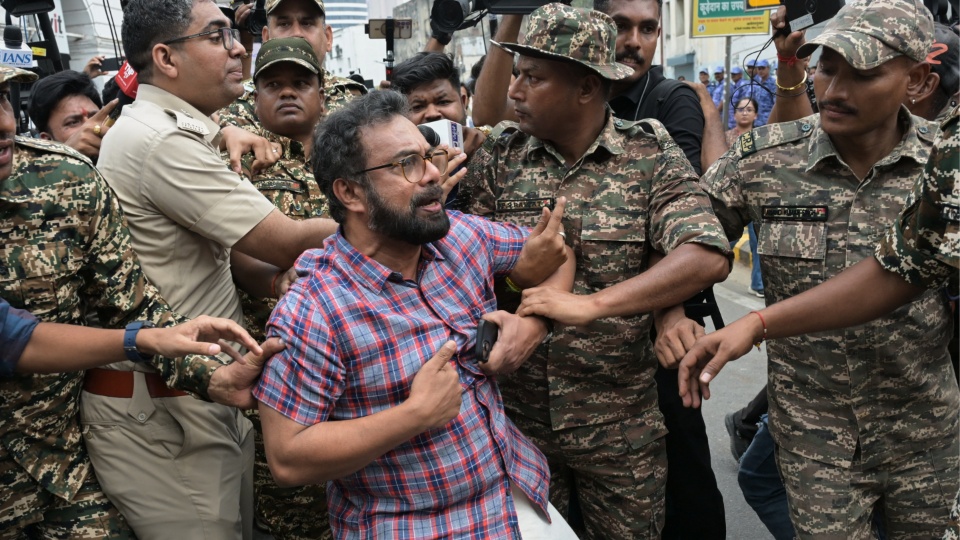
The BJP’s measures have reached an unprecedented scale of brutality within the past week, as thousands of members of CJP, CPI(M), and other parties have been arrested for participating in the protests. Though the demonstrations are nationwide, the mobilization of Delhi police has been especially extensive, with more than 40,000 officers cramming into a two-mile radius around Jantar Mantar, a historic site for demonstrations and the center of the CJP’s successful education protests months before.
CPI(M) leader John Brittas was hospitalized after he was attacked by police. While some journalists and political leaders—including all members of CPI(M) national leadership—were later released, leaders of the CJP remain jailed.
The wave of democratic opposition to the Election Commission’s anti-democratic maneuvers has seen the broad participation and leadership of women, who have faced targeted violence by Delhi Police and other state machinery. Participants in the protests have documented systematic sexual harassment by police, as part of an effort to intimidate women out of joining the demonstrations.
Though the repression has intensified, it has also galvanized the opposition and illustrated the BJP’s weakness to democratic movements on multiple fronts. Its de-registration of over 130 million voters reveals its fear of losing future elections if they are allowed to vote, while its attempt to ban protests in the capital demonstrates the power of the mobilizations to challenge the government. Meanwhile, both Communist-led and unaffiliated labor unions have signed on to the movement’s demands, circulating them among their millions of members.
Communist parties voice solidarity
The Communist Party USA reacted strongly to the repression of the protests, issuing a statement in support of the CPI(M)’s demands. The statement reiterated the party’s condemnation of the alliance between the Trump and Modi administrations, emphasizing that “the coordination of far-right forces in India and the United States has intensified the scale and severity of [anti-democratic measures] in both countries.”
Communist parties from around the world rallied behind the slogan of “Hands off India’s communists!” Parties in Pakistan, Bangladesh, Greece, Turkey, Britain, and elsewhere offered statements of solidarity with the protests, helping to turn the world’s eyes to a pivotal moment in the global struggle against the extreme right.
No paywalls at People’s World
We hope you appreciated this article. At People’s World, we believe news and information should be free and accessible to all, but we need your help. Our journalism is free of corporate influence and paywalls because we are totally reader-supported. Only you, our readers and supporters, make this possible. If you enjoy reading People’s World and the stories we bring you, please support our work by donating or becoming a monthly sustainer today. Thank you!
CONTRIBUTOR