LOS ANGELES— There is infallibly something indecent about every great fortune. However much we may admire what it may eventually produce—libraries, concert halls, universities, museums, symphony orchestras—we know, or ought to, that the money had an earlier life. Before it became philanthropy it was extraction; before it acquired a marble façade it was copper, oil, railroads, land, bone-crushing labor. The respectable monument is usually the last act of the story.
Liz Brown’s Twilight Man: Love and Ruin in the Shadows of Hollywood and the Clark Empire focuses on the part of that story that doesn’t make it onto the plaque.
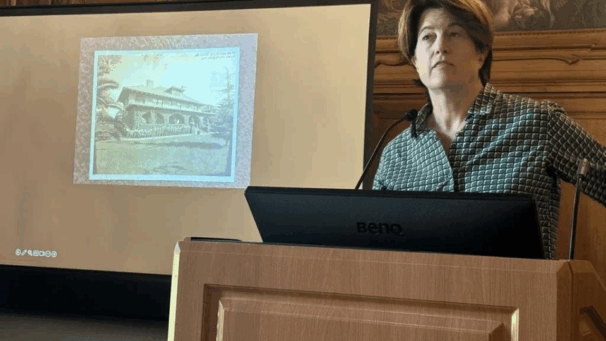
A few weeks ago I received an invitation to visit the William Andrews Clark Memorial Library, a facility belonging to UCLA but housed off-campus—actually closer to the University of Southern California. Ms. Brown joined a group of Los Angeles Philharmonic devotees on a tour of the property, followed by a Q&A with the author.
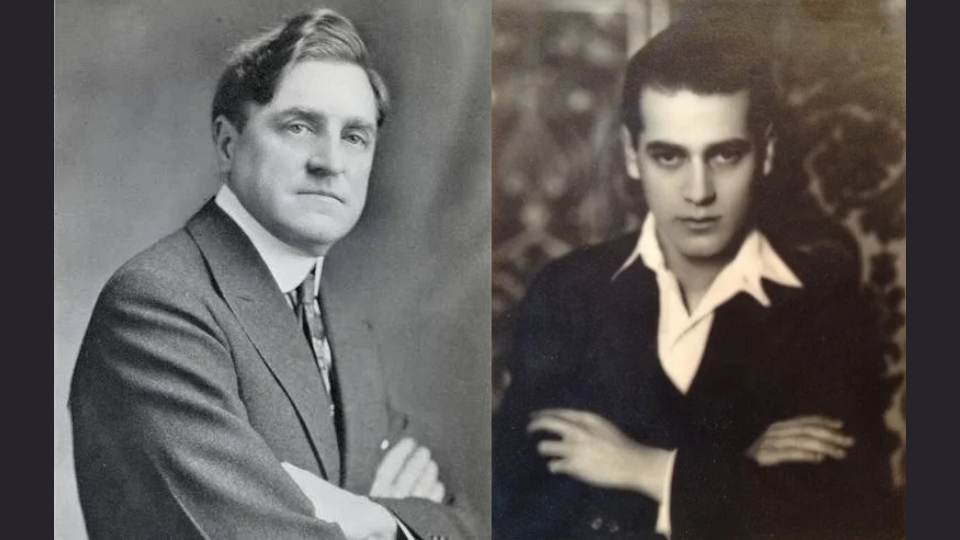
Brown’s book centers on William Andrews Clark Jr. (1877-1934), heir to one of the great American mining fortunes (think Montana copper for starters), and Harrison Post (1896-1946), the younger man who became his secretary, lover and beneficiary. The library, specializing in rare editions, with perhaps the world’s best collection of Oscar Wilde imprints, was created by Clark. It features frescoes of 13 cavorting ancient gods—undraped studs that curiously all look like Clark’s “copain”—his companion or BFF.
Brown, who is herself connected to the Clark family, has not written a conventional biography of either man, but rather an investigation into disappearance: how a person can be central to a family’s intimate history and yet almost vanish from its public record; how money can preserve some lives while erasing others; and how the honorable history of Los Angeles has been constructed by leaving certain kinds of experience in the shadows. Her aesthetic is latter-day noir.
It all starts with a photograph, used as the principal design element for the book cover. Brown discovers a mesmerizing image of Harrison Post among her grandmother’s possessions and, like someone in a detective story who has found the first piece of evidence in a cold case, wants to know who he was. At first she assumes he must have been an actor: He has the face, the clothes, the look of someone who belonged to the Hollywood world of glamour and reinvention. The revelation that he was the lover of her great-uncle opens the door to a much larger and stranger story.
The photograph becomes the book’s governing metaphor. We have the face but not the life. We have the evidence, but not the explanation of intimacy, the surviving image of a man whom history has done its best to forget.
After years of immersion into the mystery of this photograph, Brown uncovers a tale worthy of the most extravagant Hollywood fiction. William Andrews Clark Jr. possessed the enormous inherited wealth of one of America’s copper kings, who managed to purchase his way into the United States Senate representing the state of Montana. The son was also a cultural benefactor of consequence, remembered today for helping establish the Los Angeles Philharmonic and for creating what became the Clark Library. His name survives because institutions have a long memory.
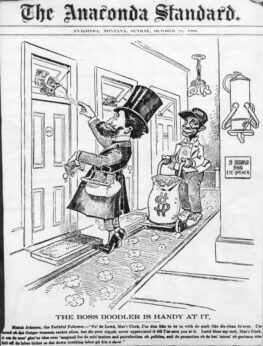
In Twilight Man, Brown fuses the titillating sexual history with economic history. The story she unspools is that of two men whose homosexuality had to remain partially concealed in an era when open acknowledgment could have serious social consequences. But Messrs. Clark and Post did not occupy anything like the same social position. Clark had money, family, property, and status. He could purchase privacy—and Brown details various incidents when substantial payoffs to city authorities and the inquiring press silenced unsavory rumors. Post had to negotiate what could have been the far more dangerous terrain of societal and financial dependency.
In Brown’s portrait of Harrison Post, her protagonist comes across as an elusive, sometimes exasperating figure, capable of manipulation as well as devotion. His life demonstrates the peculiar instability of borrowed privilege. His connection to Clark does not magically provide him with security. Indeed, especially after Clark dies, the more apparent it becomes that intimacy with great wealth is not the same thing as possessing it. His proximity to power is always conditional.
“Though Harrison had seemed at times like a spouse to Will,” writes Brown, “it’s not possible to simply transpose the concept of a monogamous, traditionally heterosexual marriage onto their relationship. They might wear the same ring, they might travel together, but they didn’t live together, and if Buck Mangam was correct about the ‘indescribable orgies,’ their sex lives were not restricted to one another. Likely they had an understanding similar to the one between Wilde and Douglas—that they were each other’s soulmate, but not sole sexual partner. While Harrison might have romances and liaisons with other men, his devotion would never falter. He would never develop the type of bond he had with Will with anyone else” (p. 170).
What makes the Clark family saga especially revealing is the transformation of private wealth into public virtue. Clark Sr. made his fortune in the brutal world of 19th-century mining. Clark Jr. inherited the fortune and gave some of it back to the public in the form of cultural institutions. Thus capitalism becomes culture.
Brown’s book thereby attains a significance larger than the romantic mystery that initially attracts us. Twilight Man asks us to look at the relationship between the private history of a wealthy family and the public institutions that bear its name. What gets preserved? What gets commemorated? Who is worthy of a building?
The Los Angeles setting gives these questions an additional resonance. L.A. has always been a city of reinvention, a place where identity can be manufactured almost as readily as movies and its pampered stars. Post’s life is a succession of roles and relocations, attachments and escapes. A surprising piece of his story involves an ill-timed visit to Norway, where he is forced to survive the years of Nazi occupation, a chapter that scholars of that period would find of special interest.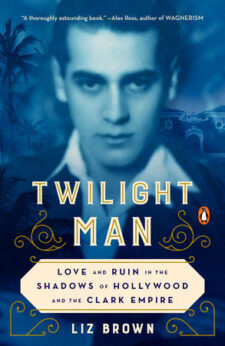
Brown devoted years of research to uncover an abundance of source material—letters, diaries, photographs, financial transactions, family recollections, legal records, newspaper accounts and prison documents. Corralling all this information into a readable book must have been one of her greatest challenges. If we don’t actually gain a grasp on the emotional truths that flowed between the pasha and his pet over the course of many years, we have to remind ourselves that we are dealing with people who never expected us to immerse ourselves in their story. She is reconstructing their lives from traces left behind by people who had powerful reasons not to leave a complete record. And as she is investigating members of her own family, she is not simply asking what happened to Harrison Post, but asking what her family chose to remember, and what it chose to consign to oblivion.
She does something more difficult than recovering a forgotten gay man for the sake of adding another name to the historical roster. She is showing how sexuality, class, and wealth converged in society. The closet was not the same for everyone. Secrecy could be a privilege for those with money. Exposure could be catastrophic for those without it.
To revert to a cliché, the book reads like a novel, reminding us that archives are full of dead people who were once rashly alive. Harrison Post wanted money, respectability, love, and security, in short, access to a world far outclassing the one he’d been born to. He lied, adapted, survived, and recast himself. He was not an archetype, a symbol, a screenwriter’s invention. He was a man.
The William Andrews Clark Memorial Library is located at 2520 Cimarron Street, Los Angeles, CA 90018. For information about visiting or using the library, go to its website.
Liz Brown
Twilight Man: Love and Ruin in the Shadows of Hollywood and the Clark Empire
Penguin Books, 2021, 383 pp.
ISBN: 978-0-14-313290-5
No paywalls at People’s World
We hope you appreciated this article. At People’s World, we believe news and information should be free and accessible to all, but we need your help. Our journalism is free of corporate influence and paywalls because we are totally reader-supported. Only you, our readers and supporters, make this possible. If you enjoy reading People’s World and the stories we bring you, please support our work by donating or becoming a monthly sustainer today. Thank you!
CONTRIBUTOR