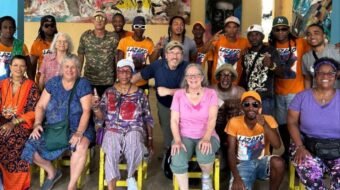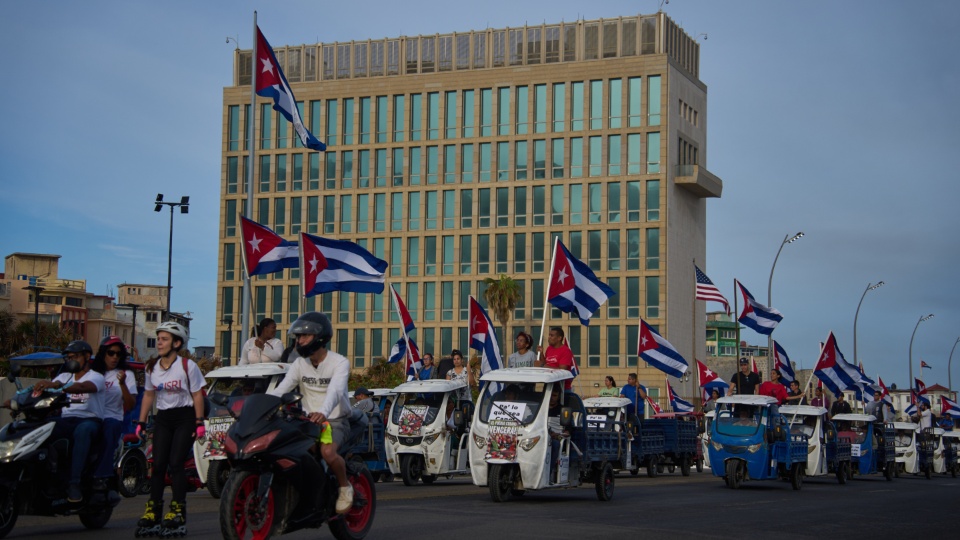
HAVANA—People’s World recently had the opportunity to sit for an exclusive interview with two representatives of the North American Division of the Cuban Institute of Friendship with the Peoples (ICAP) while in Havana in late October.
As delegates squared off on the floor of the United Nations General Assembly in New York over the annual vote to denounce the U.S. blockade, Iram and Edwin took the time to explain to our readers the situation in Cuba as her people enter their tenth month of being starved of all fuel imports by the Trump administration.
They also explained the current economic challenges facing the island, the unique formation of democratic institutions and practice of democracy in Cuba, and how peace activists in the United States might get involved with fighting back against the blockade.
This exclusive interview, more than 90 minutes in its entirety, has been edited for clarity and length. It will be presented in more than one installment. Both participants asked to be identified by their first names because of U.S. scrutiny towards ICAP as part of its latest round of sanctions.
In this first installment, Iram and Edwin discuss fraudulent reports in U.S. media, the effects of the blockade on the Cuban private sector, and the importance of reaching people in the United States directly.
People’s World: We understand that you are very busy right now. Why agree to sit down for this interview to reach the people of the United States?
Iram: Nowadays, it’s even more critical since the recent sanctions are preventing U.S. citizens to directly access Cuba. It’s not as easy to come to Cuba as it used to be before, not as easy to access information about what is going on here, what’s happening here in Cuba.
How we how are we living? How do we keep working? How do we keep trying to build the better kind of society possible? It was easier then because people used to come.

Before Trump’s first term, people used to come all the time, through different kinds of projects, whether it was with ICAP or not. We had a lot of different projects, including sister city projects. We had the brigade projects.
So, there were a lot of us people coming here and experiencing Cuba firsthand. It is not like that anymore. At least, not just right now because people are being threatened not to come here. I think it’s critical having opportunities like this in which we Cubans can share a little bit about how is life being experienced right now under so much pressure coming from the United States government.
Edwin: The traditional media, the traditional press is hiding the fact that the Cuban people are suffering. They are hiding the current situation, the current actions of the U.S. administration against Cuba.
The lack of oil is pushing the Cuban people to make difficult decisions, but they are facing the situation with bravery. We are so proud of that. A mother, a grandfather, teachers, doctors are all going about their lives every day and do their jobs with bravery, and I think that’s something that the traditional media is hiding from the American audience. You have an opportunity to show the reality, the current life of the Cuban people.
Iram: I mean, let’s face it, mainstream Western media has never been friendly to Cuba, with very limited expectations. The truth about Cuba usually gets out through alternative media outlets, but right now, even that is more difficult. So, it’s important to have a space in which we can share a bit about our opinions, ideas, points of view, and our personal experiences.
PW: Speaking of the mainstream U.S. press, since we’ve been in Cuba, there have been two separate articles published about Cuba, one in The Atlantic magazine and another in The Wall Street Journal. The Atlantic article claimed that the state in Cuba has completely collapsed, that there are no police officers or soldiers to be seen, for example. The Wall Street Journal, meanwhile, says that the private sector in Cuba is thriving. Neither mentioned that today is the annual vote at the United Nations where the world denounces the U.S. blockade on Cuba. So, what’s actually going on here?
Iram: Neither of those two points of view are the actual truth, right? Because if you compare your current experience with the ones you had in your previous visits, you will see that despite the fact we are living in harder conditions, the infrastructure is the same. There is the government, there are the authorities, there is law and order. There is a civil society.
I mean, of course since people are having such a hard time you will notice on the streets things you didn’t witness before, right? I can give you examples. People in the street, garbage on the corners, things like that. But we still have an infrastructure that is working,
Actually, we are taking the challenges as an opportunity to reduce bureaucracy, implement new measures in order to boost our economy. Some of the measures might not be as popular…because sometimes they imply, that for some people, life is not going to improve in the short term. But we still have police, we have the Ministry of Foreign Affairs, we have the army.

As for the second article, the perspective that the private sector is doing well is also not completely accurate. As part of our economic opening, of course, the private sector has been granted more capabilities to operate, less paperwork, opportunities to directly import, which is good for them because it should have an impact on the prices of the products and services they provide. But that’s not happening right now.
There have been measures taken to foster the ability of the private sector to operate, hoping that will imply, in the medium and long term, a benefit to our national economy. But the private sector is also actually suffering the impact of the U.S. hostility towards Cuba. Right now, as we speak, there are thousands of containers that were seized by the U.S. with a lot of goods, not only for the Cuban state to distribute among the population, but also those bought by private entrepreneurs with invested money.
This has a serious impact on the private sector’s ability to function and prosper. It’s a matter of trying to impede them from properly functioning because the main goal of the blockade is to strangle our economy so hard that people will choose a different kind of government, choose a change of society. This economic war is accompanied by all other kinds of hostility ,such as media warfare and regime change operations. It’s a whole package.
People might think that it’s only been a year of Trump applying these measures, but that’s not true. We’re talking about the accumulated effect of almost 70 years of a U.S. blockade that has been nothing but enhanced and reinforced during certain periods in the history of our bilateral relationship, including the Torricelli Act in 1992 and the Helms-Burton Act in 1996. And then everything that Trump has added on top.
Economically, speaking in terms of quality of life for everybody living in Cuba, whether you are part of the private sector or a government worker, a retiree, a teacher, or whatever, everyone is suffering the impact of the U.S. economic war against Cuba.
Edwin: I’m thinking about the recent U.S. State Department Office of Foreign Assets Control (OFAC) measures that foreclosed the opportunity for anyone in the Cuban private sector to open a U.S. bank account. The hypocrisy is incredible. For instance, if the Cuban government is so inefficient and not prepared to fulfill all the needs of the Cuban people, why establish new sanctions every week against the Cuban government?
Earlier, I watched the speech of the U.S. representative to the UN. It’s really sad how the international community is watching the situation happen before their eyes and doing nothing.

Every year, the Cuban government presents the UN with a report on the impact of the blockade. These are real studies that you can check on the ground in Cuba; that’s one of the reasons why we invite everyone to come to Cuba to see reality on your own, not through an article in U.S. media.
And then we see the representative of the United States to the UN saying these blatant lies. I can’t even imagine the Minister of Foreign Affairs sitting in the audience in front of the representative of the U.S. while he’s saying these lies. He says that the Cuban government is committing a genocide against the Cuban people. It’s cynical.
The blockade established the most restrictive criminal system of economic measures against a country in the history of the world. And they say it’s not a blockade, that it’s an “embargo,” or they stay it’s “sanctions.” It’s not sanctions. Sanctions are part of international law, but the measures taken against Cuba by the U.S. every day, every week, every year against Cuba is a crime.
As the president of ICAP said earlier, it’s an act of war that we are facing today. Maybe that’s the reason why some people say that Cuba is a Gaza without bombs. Maybe that’s true. It’s really sad to see what is going on in Cuba and Gaza. And the international community is only going to the UN, maybe voting against these crimes. Cuba and the world require more extraordinary efforts to face and fight this expression of colonialism, imperialism, and even worse crimes.
PW: In your view, what is the real purpose of what Marco Rubio and the Trump administration are doing to Cuba right now?
Iram: When facing that question, we always tell people to go look at Lester Malloy’s memo from 1960. He was Deputy Assistant Secretary of State and wrote a memo to his superior, which I am going to paraphrase because I don’t know it by heart, but it basically said that the majority of the Cuban people support Fidel Castro. In order to change that, the U.S. needs to make the Cuban people’s lives so miserable that they will choose to overthrow the government.
This memo was secret for a long time, but it’s the core essence that has led U.S. policy towards Cuba since the triumph of the Cuban Revolution.
And that’s what they’re trying to do right now, look for every small gap that is left in sanctions policy and try to close it. During Obama’s last two years, we had a reopening of our embassies. We moved forward to improve relationships, but that didn’t mean that they changed their goals.
They were just trying to do it in a different way: Loosen up some of the measures of the blockade, increase prosperity for the people and the private sector. It was very different if you came here in 2017 to 2019 because more U.S. citizens were tourists here. They didn’t threaten other countries for participating in our tourism sector, like they’re doing now.
Now they’ve torn all that down and go even further. President Trump acknowledged it himself; he said that all that’s left is to bomb Cuba.
Ever since the 1990s, the United States has bet on the private sector being the agent of change in Cuba. That’s where the rhetoric comes from for Cuba to open up, free economic forces, etc. And so, that’s what we did a few years ago.
At first, the U.S. thought, well this is our opportunity. They even took a delegation of Cuban entrepreneurs to the United States as a sort of training trip. They let them open accounts in the U.S. They had an interview with a Cuban living in the United States, a very well-known counterrevolutionary and terrorist, from the days of Posada Carilles, and he said that they would work the private sector in Cuba, that this was the angle they were going to have.
But if you ask me, it backfired. I’m not going to say that every private entrepreneur in Cuba is worried about improving the national economy and society, but many of them are people who have a community impact on their local level. They support housing for kids with no family support, shelters for the elderly. This is a kind of community work coming from private businesses.
So, it sort of backfired, because the U.S. was betting on these guys and they’re not doing what they wanted them to do. So now, the U.S. is trying to turn them against the rest of the country. The private sector either needs to rebel [against the Cuban government] or die.
PW: The Wall Street Journal admitted that some of the Cuban entrepreneurs interviewed expressed anxiety about being eaten up by larger capitalist interests in Miami, by big U.S. capitalist interests, large corporations.
Iram: That would only happen if the political, social, and economic project we have now, the Cuban Revolution, falls apart. Because otherwise, I wouldn’t think that big corporations would get here to take over anything, right?
Some Cubans have friends and family in the private sector, and for many of them, the aim is staying in Cuba, building themselves up of course, making their own lives better, but also trying to give back to others.
Because, let’s face it, if you can become a successful entrepreneur in Cuba, it’s because you have the means. But the knowledge is because of what you learn. And in Cuba, you are born and go through kindergarten to post-graduate studies without paying a cent. Having no debt. Owning your own house. So, you have the means and the knowledge and the people. Some people feel happy and fulfilled giving back, some of them don’t, but many of them do.
And, of course, they don’t want big corporations like McDonald’s coming in and taking over the place. Also, many of the private initiatives have eco-friendly standards, and big corporations don’t have those.
Anyway, you would have to go out to interview a large swath of private entrepreneurs, but you would find all sorts of opinions. You will find some who are committed, who say they want to stay, that this is their home, that they want to make it a better place.
PW: Speaking of the future, Edwin, we don’t want to ask you to speak for all Cuban youth, but could you share what the future for Cuba looks like from where you’re sitting?
Edwin: It’s a really hard future, but I also have the conviction that we don’t ever give up. That’s not an option, and I think it’s important to say that. Maybe next year will be worse.
Unfortunately, the blockade may be harder than today. Maybe restrictions on international trade will be worse than they are today.
But the Cuban youth, the Cuban people are a revolutionary people. We don’t give up.
No paywalls at People’s World
We hope you appreciated this article. At People’s World, we believe news and information should be free and accessible to all, but we need your help. Our journalism is free of corporate influence and paywalls because we are totally reader-supported. Only you, our readers and supporters, make this possible. If you enjoy reading People’s World and the stories we bring you, please support our work by donating or becoming a monthly sustainer today. Thank you!
CONTRIBUTOR