WASHINGTON —U.S. voters are fed up with Donald Trump’s corruption, congressional refusal to tackle their problems, and the undue influence of both Trump’s MAGA movement and the power of the nation’s billionaires. The panelists at the Brennan Center event here yesterday said voters are demanding action on a wide range of issues including health care reform, the war in Iran and the crippling high prices people have to pay for food and fuel.
And if they don’t get it in the 120th Congress, which starts January 3, or at least if the new Democratic majority on Capitol Hill doesn’t tackle those problems despite threatened constant vetoes from the right-wing GOP president, those new lawmakers may be voted out, too, the panelists said.
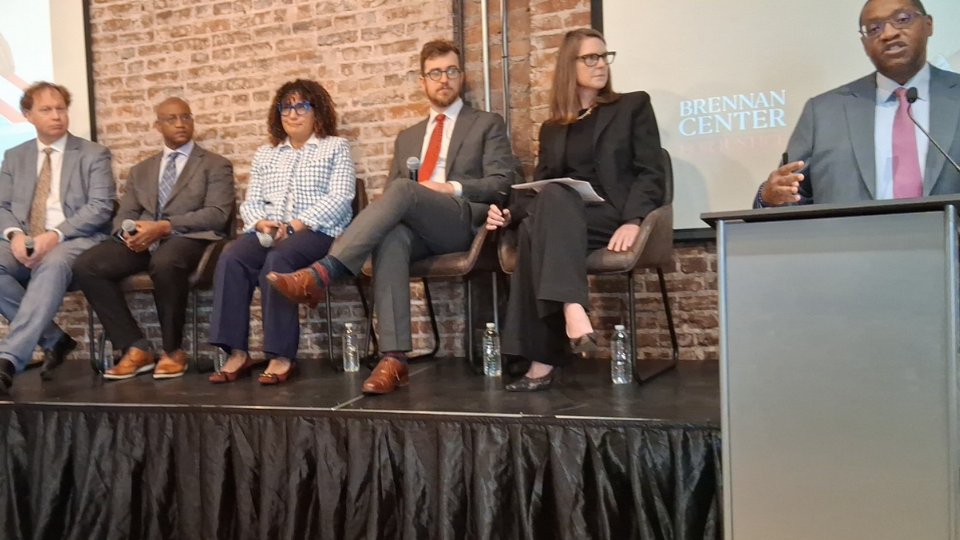
The speakers, in two panels convened over four hours by the Brennan Center for Law and Justice of New York University, along with the Howard University Law School, offered those observations before a capacity crowd of more than 100 people in a meeting room in downtown D.C., plus hundreds more watching on Zoom.
Panelists were clear that the 2026 Democratic landslide—which all but one said they did not realize was looming—was “a repudiation of MAGA” and of Trump, as Brennan Center analyst Kevin Morris put it.
But voters also understand that “corruption is a structural issue,” even if politicians don’t, warned Daniel Weinger of the Brennan Center, who moderated a second Brennan Center panel that took place in the same room. “The polls say most Americans want the government to be fair to everyone,” he said, and not favoring the rich—such as Trump, who’s earned $2 billion while in office–or corporations and elites.
“The key is solidarity” among the anti-MAGA, anti-Trump forces, said Sekou Franklin, director of the John Lewis Institute of Politics and Elections at Fisk University in Nashville, Tenn. “It beat a very powerful right-wing fascist force,” he said about the outpouring to the polls.
In Michigan, national leaders came out to support progressive Dr. Abdul El-Sayed, the Democratic nominee for an open U.S. Senate seat, Franklin said. “Barack Obama, Kamala Harris and old establishment guy (Rep.) Jim Clyburn,” D-S.C., plus Sen. Bernie Sanders, Ind-Vt.
“El-Sayed won despite being heavily outspent—four-to-one—by right-wing dark money whose backers were angry over his support for the Palestinian cause, against Trump’s war on Iran and for Medicare For All,” Franklin added.
The numbers prove that case. As of 12:01 a.m. on November 10, a week after Election Day, the Senate had shifted from 53-45 Republican with two independents, to 54-44 Democratic with two independents and with Democrats leading narrowly in normally Republican Alaska and Mississippi.
The rout in the U.S. House was even more complete. Going into the voting, the Republicans led 218-214 with one GOP-leaning independent and two vacancies. The count is now 252-158 Democratic, with 25 seats still left to be counted. Republicans had held 20 of them. Democrats flipped 44 seats—including races in areas they hadn’t won in decades—while the GOP flipped two.
The House switch is the largest in decades, and panelists warned the two parties must draw lessons from it: The GOP that it must distance itself from Trump and Trumpism and the Democrats that they need achievements, not just investigations, to meet public discontent and consolidate it.
Whether lawmakers will listen is another matter. Just as one example, the first issue the U.S. House tackled when it reconvened November 9 for its “lame-duck” session is a resolution by Rep. Thomas Massie, R-Ky.—a victim of Trump retribution in his party primary early this year—to impeach widely disliked Trump “War” Secretary Pete Hegseth. By congressional rules, a vote on Massie’s move must occur within two days.
“This is a huge repudiation of MAGA, but it’s also an opportunity for Congress to take action, especially in (strengthening) the Voting Rights Act,” said Kevin Morris of the Brennan Center during the first panel. The Supreme Court has essentially completely deregulated U.S. elections, turning control of them over to the billionaires, starting in 1976.
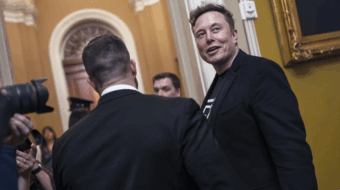
The billionaires, led by trillionaire Elon Musk, plowed record amounts of money, much of it “dark” or hidden, into preserving the GOP Congress. They lost big.
Voters were also emotional about the Trump administration’s “lack of morals, petty disregard for women and rising prices and why there’s a war on Iran,” said Howard University political scientist Keesha Middlemass. “Even in places with [Democratic] losses, there were seismic shifts towards progressives,” in terms of candidates, issues and credibility, added Sekou Franklin, executive director of the John Lewis Center for Elections at Fisk University in Nashville, Tenn.
But it was also a wave that had been building through “years of targeting and voter mobilization,” added Franklin. Other panelists said the obvious example of that was Texas, the nation’s second most-populous state and largest “red” state—until now.
Democrats swept all top Texan offices, and will control the state House. Their top two candidates, James Talarico, a former seminarian, for senator, and Gina Hinojosa, a Latina state legislator, for governor, romped. Both are from the Democrats’ rising progressive wing, panelists said.
Still, “moderates got something out of it, too,” Franklin pointed out, citing wins in other red states such as Iowa, Kansas, Alabama—where the GOP legislature carved up Black Democrat Shomari Figueres’s district but he won anyway—and the real shocker, the Mississippi U.S. Senate race. There, the more votes were counted, the more the margin for District Attorney Scott Colom (D) grew. With 97% of votes counted, he had a 2,500-vote lead.
Ironically, Middlemass noted, incumbent GOP Sen. Cindy Hyde-Smith could have blocked Colom in advance. He was on a commission list for a federal judgeship, and she exerted a home-state veto to nix him. “‘Fine, I’ll run against you,’ he replied,” Middlemass said. Now Colom will likely be Mississippi’s first Black senator since Reconstruction.
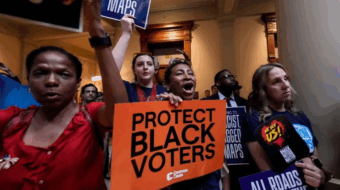
Morris made one other point: Black voters showed up in record numbers in 2026, energized and angered by the Trump regime’s constant attacks on their voting rights. “Twice as many Black voters, relative to whites, showed up compared to two years ago,” in the 2024 presidential election.
The same bigger turnout happened for Latinos, angry and upset at Trump’s white nationalism and brutal ICE raids targeting people, including citizens
“In Starr County, Texas, the most-Latino county in the country—97%-74% of the voters swung left,” Morris said.
Trump also tried to skew the election in advance by ordering red states—led by Texas and Florida—into mid-decade redrawing of congressional district lines, known as gerrymandering. A U.S. Supreme Court ruling from the GOP-named majority in a case from Louisiana aided him. It all backfired, said Brennan Center analyst Peter Miller. He called Trump’s move and the response “a dummymander.”
“Efforts to predetermine the outcome were a bust.”
The one panelist who claimed to have a little bit of foresight of the landslide was Yamiche Alcindor on the second panel. Ordinarily the White House correspondent for NBC News—and target of Trump insults during press conferences—Alcindor spent the last month of the campaign in the Deep South. And it was Mississippi that gave her the clue.
“This is a repudiation of Trump’s policies and Trump himself,” Alcindor said. “In Mississippi, Republicans were saying to me, ‘He’s building a ballroom, and I can’t afford gas,’” noted Alcindor. Trump’s ballroom, at a $1 billion cost, is being erected in defiance of courts, Congress, preservationists, and others. Trump razed the White House East Wing to build it.
“African-Americans” in Mississippi and elsewhere “said, ‘We have suffered enough,’” from years of Jim Crow and from Trump’s white nationalism, Alcindor said. “My mother had to pay a poll tax” to vote, said Alcindor. “I’m dragging the whole family to the polls.”
Panelists offered differing views on what the incoming Congress should do to tackle the nation’s problems, with at least one saying lawmakers should pass “simple” bills—such as pieces of health care reform, which voters can easily grasp.
Alcindor warned the Democrats will contain “lawmakers with different agendas” which the two Democratic leaders will have to balance. “There is part of the (party) base that wants to see revenge politics,” Alcindor said.
“We’ve seen deadlock and gridlock before, and we’ll see it again,” predicted Kyle Whitmore, veteran Capitol correspondent for AL.com, an amalgamation of the Birmingham (Ala.) News and several other papers, now all online in one website. “So go one by one and get things done—and let the other side”—the GOP—“filibuster to take them down.”
“I’ve had people say to me again and again, ‘I want the cost of living to go down so I can afford homes and cars,’” said Alcindor.
No paywalls at People’s World
We hope you appreciated this article. At People’s World, we believe news and information should be free and accessible to all, but we need your help. Our journalism is free of corporate influence and paywalls because we are totally reader-supported. Only you, our readers and supporters, make this possible. If you enjoy reading People’s World and the stories we bring you, please support our work by donating or becoming a monthly sustainer today. Thank you!
CONTRIBUTOR