What began as a decades-long U.S. economic blockade has evolved into an outright state of siege for Cuba. With the Trump administration imposing a total oil chokehold on the country amid a mounting humanitarian crisis, vulnerable lives are being lost.
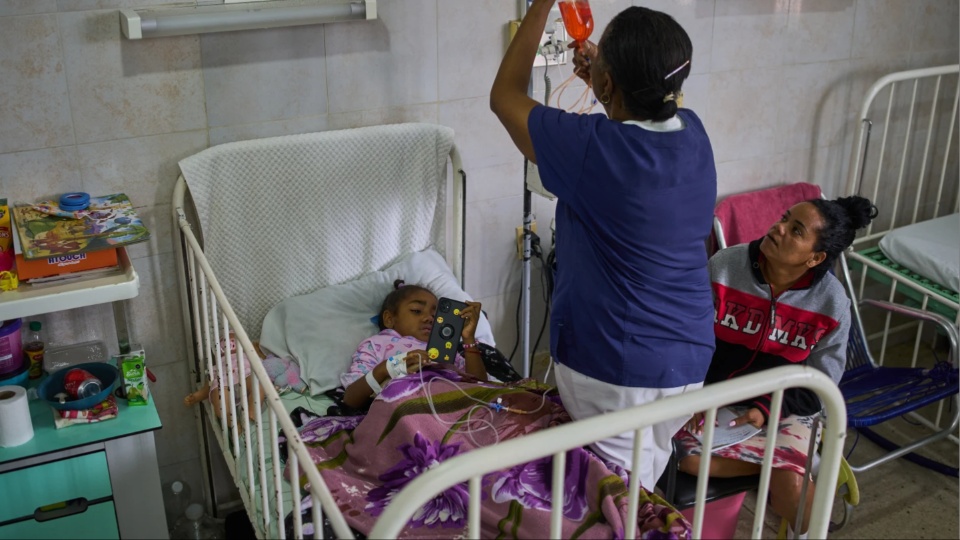
Lack of electricity leads to food and water shortages, no air-conditioning, and limited transportation to services. Shortages of supplies and power put surgical operations on hold. Most medications are unavailable, and with electricity out, hospitals are dark and disabled.
This U.S. assault endangers everyone, but especially very young children, the elderly, and the chronically ill. Cuba’s overall death rate of 9.5 deaths per 1,000 persons in 2014 rose to 14.2 in 2025.
As a pediatrician, the extraordinary harm done to babies is particularly troubling for me. A rising infant mortality rate (IMR)—the number of infants out of 1,000 births dying in their first year of life—tells the story. In 1950, Cuba’s IMR was 87.1. It dropped to 61.7 in 1960, 38.5 in 1970, 9.94 in 1990, 6.13 in 2000, and 4.0 in 2018.
The IMR then rose to 7.6 in 2021 during the COVID-19 pandemic and to 9.9 in 2025. Observers say many more babies are dying now because of the U.S. oil blockade imposed on the orders of President Donald Trump on Jan. 29, 2026
An overview shows that only 65 babies died in Cuba in 2018 when 116,333 babies were born; 752 died in 2021 when new babies numbered 99,096; and 653 died in 2025, a year with only 68,064 births.
Harm to healthcare and health shows in many ways, including:
- Shipping companies fearing U.S. sanctions have stranded 7,000 containers on docks away from Cuba. These contain medical supplies and drugs ordered from abroad.
- Pharmacy shelves are mostly empty. Thanks to the blockade, Cuba can no longer import raw materials needed for manufacturing their own drugs.
- Water is short or foul because fuel and spare parts for treatment facilities are lacking and many pumps don’t work.
- Food is short because of shortages of fuel for farm operations and deliveries.
- Healthcare workers are missing. Many have emigrated in part due to blockade-related shortages.
- When electricity is short, doctors and nurses work in the dark, or are not able to work at all.
- Premature infants requiring assisted respiration and/or heat-producing incubators suffer or die because of no electricity.
- Over 100,000 Cubans needing surgery have to wait, 12,000 children among them.
- Live-saving anti-cancer drugs may be unavailable, including the agent enabling a 90% survival rate for the most common form of childhood leukemia. The rate has fallen to 50%.
Children are hurt
In the U.S., healthcare workers and others have long called for early recognition of children injured due to inflicted violence. Pediatrician Henry Kempe’s watershed article Battered-Child Syndrome (1962) enlightened them. Working as doctor for children, I was learning the same reality on the job myself.

While visiting Cuba in 1994, I joined a pediatric surgeon making rounds in a hospital in Havana. He pointed to two post-operative little girls. Each had damaged her esophagus by swallowing sodium hydroxide in the form of lye. The surgeon had replaced the damaged part of the esophagus with a section of colon. He had performed this operation over 80 times.
I knew as a medical student that so-called corrosive esophagitis was a relic of the past. Before soap was commercially available, people made their own soap from lye derived from wood ashes. Young children, exploring, swallowed it. The surgeon explained that Cuba had no soap.
I later learned that a U.S. State Department representative told the Spanish manufacturer of most of Cuba’s soap that selling soap to Cuba would cause it to lose its U.S. market. A Mexican soap-maker received the same message.
The U.S. blockade had materialized in front of me. It looked like child abuse. I stated as much in an article (Monthly Review, October 2002) on the blockade. It offered more righteous fervor than analysis.
Why the blockade?
U.S. policy on Cuba has momentum of its own. Washington’s compulsion to dominate in the region and smother social revolution propels it. The U.S. seeks to make Cubans miserable enough to rise up and overthrow their government, an approach first outlined by State Department official Lestor Mallory in 1960.
The roots go back even further, though. U.S. governments have sought to control or own Cuba ever since President Thomas Jefferson’s time. The Monroe Doctrine of 1823 set the scene for U.S. interventions throughout the Americas, including Cuba. The Trump administration’s recently-issued National Security Strategy outlines special U.S. focus on the Western Hemisphere and, by implication, Cuba.
After revolutionary forces took power in Cuba in 1959, the country abandoned a previous relationship of service to the United States. Many other countries in the region would continue exporting minerals, oil, and agricultural commodities, maintaining a low-wage labor force to produce cheap consumer goods for export, and paying on debt owed to northern banks.
Cuba’s relations with the United States, and northern capitalism in general, were put on a different footing. Socialist Cuba, by its very existence, offered an implicit but strong rebuke to U.S. capitalism and its workings. It did so from a vantage point of commitment to protect and uplift all Cubans.
Rulers in Washington took offense and grew weary of the influence of the Cuban Revolution’s example among progressive forces elsewhere in the region. Left-leaning activists in many countries were learning about Cuba’s assistance to South Africans in struggle against apartheid, about poor people far and wide cared for by Cuban doctors, and about Cuba’s advocacy for Latin American integration and independence from U.S. interventions.
U.S. strategists feared a strong Cuban role in shaping what looked like the beginnings of a continent-wide, multi-national opposition force opposed to U.S. designs. Cuba’s part in creating the Community of Latin American and Caribbean States (CELAC) and the Bolivarian Alliance for the Peoples of Our America (ALBA) surely prompted such suspicions.
Cuba’s experience and advocacy may have contributed to awareness of a different mode of economic and social development. The foreign assistance countries received from Cuba in those years came without the requirements usually accompanying U.S. aid packages that serve the acquisitive interests of U.S. capitalism.

That possibility surely was one factor in persuading countries to latch on to China’s participation in their economic development. The growth of Chinese trade became another factor attributed to Cuba’s supposed influence.
U.S. rulers in and out of government are understandably full of wrath on the subject of Cuba. That’s the basis for their having arrived at a policy of economic blockade so as to disappear Cuba’s revolutionary government.
Past history suggests the U.S. government will probably stay the course and stop at nothing, even the deaths of more children.
The U.S.’ long-running embarrassment when it comes to Cuba is yet another factor to take into account. Of the few communist-led governments in the world, the one in the Western Hemisphere is just off the coast of the world’s top military power. If the revolutionary government were to end, this evident contradiction would go away at once.
The work ahead
On a past visit to the island, I spoke about the U.S. blockade with a North American communist activist. When I argued that socialists must secure a share of U.S. political power to end the siege, they countered that the priority was reaching into the political mainstream to build broad consensus.

While well-intentioned, that advice was inadequate then and remains so now. Beyond detailing the suffering caused by U.S. policies and analyzing Washington’s underlying motives, this report points toward urgent, concrete action:
- International solidarity: Connect U.S. organizers directly with global networks fighting the blockade.
- Organizational strength: Consolidate existing U.S. solidarity groups to boost their impact and effectiveness.
- Labor coalition: Engage U.S. trade unions to adopt Cuba’s struggle and partner with Cuban labor organizers.
- Political power: Build a unified socialist movement in the U.S. equipped to force a just foreign policy toward Cuba and pursue a transformative governing vision at home.
Following the November 3, 2026 election, the Democratic Party is set to control the incoming Congress—a pivotal shift, given that federal law grants Congress, not the president, the sole authority to lift the blockade. With the legislative landscape redrawn, the moment has arrived for relentless grassroots agitation to demand that Congress finally bring this siege to an end.
No paywalls at People’s World
At People’s World, we believe news and information should be free and accessible to all, but we need your help. Our journalism is free of corporate influence and paywalls because we are totally reader-supported. Only you, our readers and supporters, make this possible. If you enjoy reading People’s World and the stories we bring you, please support our work by donating or becoming a monthly sustainer today. Thank you!
CONTRIBUTOR