
President Donald Trump is getting the red-carpet treatment from the Philippine government, with a state banquet planned in his honor, while the people there rise up in protest against him and his agenda.
Manila is the first stop on a several-day trip through Asia where Trump will try to hammer out deals favorable to big business in the U.S. Later in the week, he meets with Chinese President Xi Jinping and Russian President Vladimir Putin in Shenzhen during the APEC forum.
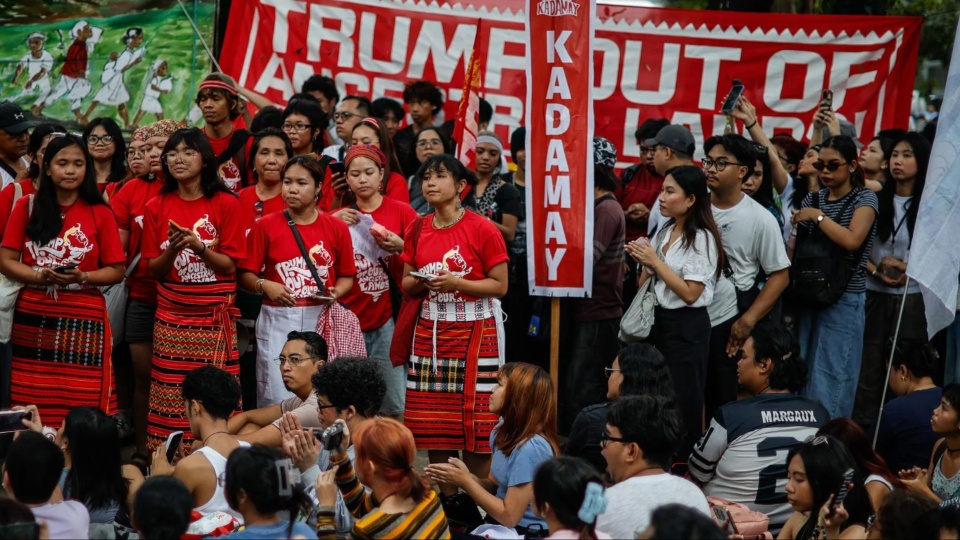
Tuesday marked the third day that union members, students, Indigenous people, and a wide range of activists demonstrated against Trump in the Philippines, and they are being met with brutal beatings and arrests by law enforcement authorities. More than 200 people were arrested on Sunday alone.
Trump is in the Philippine capital for the summit of the Association of Southeast Asian Nations (ASEAN) summit, described by a leading activist in Chicago’s Filipino community as “the Asian version of NATO, an exploitative alliance of countries that does the bidding of U.S. imperialism.”
The Rev. Primo Racimo is the priest at St. Margaret’s Episcopal Church on Chicago’s South Side and a leader of Defend the Migrants, a Filipino immigrant rights organization.
“The Philippines has become the place where U.S. imperialism does whatever it wants. We got rid of U.S. bases in the early 1990s, but they came back in, first inside Filipino bases and now again operating on their own,” Rev. Racimo explained.
Since they first hit the streets this past weekend, “Trump Out” demonstrators in Manila and Cebu have been met with brutal police attacks. They have reportedly been beaten bloody. Civic groups have condemned the police, who insist they showed “maximum tolerance.”
Rev. Racimo told People’s World about events at a Catholic church in Manila with which he is familiar. “Police chased demonstrators, and they ran and sought sanctuary inside the church, but police broke in and started beating and arresting people right in the church. They were taken to jail.”
The Philippines opened the summit on Sunday, and from the beginning the government tried to make the anti-Trump protests go away. A spokesperson for President Ferdinand Marcos, Jr., urged people not to tarnish the country’s image before the rest of the world.
The brutal crackdowns, and the absurd request to the public in light of them, only angered the people more, apparently. Protest leaders expected more than 10,000 people to turn out as Trump’s plane landed.
Pax Silica: Empire’s new supply chain
Central to the protests is the U.S.-led effort called Pax Silica, and it is the key to understanding why Washington cares so much about the Philippines right now.
Launched by the State Department in December 2025, Pax Silica is a coalition of more than two dozen countries built to create an AI supply chain free of China—from the mines to the chip plants to the data centers. Its architect, Under Secretary of State Jacob Helberg, has been blunt that the Pax Silica plan is intended to compete with China’s Belt and Road Initiative.
The name itself signals U.S. intentions. Pax is Latin for “peace,” an echo of the Pax Romana and the Pax Americana—eras of so-called “peace” enforced by imperial power. Silica is the raw material of the computer chip. With China dominating the refining of many critical minerals, the Trump administration is organizing its allies and client states into a bloc to break that hold.

It is an old story in new technological dress. Since seizing the Philippines as a colony in 1898, U.S. imperialism has worked to control the resource chains the world economy depends on: sugar and hemp, rubber, oil from the Middle East to Latin America. Today, the prize is nickel, cobalt, and the chips that power drones, missiles, and surveillance systems.
The Philippines sits at the center of that scheme. It is the world’s second-largest nickel producer, and semiconductors and electronics made up nearly 60% of its merchandise exports last year, according to a report in Time. The U.S. State Department said that a planned Philippine hub is part of a strategy to surge production of “inputs vital to U.S. supply chains.”
Trump has spent considerable effort in both his first and second terms to bring the Philippines into an economic alliance against China, and he’s seeing success. Marcos signed on to Pax Silica in April, making the Philippines its 13th signatory, and his administration now claims the project could create up to 130,000 jobs.
“President Marcos is all too willing to do the bidding of and follow the directions of the U.S.,” said Rev. Racimo. “He lies to the people by telling them following the U.S. will bring jobs and prosperity to the Philippines. This, of course, is not true. What it is bringing is more and more poverty as the costs of everything go up and up.”
The centerpiece is a 4,000-acre “Economic Security Zone” planned for New Clark City, north of Manila, on land that was once part of the U.S. military’s Clark Air Base. It will reportedly be larger than 3,000 football fields. In May, Helberg proposed treating the zone like an embassy, under U.S. law on Philippine soil, with immunity for American investors. Philippine officials said they “outright rejected” the idea.
The development would chew up Indigenous land and destroy many farms. The site overlaps land long inhabited by the Aeta, an Indigenous people, and farmland worked for generations. Critics warn it could consume up to 90 million liters of water a day.
What the people demand
The movement on the ground has put forward clear demands. The left-wing alliance BAYAN (Bagong Alyansang Makabayan), which organized the “Trump Out!” campaign, calls for rejecting Pax Silica and every agreement tying the Philippine economy to “U.S. war-making.”
It wants full disclosure of the government’s commitments, rejection of any facility that could serve military logistics or wartime production, and a sovereign national industrial policy built on real technology transfer and workers’ rights.

Environmental groups like Kalikasan PNE and Aeta communities demand the outright rejection of Pax Silica and a development strategy based on food security and national industrialization. Human rights advocates point out the project is moving forward without the free, prior, informed consent of affected communities.
Call center workers have petitioned to scrap every agreement under Pax Silica, halt resource-hungry data centers and mining, and win protections against AI on the job. Last week, more than 500 college deans, faculty, and union leaders signed a unity statement against the initiative.
“It’s not just U.S. submarines capable of carrying nuclear weapons that we are worried about,” Rev. Racimo said. “We see Trump is making war against Iran and war all over the Middle East. It must be stopped.”
He applauded the bravery of the demonstrators. “They are showing us here that we are not alone in the U.S. after having delivered such a big defeat to Trump and his agenda in our elections. It is international solidarity at its best.”
An Indigenous protester is quoted by Time as asking, “What will happen to our ancestral land?”
It’s a question that Presidents Marcos and Trump don’t want to be asked.
No paywalls at People’s World
At People’s World, we believe news and information should be free and accessible to all, but we need your help. Our journalism is free of corporate influence and paywalls because we are totally reader-supported. Only you, our readers and supporters, make this possible. If you enjoy reading People’s World and the stories we bring you, please support our work by donating or becoming a monthly sustainer today. Thank you!
CONTRIBUTOR