
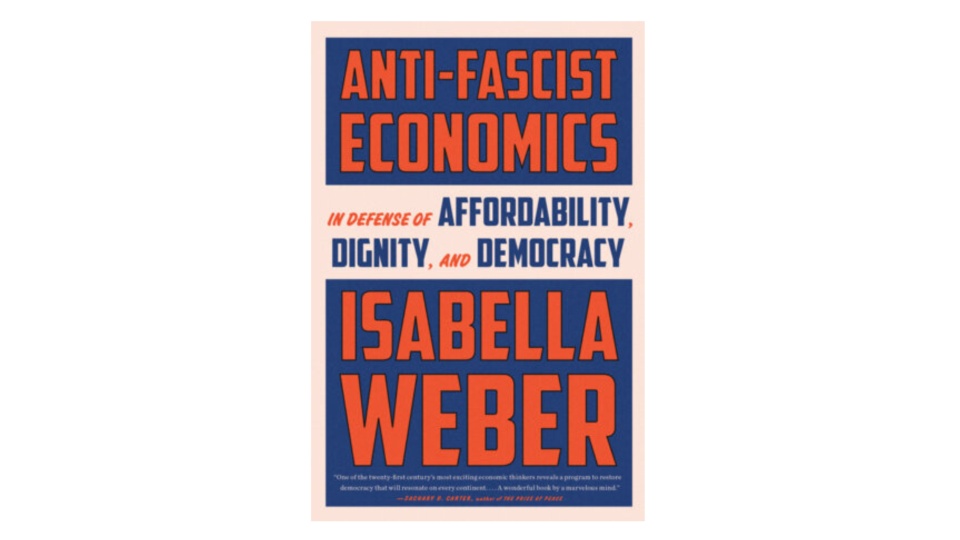
“Economic insecurity, inflation, and austerity are not merely technical economic policy failures,” Isabella Weber argues in her timely new book. “They create…the political conditions in which fascism has flourished.”
A German-born Associate Professor in Economics at the University of Massachusetts Amherst, Weber argues the election of Donald Trump to the presidency of the United States “was not an accident but the monstrous outgrowth of decades of stagnating living standards and frustrating working conditions” and “brutal marketization policies.”
Why? “People who worry about food on their table, who are anxious about their savings, who see no future, are available for political mobilization by movements that names their suffering.”
Thus, the book eviscerates the oligarchy-creating neoliberalism practiced and cheered on over the last 40 years by Democrats and Republicans in the U.S.; the Tories, Labour, and Liberal Democrats in Britain; and by far too many parties in the European Union.
Engagingly and accessibly written, many of the book’s arguments will be familiar to readers of writers like Naomi Klein, George Monbiot, or Aditya Chakrabortty.
Indeed, Weber’s thesis is backed up by a 2025 public intervention from Olivier De Schutter, the United Nations special rapporteur on extreme poverty and human rights, who pointed to decades of welfare cuts as giving rise to the far right across the world.
In contrast, “an anti-fascist economics is one that addresses the material concerns of the people above everything else.” This, Weber explains, will require restraining corporate power, rebuilding state capacity, strengthening unions, and making the essentials for living affordable, with price controls if necessary. She is a proponent of Universal Basic Services, rather than a Universal Basic Income.
Stopping the rise of the far right will, in short, require governments “to break with market and ultimately capital subordination as the guiding logic of our economic governance.” To illustrate her argument, she repeatedly returns to the 1930s, when soaring unemployment, hunger, and economic instability afflicted much of the industrialized world.
“Germany and America stood at a similar crossroads,” she argues. “One chose to protect the orthodox economic order and got Hitler. The other chose to subordinate that order to democratic politics and the New Deal.”
Perhaps unsurprisingly, the defeat of Nazi Germany led to an intense battle of ideas, with economists proposing differing policies which they believed would prevent a return of fascism, including Frederich Von Hayek’s Road To Serfdom, which would become a foundational anti-socialist text for Thatcherism in the U.K. and Reaganism in the U.S.
However, in the postwar years before the turn to the right, the social democratic economic theories of John Maynard Keynes and Karl Polanyi won out, with much of the West introducing mixed economies with significant public ownership. “Neoliberalism has made us think this is the exception, but it wasn’t for decades,” Weber recently told The Guardian recently.
Bringing the book up to date, Weber highlights some hopeful examples of governments sketching an initial outline of anti-fascist economics in practice. This includes New York City Mayor Zohran Mamdani, who has cited Weber’s work as informing his election pledges to freeze rents, make buses free, and introduce universal childcare.
There has also been significant state intervention in the economy in Mexico, with President Andres Manuel Lopez Obrador negotiating a deal to fix the price of a basket of 24 essential goods. Similarly, Spain under President Pedro Sanchez has put a price cap on soaring gas prices and rents.
Turning to Britain, The Guardian reported Weber has done consultancy with “U.K. ministers, including Ed Miliband,” while Andy Burnham’s Labour conference speech “was Weberesque in its messaging.” However, there’s little evidence the British government, obsessed with their self-imposed “fiscal rules,” is able, or willing, to break with the neoliberal economic orthodoxy.
As Brazil has recently shown, only the mobilization of huge sections of the population, through mass movements, including re-energized trade unions, can create the political conditions that enable the introduction of a truly anti-fascist economics.
Weber’s book is a vital foundational text for this urgent task.
Anti-Fascist Economics
by Isabella Weber
Penguin Random House Publishers; 400pp., 2026, $32.00
Morning Star
No paywalls at People’s World
At People’s World, we believe news and information should be free and accessible to all, but we need your help. Our journalism is free of corporate influence and paywalls because we are totally reader-supported. Only you, our readers and supporters, make this possible. If you enjoy reading People’s World and the stories we bring you, please support our work by donating or becoming a monthly sustainer today. Thank you!
CONTRIBUTOR