
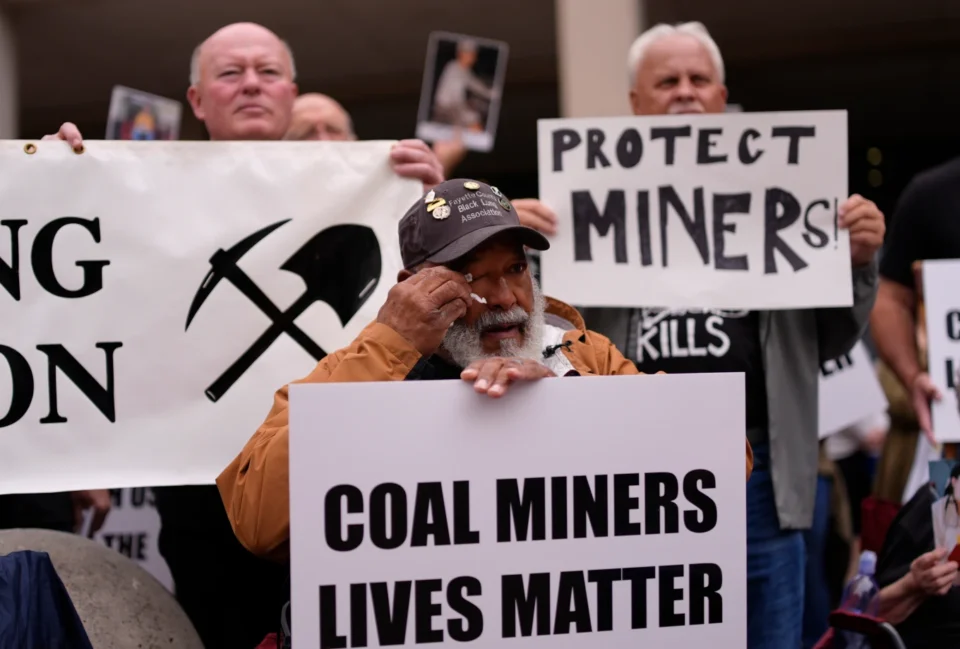
Coal mining is dangerous and takes a toll on the body, but a miner working underground can earn enough to buy a house, drive a nice car, and send the kids to college. There was a time when John Robinson thought the trade-off was worth it. No longer. He was diagnosed with black lung disease at age 47, a consequence of inhaling toxic silica dust in the mines of Virginia.
“These companies will bait you in with this big money,” said Robinson, who is now 60 and vice president of the National Black Lung Association. “When you get down and out, well, guess what? You’re like an old wore-out tire on the car or something. They’ll throw you to the side ’cause you ain’t worth nothing.”
For more than 50 years, coal miners, their families, and advocates have pressed the federal government for stricter limits on silica exposure, stronger enforcement of rules meant to protect miners, and improved health benefits for those disabled by the disease. In 2024, the Biden administration set the permissible exposure limit for respirable crystalline silica at 50 micrograms per cubic meter of air, matching the Occupational Safety and Health Administration threshold for workers in other industries. The rule was finalized in 2024, with coal companies required to comply beginning in April 2025.
That regulation was meant to update protections in coal mines and in what regulators call metal and nonmetal mines, which extract everything from copper and critical minerals to stone, sand, and gravel. All of them carry a risk of inhaling silica dust, whose fine particles can lodge deep in the lungs. But research over the past two decades has shown that Central Appalachian coal miners have experienced an acute increase in exposure and the most severe forms of lung disease associated with it, including progressive massive fibrosis.
Though the Biden-era revision wasn’t perfect, advocates like Robinson and his wife Vonda Robinson, who is president of the National Black Lung Association, were hopeful. It seemed as though decades of organizing for a stronger standard were finally coming to an end. But a federal appeals court put the rule on hold last year while it considered legal challenges filed by the mining industry. Now the Mine Safety and Health Administration wants to revise the rule.

Its proposal would retain the 50-microgram silica limit while changing several requirements governing how mines monitor exposure and protect workers. Brendan Muckian-Bates, a policy analyst with Appalachian Citizens’ Law Center, said those revisions could substantially weaken the protections behind the stricter limit.
Black lung is the common name for coal worker’s pneumoconiosis, an incurable, progressive, and fatal respiratory disease caused by inhaling coal dust and fine silica particles, which can cause severe inflammation in the lungs. Over time, that irritant scars and stiffens lung tissue, making respiration increasingly difficult until many of those afflicted with it cannot breathe at all.
In the 1960s and 1970s, according to the National Institutes of Health, as many as 1 in 3 miners with more than 25 years of work experience were testing positive for black lung. The United Mine Workers of America agitated for stricter protections again the disease, and in 1969, Congress passed the Federal Coal Mine Health and Safety Act, which required regular inspections. Disease rates plummeted to a historic low in the 2000s, only to begin climbing again.
Rates of black lung are now at a 50-year high and still climbing. A study led by the National Institute for Occupational Safety and Health, or NIOSH, found these increases across all age groups, including miners in their 20s and 30s, although rates remained highest among those who had spent decades underground. In routine health screenings by the agency during the past three years, more than 1 in 3 miners in Central Appalachia once again tested positive for the disease, making the epidemic into a U-shaped curve.
The new rule was published in the Federal Register on November 12 and will be open for public comment until January 11. Although the stricter limit of 50 micrograms remains, Muckian-Bates said the fine print matters: Other changes in the rule undermine that threshold and give mine operators greater control over how it is enforced.
“On the one hand, it looks on the surface like the administration is saying, ‘Yes, we agree that silica is the leading cause of the black lung right now,’” Muckian-Bates said. “However, they’ve provided these measures to effectively nullify that.”
Among them is a 21 percent margin of error in testing, meaning companies would only be fined if a sample exceeded the 50 microgram limit by at least that amount. That effectively gives companies a 10 microgram increase in the amount workers can be exposed to, according to Muckian-Bates.
The 2024 rule enforced regular silica monitoring by requiring air sampling in each underground mine every six months. The proposal eliminates that schedule, instead requiring mine operators to assess when changing conditions could increase exposure and test “as frequently as necessary.” Mines could therefore go longer than six months without being sampled if operators determine additional testing isn’t needed, as long as they remain below the exposure limit.
The proposed rule also would also make medical exams voluntary for new metal and nonmetal miners; the 2024 rule made them mandatory. Advocates and health professionals say those initial exams establish a baseline that can later help determine whether lung disease developed from workplace exposure rather than an earlier condition or exposure. That is particularly important because the consequences of silica exposure may not become apparent for decades.
“What we have in the pipeline right now is not going to show up until like 20 years later,” Muckian-Bates said. “That just means we’re going to have a new crop of sick miners who we don’t know are getting sick, and they don’t know they’re getting sick, until it’s too late.”
The Mine Safety and Health Administration did not respond to questions. A spokesperson for the Department of Labor said in an email that anyone interested in offering feedback can do so within the 60-day window that opened on November 12, or during a virtual meeting on December 15.
“MSHA looks forward to reviewing all stakeholder comments before publishing a final rule to better protect the health of the Nation’s miners,” the email stated. The agency noted in the Federal Register that “this rule, if finalized, is expected to be a deregulatory action,” quoting President Donald Trump’s executive order titled “Unleashing Prosperity Through Deregulation.”
MSHA estimates the proposed rule will save the industry $28.7 million per year, mostly from changes in monitoring. Of that, coal companies would save $2.43 million.
With the 2024 rule on hold, miners remain subject to silica standards whose basic framework dates to the early 1970s and effectively allows exposures of roughly 100 micrograms per cubic meter of air. Virginia Tech mining expert Emily Sarver said a tighter limit is so overdue that she would rather see the proposal move forward than face years of further delay.
“I don’t think our current legacy rule is sufficiently protective,” Sarver said. Among other things, she considers the 2024 rule’s sampling scheme, involving many different labs rather than MSHA labs, chaotic, making enforcement difficult. “I think the new rule that was passed in 2024 on paper looks more protective, but I think there’s certain problems with it.”
As for John and Vonda Robinson, they plan to keep fighting for stronger protection of those who work the mines.
“If us older coal miners don’t get nothing out of this,” John Robinson said, “we can help the next batch of coal miners [that] is going to come up, that’s going to be extremely sick. This don’t go away. This is going to last for years and to [their] death.”
No paywalls at People’s World
At People’s World, we believe news and information should be free and accessible to all, but we need your help. Our journalism is free of corporate influence and paywalls because we are totally reader-supported. Only you, our readers and supporters, make this possible. If you enjoy reading People’s World and the stories we bring you, please support our work by donating or becoming a monthly sustainer today. Thank you!
CONTRIBUTOR