
On Thursday, Nov. 19, traders on the Nasdaq floor erupted in applause as Anthropic, the corporate parent of the Claude artificial intelligence platform, made its debut in the largest public offering in history.
Raising $81 billion and catapulting the company’s valuation past $1.5 trillion that day, the listing instantly made its founders billionaires and handed windfalls of over $100 million to hundreds of insiders. Glasses were raised to what financiers hailed as the ultimate validation of the AI gold rush.
Across the country in break rooms, call centers, newsrooms, and at kitchen tables, however, the mood was quite different. For millions of working people, the headlines from Wall Street didn’t signal much worth celebrating. While tech executives toast their newfound paper fortunes, ordinary families are wondering whether their jobs will still exist a few years from now and what kind of economy their children will inherit.
That divide between champagne-sipping investors and anxious workers showcases the central fault line of the class struggle in our AI-dominated economy.
Turning wages into profits
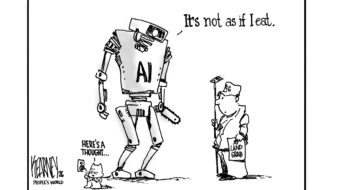
To understand what big capital actually sees when it looks at artificial intelligence, look no further than the numbers investors used to justify Anthropic’s astronomical price tag. In pitching its growth possibilities, the company pointed toward a total addressable market exceeding $40 trillion—a figure it derived by calculating the combined annual wages of virtually every knowledge worker on the planet.
In plain language, the company thinks it can eliminate all of them—software engineers, paralegals, accountants, graphic designers, journalists, administrative staff, and more. Wall Street is placing a massive bet that the paychecks of nearly everyone who does mental labor can be eliminated and the money that would have gone to workers can be moved over to the profit column of balance sheets.

Language buried inside Anthropic’s securities filings and analyst briefings reveal the thinking of the AI bosses: Human wages are framed not as the lifeblood of communities or the foundation of consumer demand but as an “addressable market” waiting to be absorbed into corporate profits.
Under capitalism, every leap in productive capacity poses the same fundamental question: Will machines lighten the load of labor and raise living standards for all, or will they be weaponized to slash jobs, speed up the remaining workforce, and funnel all productivity gains to the top one percent?
Working people are not modern-day Luddites terrified of software or automation. Across hospitals, classrooms, laboratories, and government offices, AI tools capable of processing vast amounts of data hold real promise to cure diseases, speed up scientific discoveries, and eliminate the drudgery of repetitive jobs.
So, the problem is not AI itself but rather who owns the servers, who writes the rules, and who pockets the surplus from all the efficiency it brings.
Retirement (in-)security
Knowledge and data workers aren’t the only ones in danger, though. Even those who do not sit behind a desk all day are already being held hostage to the concentration of wealth and market power built around this sector. Just look at the financial whiplash surrounding chipmaker Nvidia, whose hardware undergirds the AI boom.
Over recent days, markets swung violently as Washington and Silicon Valley were gripped by the Jensen Huang drama—a saga in which Nvidia’s CEO was pushed aside amid intelligence reports involving his relationship with a woman accused of being a “Chinese spy.”
By the morning of Monday, Nov. 23, Huang was abruptly reinstated after President Donald Trump (who is personally profiting from the AI market madness, and from Nvidia in particular) declared him clear of any national security exposure.

The instant pardon that came from the company’s board of directors underscores the brazen double standard of Silicon Valley’s old-boys’ club, where a powerful male chief executive is ushered right back into the penthouse while women in tech—who already number so few—are routinely sidelined to make way for men.
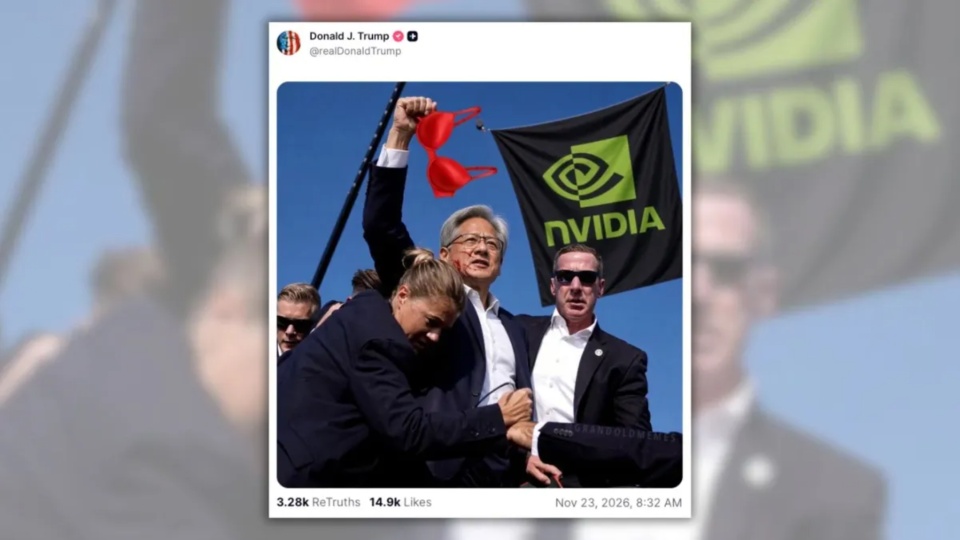
Making a mockery of both the supposed national security concerns at stake and basic workplace dignity, Trump capped off the reinstatement by sharing an AI-generated image depicting Huang raising a red brassiere in a crude parody of his own 2024 assassination survival photo.
Every twist in the Nvidia soap opera sent shockwaves through global stocks. Because a handful of mega-cap tech firms now account for so much of the stock market’s value, millions of teachers, firefighters, autoworkers, and others watched their 401(k) retirement account values swing wildly over the last few days—all because of one executive’s personal scandal and the president’s Truth Social posts.
This is the fragility of the “Nvidia economy”—a system where the jobs and retirement security of the working class is tied to a hyper-concentrated speculative investment bet that looks more and more like a classic bubble.
When will the bubble burst?
It’s happened before. In the late 1990s, the arrival of the commercial internet was hailed as a new era. It’s true that the technology itself was real and transformative, just as artificial intelligence is today. But because lawmakers surrendered the early internet to unregulated monopolies and speculative finance, the dot.com bubble eventually burst. It wiped out trillions in savings, triggered mass layoffs, and left a handful of consolidated tech giants to dominate digital life.

Allowing history to repeat itself on a $40 trillion scale would be catastrophic for the working class and the economy as a whole. Left to the anarchy of the market, AI monopolies will hollow out whole sectors of employment while inflating a financial bubble that will eventually pop at the expense of us all.
Preventing that outcome requires democratic intervention now, not after the crash. Labor unions must win binding contract protections giving workers a voice over how AI is deployed on the job, guaranteeing that productivity gains translate into shorter hours, higher pay, and retraining rather than layoffs.
At the federal level, Congress must treat AI infrastructure as a public utility—imposing strict antitrust guardrails, taxing windfall speculative gains to fund public services, and enforcing real transparency over the algorithms that govern almost everything now: hiring, healthcare, credit access, and more.
Anthropic’s $1.5 trillion debut proved that artificial intelligence can generate unimaginable wealth. That’s not the key question, though. The fight right now is about making sure that the people who make society run—not just the billionaires ringing the opening bell on Wall Street—get the rewards that generations of their labor have created.
As with all news-analysis and op-ed articles published by People’s World, the views expressed here are those of the author.
No paywalls at People’s World
At People’s World, we believe news and information should be free and accessible to all, but we need your help. Our journalism is free of corporate influence and paywalls because we are totally reader-supported. Only you, our readers and supporters, make this possible. If you enjoy reading People’s World and the stories we bring you, please support our work by donating or becoming a monthly sustainer today. Thank you!
CONTRIBUTOR