
MIDDLETOWN, Iowa—The U.S. Army blew up five tons of lead azide, what the Associated Press says is the nation’s entire stockpile of the deteriorating and toxic bomb-trigger material, at its Iowa Army Ammunition Plant on Wednesday morning, November 25, despite concerns of widespread lead contamination downwind and even possible threats to the nation’s food supplies. Iowa is a major supplier of agricultural products to the entire country.
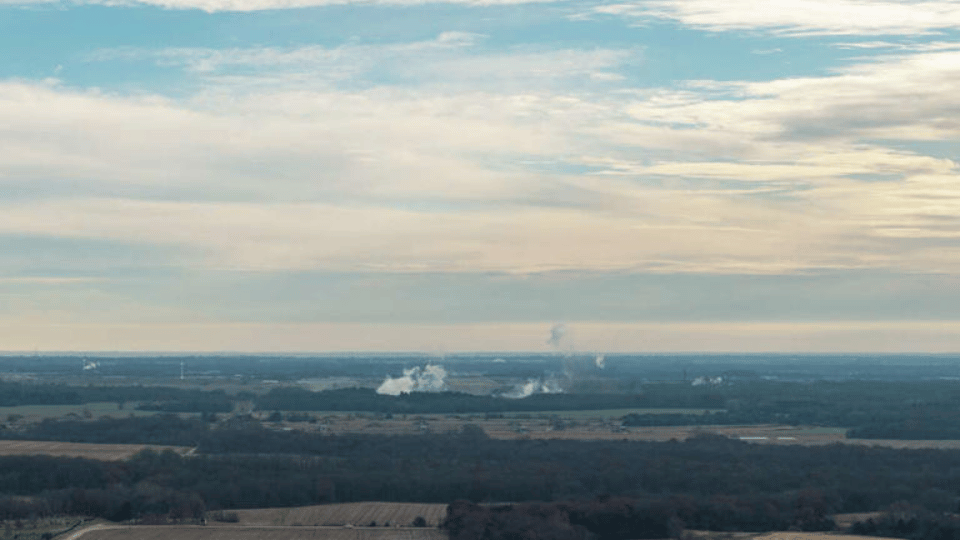
The Associated Press, whose reporters monitored the explosion from five miles away, north of Middletown, Iowa, reported seeing two huge plumes in the air around 9 a.m. Central Time.
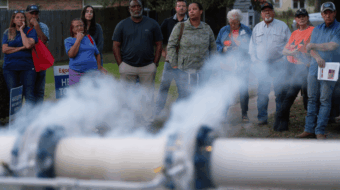
Before it set off the blast of 68 barrels of lead azide, the Army told residents of nearby Middletown to stay indoors for 48 hours, tape up their windows, and also be prepared to immediately evacuate. Schools and businesses closed.
But the Federal Emergency Management Agency contradicted part of that plan, saying nobody should go outside buildings, thus making any evacuation impossible.
The Army said it expected prevailing winds to blow the lead azide to the southwest and away from the closest large city, Burlington. But experts said in turn that could pose a contamination danger to downwind farms and cattle.
The Army said it put up barriers and gels to “mitigate” the dust from the explosion. FEMA extended its “stay inside” warning to people within 20 miles of the ammunition plant, including in Burlington.
The deteriorating lead azide is highly combustible and sensitive to temperature changes, the AP reported. It thus could have exploded in an uncontrolled blast at any time.
Lead azide, a combination of lead and nitrogen, appears as either a white or colorless crystalline powder or needlelike crystals. It is used as a detonator to set off other explosives, including TNT. No level of lead contamination is known to be safe for humans or animals.
Scientists told the AP that lead azide is sensitive to shock, heat, impact, and friction, and may explode when dry. Over time and with temperature changes, lead azide can form unstable, larger crystals that are even more sensitive.
The lead azide at the Army Ammunition Plant outside Middletown was crystallizing and so old that, scientists added, “a spontaneous detonation” could have occurred, catching the area—and the people—around the plant unaware.
Health and safety organizations and eventually congressional bodies are expected to investigate how the situation in Iowa was allowed to get out of control and to look into preventing similar problems from developing around the country. In the eyes of the public, trust in the Trump administration’s ability to protect the public has decreased even further from already low levels it had reached by the time of the recent midterm elections.
People are not happy about being told to stay indoors during the Thanksgiving holiday.
No paywalls at People’s World
At People’s World, we believe news and information should be free and accessible to all, but we need your help. Our journalism is free of corporate influence and paywalls because we are totally reader-supported. Only you, our readers and supporters, make this possible. If you enjoy reading People’s World and the stories we bring you, please support our work by donating or becoming a monthly sustainer today. Thank you!
CONTRIBUTOR