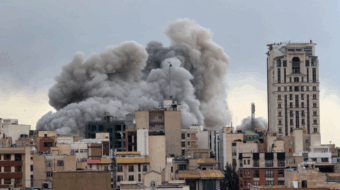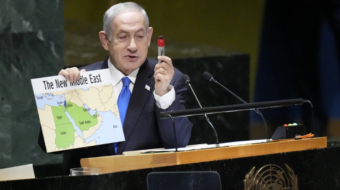
A shock and awe. The phrase is apt in describing what Israel has done in the occupied West Bank almost immediately following the events of October 7, 2023, and the start of the Israeli genocide in Gaza.
In her book The Shock Doctrine, Naomi Klein defines “shock and awe” not merely as a military tactic, but as a political and economic strategy that exploits moments of collective trauma—whether caused by war, natural disaster, or economic collapse—to impose radical policies that would otherwise be resisted. According to Klein, societies in a state of shock are rendered disoriented and vulnerable, allowing those in power to push through sweeping transformations while opposition is fragmented or overwhelmed.
Though the policy is often discussed in the context of U.S. foreign policy—from Iraq to Haiti—Israel has employed shock-and-awe tactics with greater frequency, consistency, and refinement. Unlike the U.S., which has applied the doctrine episodically across distant theaters, Israel has used it continuously against a captive population living under its direct military control.
Indeed, the Israeli version of shock and awe has long been a default policy for suppressing Palestinians. It has been applied across decades in the occupied Palestinian territory and extended to neighboring Arab countries whenever it suited Israeli strategic objectives.
In Lebanon, this approach became known as the Dahiya Doctrine, named after the Dahiya neighborhood in Beirut that was systematically destroyed by Israel during its 2006 war on Lebanon. The doctrine advocates the use of disproportionate force against civilian areas, the deliberate targeting of infrastructure, and the transformation of entire neighborhoods into rubble in order to deter resistance through collective punishment.
Gaza has been the epicenter of Israel’s application of this tactic. In the years preceding the genocide, Israeli officials increasingly framed their assaults on Gaza as limited, “managed” wars designed to periodically weaken Palestinian resistance.
These operations were rationalized through the concept of “mowing the lawn,” a phrase used by Israeli military strategists to describe the periodic use of overwhelming violence to “reestablish deterrence.” The logic was that Gaza could not be politically resolved, only indefinitely managed through recurrent destruction.
What unfolded in the West Bank shortly after the start of the Gaza genocide followed a strikingly similar pattern.
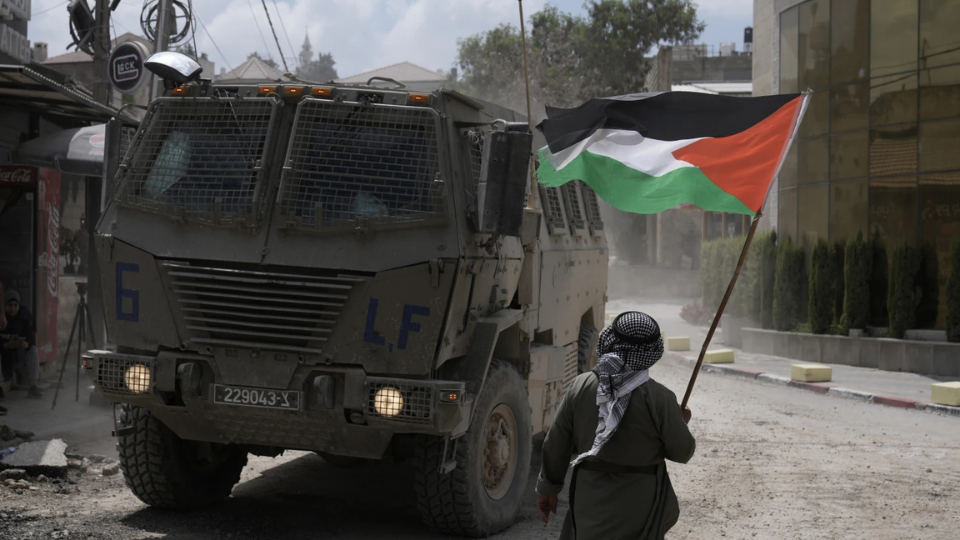
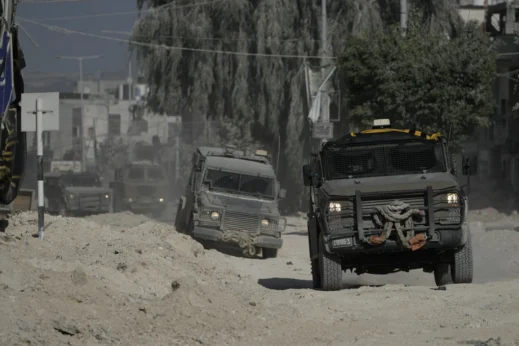
Beginning in October 2023, Israel launched an unprecedented campaign of violence across the West Bank. This included large-scale military raids in cities and refugee camps, the routine use of airstrikes—previously rare in the West Bank—the widespread deployment of armored vehicles, and a surge in settler violence carried out with the backing or direct participation of the Israeli army.
The death toll rose sharply, with hundreds of Palestinians killed in a matter of months, including children. Entire refugee camps, such as Jenin, Nur Shams, and Tulkarm, were subjected to systematic destruction: roads were torn up, homes demolished, water and electricity networks destroyed, and medical access severely restricted. Israeli forces repeatedly laid siege to communities, preventing the movement of ambulances, journalists, and humanitarian workers.
At the same time, Israel accelerated the ethnic cleansing of Palestinian communities, particularly in Area C. Dozens of Bedouin and rural villages were forcibly emptied through a combination of military orders, settler attacks, home demolitions, and the denial of access to land and water. Families were driven out through sustained terror designed to make daily life impossible.
Yet the most violent period of Israeli aggression in the West Bank since the Second Intifada (2000–2005) has been largely overlooked, in part because of the sheer scale and horror of Israel’s genocide in Gaza. The annihilation of Gaza has rendered the violence in the West Bank seemingly secondary in the global imagination, despite the fact that its long-term consequences may prove just as devastating.
At the same time, Israeli Prime Minister Benjamin Netanyahu and his extremist coalition succeeded in presenting themselves to the world as reckless, unrestrained, and ideologically driven—willing and able to expand the cycle of destruction far beyond Gaza, into the West Bank and across Israel’s borders into neighboring Arab countries. This performance of extremism functioned as a political strategy.
The consequences are now unmistakable. Large areas of the West Bank lie in ruins. Entire communities have been shattered, their social and physical fabric deliberately dismantled. According to UNRWA, more than 12,000 Palestinian children remain displaced, increasingly suggesting a displacement that may become permanent rather than temporary.
History, however, offers a critical lesson. The Palestinian struggle against Israeli settler-colonialism has repeatedly demonstrated that Palestinians do not remain passive indefinitely. Despite the paralysis and fragmentation of their political leadership, Palestinian society has consistently regenerated its capacity for resistance.
Israel understands this reality as well. It knows that shock is not infinite, that fear eventually gives way to defiance, and that once the immediate trauma begins to fade, Palestinians will reorganize and push back against imposed conditions of domination.
What is underway, therefore, is a race against time. Israel is working to consolidate what it hopes will become an irreversible new reality on the ground—one that enables formal annexation, normalizes permanent military rule, and completes the ethnic cleansing of large segments of the Palestinian population.
For this reason, a deeper and more sustained understanding of current events in the West Bank is essential. Without confronting this reality directly, Israeli plans will proceed largely unchallenged. To expose, resist, and ultimately defeat these designs is not only a matter of political analysis but a moral imperative inseparable from supporting the Palestinian people in restoring their dignity and achieving their long-denied freedom.
As with all news-analysis and op-ed articles published by People’s World, the views reflected here are those of the author.
We hope you appreciated this article. At People’s World, we believe news and information should be free and accessible to all, but we need your help. Our journalism is free of corporate influence and paywalls because we are totally reader-supported. Only you, our readers and supporters, make this possible. If you enjoy reading People’s World and the stories we bring you, please support our work by donating or becoming a monthly sustainer today. Thank you!
CONTRIBUTOR