MINNEAPOLIS—Renee Throckmorton’s managers at the Corning Cable fiber optics plant thought harassing her, including following her to the bathroom, would stop the union drive. It did the opposite. It convinced her and her co-workers even more of the necessity of organizing a union and building power on her shop floor.
Throckmorton, a rank-and-file worker now organized with the United Steelworkers (USW), told delegates at the AFL-CIO’s 30th Constitutional Convention what organizing looks like when the bosses are desperate to keep a union out. Her plant lacked very basic things, she said.
When the company bothered to show appreciation, the workers were given food truck vouchers—not better wages or working conditions. Workers tried giving feedback on how to run the plant more efficiently and safely, but management wasn’t interested. So they started organizing.
That’s the kind of fight the AFL-CIO’s new organizing resolution is supposed to help workers win—with a goal now of two million new organized workers by 2031.
Organizing the unorganized is one of the biggest, if not the biggest question facing the trade union movement. It’s no secret that union density in the U.S. is bottoming out. So it is rightfully on everybody’s minds here, from the rank-and-file workers in attendance, to worker and staff organizers, to the affiliates and their leadership.
The organizing resolution, called “We are the Organized Power of Working People,” passed Tuesday encourages the federation to coordinate multi-union campaigns, align bargaining dates across sectors, launch a mass training program for rank-and-file organizers, draw a hard line on political endorsements—no candidate gets labor’s support unless they’re willing to fight for collective bargaining rights—and even organize outside the traditional NLRB process.
The previous goal of one million new organized workers the federation is citing reflects growth in sectors such as auto, healthcare, public service, as well as newer ones like video game developers, tech workers, baristas, and other service industries.
But, as previously mentioned, union density in the U.S. still sits at just 10% of the workforce. That’s barely up from the historic lows of the last decade—albeit a sign the bleeding has stopped for now.
Questions about whether the AFL-CIO’s new goal is achievable, whether it is ambitious enough, and what the nuts-and-bolts and resource allocation will actually look like were central to discussions among delegates in the halls and bars outside the convention hall this week.
The resolution calls for “maximizing resources and capacity” and “multi-union, multi-sector organizing campaigns.” It’s clear to almost all workers by now that union-by-union, employer-by-employer organizing isn’t enough, especially not when the billionaire class and monopoly capital have consolidated into a coordinated, well-funded anti-union apparatus.
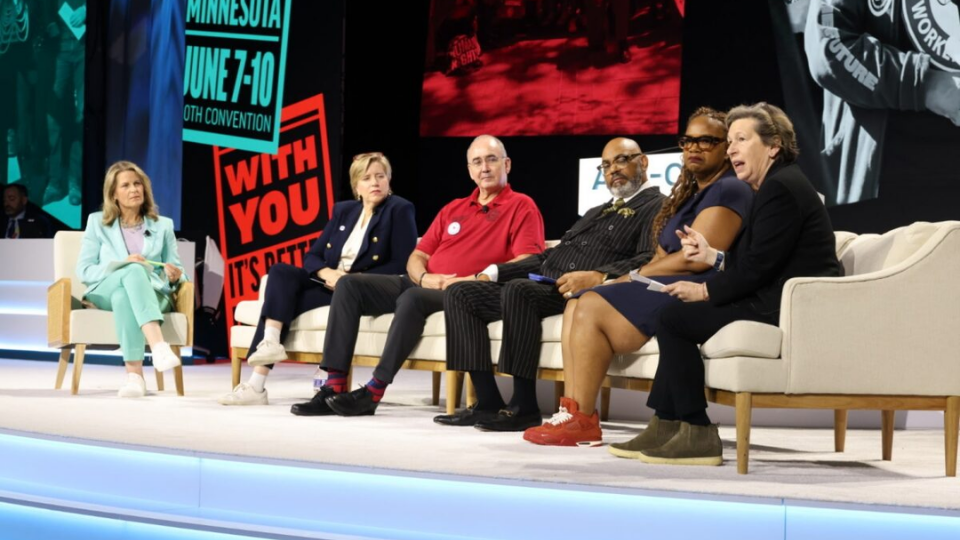
UAW President Shawn Fain, who has become labor’s most visible example of how aggressive organizing combined with aggressive bargaining can feed each other, was a key speaker on a panel about organizing the unorganized.
“I have always said that in our union, bargaining and organizing go hand in hand,” Fain told delegates. “When we bargain a good contract, people want to join the movement—they want to join the union.
When the UAW’s Stand-Up Strike against the Big Three won back concessions and gains in 2023, unorganized auto workers were watching, Fain said. Toyota, Nissan, Honda, Volkswagen, Mercedes, and Hyundai all gave their workers 10% wage increases and cut progression to full pay from eight years down to four, he said, calling it the “UAW bump.”
“We all know why they did it,” he said. “They were scared to death that their workers were going to organize.”
Less than six months after the Big 3 strike ended, Volkswagen workers in Chattanooga won their union after a 15-year battle. And that’s a model worth paying attention to—organizing driven by successful bargaining, not separate from it, he said.
The panel on “Organizing to Win,” moderated by April Sims, president of the Washington State Labor Council, featured several workers who are part of organizing campaigns, whether building new unions or reorganizing existing ones.
Iesha Franceis, a worker leader with SEIU’s Union of Southern Service Workers (USSW) in North Carolina, left an assisted living facility during COVID, thinking fast food might be marginally safer. She was wrong. But instead of just surviving, she and her coworkers started taking shop floor actions at a Freddy’s fast food restaurant, including a walkout during peak hours.
“Burgers on the grill, fries in the oil, customers in the lobby and the drive-thru,” she described. “The lights went out. Without us, there is no business.
“It’s never easy organizing in the South,” Franceis said. “But the South is resilient, and we’re fighting back hard.”
Beyond the notoriously anti-union South, the NLRB under the Trump administration has been mightily weakened to the benefit of capital. But even in friendlier political moments, the board process is slow, easily gamed by employers, and completely unavailable to federal workers—1.3 million of whom just had their bargaining rights axed entirely by Trump.
Thus, the resolution commits the federation to supporting federal workers, but also others, without statutory bargaining rights “regardless of legal designs by their employers.”
The test ahead
With no speakers from any political parties or politicians present or invited at the convention, the resolution also declares that candidates “should receive no labor’s support unless they are willing to fight for stronger collective bargaining rights and the empowerment of working people.”
Furthermore, the PRO Act is the floor, not the ceiling, many delegates insisted. The resolution also calls for industrywide bargaining, state constitutional amendments to enshrine organizing rights, and an end to worker misclassification.
April Verrett, president of SEIU, said, “We are absolutely going to pass the PRO Act. But even that is not enough. Our current labor laws were created nearly 100 years ago. What else in the world has stayed exactly the same over the last century?”
At this convention, the AFL-CIO formally committed itself to organizing two million more workers in five years. The resolution, of course, is a document, and the speeches are moments in time. The real work will happen in places like Corning Cable, Amazon, unorganized auto plants, and on the aisles of Delta flights, where 40,000 workers are organizing a massive campaign with AFA-CWA. The shop floor is where workers decide for themselves whether organized labor shows up when it counts.
The resolution passed unanimously. Now the follow-through begins. And workers all over the country, desperate to organize, build, and join a union, will be watching to see whether the federation’s ambitions match the resources, coordination, and staying power this moment demands.
We hope you appreciated this article. At People’s World, we believe news and information should be free and accessible to all, but we need your help. Our journalism is free of corporate influence and paywalls because we are totally reader-supported. Only you, our readers and supporters, make this possible. If you enjoy reading People’s World and the stories we bring you, please support our work by donating or becoming a monthly sustainer today. Thank you!
CONTRIBUTOR