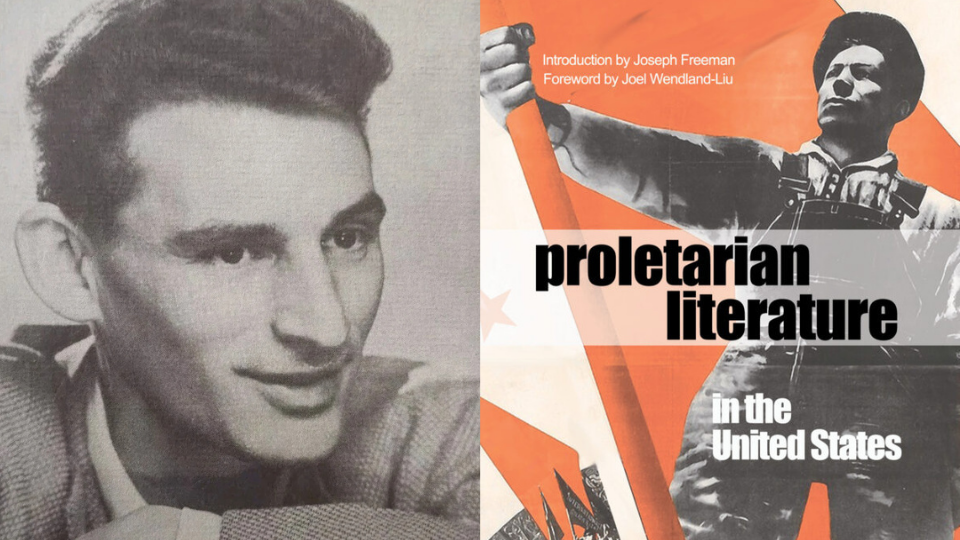
Originally published in 1935, Proletarian Literature in the United States has been long out of print. International Publishers has brought the collection of short stories, poems, reportage, and literary criticism back to print. Below is one of the featured poems, “Unit Assignment” by Edwin Rolfe, followed by a deep-diving analysis by writer Joel Wendland-Liu.
Unit Assignment
Now the beginning: the block divided,
I chose a tenement,
press bells that do not ring, ascend
by feeling stairs where no lamps shed
light to guide a stranger and am led
by banisters towards a door.
Again a futile bell. I knock,
hear scuffling through the wood, a voice
gruff and questioning. I explain.
Enter. Am home.
“This is my block,” I say. It is.
“Just four doors down.” “And this,” he says,
“is my wife, and this my son, my daughter.
Here is the living room.”
He clears the best chair for me,
momentary host, curious, proletarian;
the family—my son, my daughter—gather
around me, listen to the familiar word
Communist falling from unfamiliar lips.
Strange, too, they must have mused,
its sound is good when he says it
and what he says it means is good.
The evening passes quickly: tea is drunk
from glass, cups, an old cheese jar.
My host, John Winter, fifty-four,
asks questions, listens, deep in thought.
I tell him what I know, I cite
stories in The Daily, demonstrate
items killed, never to appear
elsewhere. “What is this?” he asks—
the word unity is in his brain.
My son, my daughter listen too.
They who were most suspicious now
join us, and all I say
enters them in images of food, of jobs,
the wanted weekly pay.
They too see what I mean is good.
The skyscraper bell rings out eleven.
I leave a copy of The Daily. Am asked
again to spend an evening with them. Rise.
John Winter walks me to the door, holds
my hand in his a moment, saying goodnight.
“These things you were saying—
They’re good.”
He fumbles for words.
“I shall return,” I say.
“Unit Assignment” is a free-verse, narrative poem that portrays a visit by an unnamed Communist Party organizer to a working-class household in an urban tenement. It wonderfully contrasts the initial feelings of distance and suspicion between the organizer and the family, gradually transforming into a touching moment of genuine connection. This progression sees the family come to a tentative yet growing interest in the communist message and movement, leaving readers with a sense of hope and anticipation.
First appearing in the New Republic in 1934, “Unit Assignment” was republished the following year in the landmark anthology Proletarian Literature in the United States. The poet was Edwin Rolfe, born Solomon Fishman in Philadelphia in 1909. Fishman began using a pseudonym when he first wrote poetry in high school. At age 18, he read some poems at “Red Poets Night,” a fundraising event hosted by the Daily Worker. The program for that event included Langston Hughes, whose books The Weary Blues and Fine Clothes to the Jew had been published just two years earlier; the lyric poet Lola Ridge, who had recently published her third book of revolutionary poems in Red Flag; and Chinese poet and novelist H.T. Tsiang, who likely read from his forthcoming Poems of the Chinese Revolution. Suggesting the internationalist flavor of the movement, the poetry event was emceed by leading Jewish party members and held at a site that also offered Yiddish language classes.
In the early 1930s, Rolfe held various journalism positions and joined the staff at the Daily Worker, where he wrote and edited features. His first poetry collection, To My Contemporaries, was published in 1936, and a review in the New York Times helped establish his poetic reputation. The following year, he joined the International Brigades in Spain to fight against the Hitler-backed Franco forces trying to take over the country.
After Spain, he briefly worked for the Soviet news outlet TASS. During the Second World War, Rolfe joined the Army at the age of 34 and was sent to train in an anti-tank unit. On training maneuvers, Rolfe collapsed due to a dangerous parasitic disease. The Army’s medical team ordered Rolfe’s discharge from service as a result. After this, Rolfe moved to Los Angeles and wrote scripts for the movie industry while co-writing the successful novel, The Glass Room. Rolfe enjoyed some minor success in Hollywood but suffered from several heart attacks and from the McCarthy-era blacklisting regime. Heart disease took his life in 1954 at the age of 44. Despite his growing achievements in fiction and filmmaking, his several collections of poetry remain his most enduring artistic contributions.
Like most proletarian writers, Rolfe sought to deliver more than just a favorable message about the Communist Party in “Unit Assignment.” These lines, developing in two-stanza chunks throughout the poem, evoke the delicate process of building trust during organizing conversations, showcasing the initial meaningful connections that are essential to collective working-class power and a radical new form of democracy. The poem illustrates how political change starts with a conversation in a living room, speaking the language of shared needs.
Through its imagery, rhythm, meter, and voice, “Unit Assignment” creates an atmosphere that shifts from hesitant doubt about the organizer’s message to one of intimacy and community with John Winters and his family, culminating in an invitation to meet again.
The imagery in “Unit Assignment” is the main tool the poet uses to establish the setting, convey themes, and map the emotional journey from alienation to connection. For example, the poem opens with images—words or sensory impressions that invite a reader to see, hear, or feel the events. The first two stanzas create a sense of lack through silence and darkness. The organizer “press[es] bells that do not ring” and climbs “stairs where no lamps shed light.” Both images suggest a building that is poorly maintained, likely by a landlord eager to save money rather than ensure safety and care for tenants. The organizer is forced to feel his way up the stairs, symbolizing both exploitation and the political darkness they are about to enter. It also subtly reveals the organizer’s own anxiety about what a visit to a stranger to discuss political solutions—from a Communist perspective—to everyday problems might involve.
The meter and rhythm of “Unit Assignment” feature the poem’s meaning and effect, delivering a deliberate conversational tone. Using free verse, or a poem without a regular, repeating metrical pattern or a rhyme scheme, the poet’s choices mirror the poem’s content. The speaker is a working-class organizer, not a wannabe aristocrat delivering a formal ode. Free verse gives the poem immediacy, authenticity, and a grounding in real-world experience. Despite this, the poem employs poetic craft, including rhythmic variations, pauses, and strategic metrical phrases, to create emphasis and guide the reader’s emotional response.
The short line “Enter. Am home.” is a masterful rhythmic moment, especially read aloud in context. The two statements are separated by a strong caesura (the period). Caesura refers to a natural pause in reading, often marked by punctuation, but also a moment created by the word choices of the poet. The first is either John Winter’s command or the speaker’s observation of a familiar setting—perhaps both. The rhythm causes the reader to pause to consider the weight of this statement.
As the speaker enters the apartment and dialogue begins, the rhythm often settles into a more recognizable, speech-like pattern, frequently using what poets call iambic feet (da-DUM), the meter closest to natural English speech. I have indicated the weight of a caesura with the mark | or || in the following lines as examples.
“This is my block,” | I say. | It is.
“And this,” | he says, | “is my wife, | and this | my son, | my daughter.”
A little further along, as the conversation turns from pleasantries to complex political ideas, sudden metrical shifts highlight key words and concepts.
…listen to the familiar word
Communist || falling from unfamiliar lips.
The line break and the slightly longer pause before “Communist” emphasize the word through a slightly longer breath, giving it significant weight. The rhythm forces the reader to say it slowly and distinctly. And still further, as the organizer’s message is imbibed:
…and all I say
enters them || in images of food, || of jobs, || the wanted weekly pay.
And finally, the poem’s climax delivers a halting, authentically struggling rhythm.
“These things you were saying— |
They’re good.” ||
He fumbles for words.
The dash at the end of the first line and the period at the end of the second signal a pause, both to reflect the man’s thoughtfulness and the huge weight of the decision he faces, presumably to mull over stepping up into leadership in the working-class movement or even joining the Communist Party. This rhythm facilitates the poem’s narrative of a journey toward connection and political understanding.
The poem is written in the first-person point of view of a Communist Party organizer. The voice is not that of a ranting ideologue but of a thoughtful, committed activist. The organizer uses the terminology of the cause (“Communist,” “The Daily,” “proletarian”) matter-of-factly, as part of their everyday lexicon. The speaker is highly observant and reflective, noting the family’s reactions (“Strange, too, they must have mused”) and the emotional weight of moments (“holds my hand in his a moment”). This blend makes the organizer (and the poem) credible and human, not just a mouthpiece for a doctrine.
Like imagery and rhythm, voice in “Unit Assignment” demonstrates the poet’s great skill. It is the voice of a compassionate revolutionary—a keen observer, an empathetic listener, and a resolute actor. Voice, here, seeks to erase the distance between “I” and “you” to create a “we,” embodying the very concept of “unity” it has come to preach. In fact, unity is elevated similarly to the word Communist by being placed in italics. Through this voice, the poem argues that revolutionary change begins with speaking honestly and listening intently.
The poem models the atmosphere and goals of good organizing conversations. The organizer doesn’t lead with theory but flexes the practiced skill of listening. They enter the home, a personal and domestic space in which they accept the Winters family’s hospitality and acknowledge their shared neighborhood connection. This action immediately frames the organizer not as a guest and a potential ally. The organizer taps into their shared understanding of reality as the starting point for this conversation. Together, one imagines, the organizer and the Winters family creating a narrative that reflects their daily struggles and potential political solutions.
Together, the organizer and the family reclaim the word “Communist.” This term, which was already loaded with negative connotations in the dominant ruling-class narrative at the time, is emptied of its scaremongering meaning. Together, Winters, his children, and the organizer refill it with new, positive meanings based on shared class affiliations, perceptions of political struggle based on collectivity and unity, and aspirations for the concrete benefits of work that pays and relief from capitalism’s economic crises. “Unit Assignment” conveys an atmosphere and mood in which the work of community organizing is elevated as an event worthy of a poetic theme.
We hope you appreciated this article. At People’s World, we believe news and information should be free and accessible to all, but we need your help. Our journalism is free of corporate influence and paywalls because we are totally reader-supported. Only you, our readers and supporters, make this possible. If you enjoy reading People’s World and the stories we bring you, please support our work by donating or becoming a monthly sustainer today. Thank you!
CONTRIBUTOR