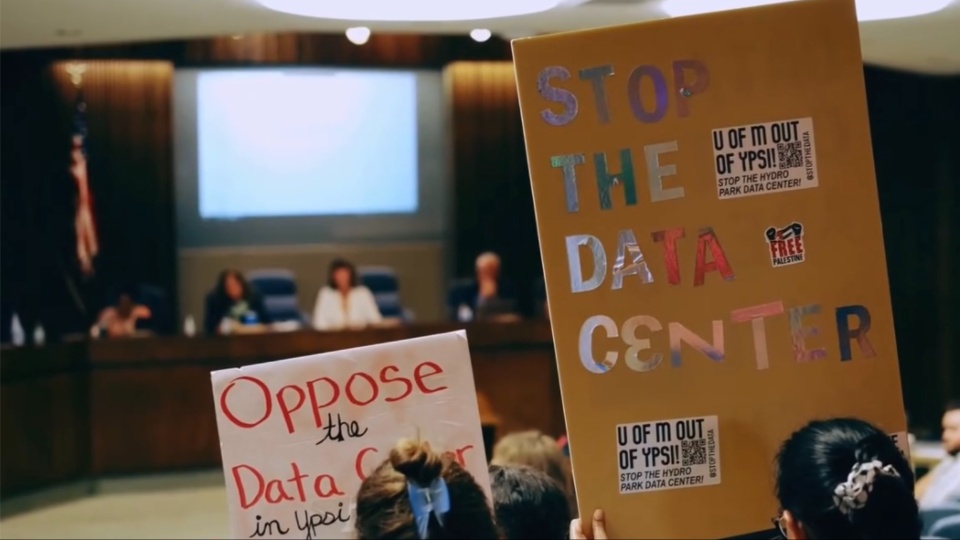
YPSILANTI, Mich.—Ever since a team of activists began stickering the Ypsilanti-Ann Arbor area of Michigan with provocative slogans, the “Ypsi Data Center” has been the talk of the town.
The data center in question is a joint project between University of Michigan and Los Alamos National Laboratory, a federal government weapons development lab best known for its work on the atomic bomb. The project is set to be built in Ypsilanti Township, near South Hydro Park, hence one of the sticker slogans seen around town: “UofM out of Ypsi!”
UofM hopes to break ground on the project next year and have the center fully operational by 2030. This is part of a wave of data centers coming to Michigan and the broader Great Lakes area, with developments being proposed by Amazon, Microsoft, and others throughout the Midwest.
While advocates for the data center say the project represents a $1.25 billion investment in the community (yes, you read that number right), Ypsilanti residents and policy experts fear that money spent will actually generate few opportunities for working people while driving up their cost of living.
What’s known
As to what the UofM data center will actually look like, residents have been left guessing.
“The Los Alamos project is shrouded in mystery…. It’s not accidental,” said Ira Anwar, a Ph.D. student at UofM’s School of Information who researches data centers as part of her degree.

UofM first announced the project in December 2024, just days before the it was awarded a $100 million grant from the state through the Michigan Strategic Fund (MSF). This giveaway of taxpayer money required no congressional approval. Overall, the university is sinking $850 million into the facility while Los Alamos, the project’s biggest beneficiary, is putting up $300 million.
The main sources of information on the project come from a statement put out by the university and a memorandum from the MSF, both of which are speculative documents. According to these documents, the main purpose of the facilities will be to conduct research in artificial intelligence (AI), with a focus on national security. UofM has yet to provide any official plans for the center.
The MSF memo states the facility will consist of two centers: A larger center where Los Alamos will work on classified projects related to “critical national security” issues (likely military projects), and a smaller, non-classified center which the university will use for research and academic purposes. The document also notes the potential for private businesses to partner with the university to gain access to the facility and secure Department of Defense contracts.
Combined, the labs will require 110 megawatts of energy to power them, which is nearly four times the total power used by the more than 24,000 households in Ypsilanti Township. Christopher Kolb, the university’s vice president for government relations, has described the project as “the biggest, baddest, fastest computer in the world.”
Los Alamos and UofM predict the creation of 200 direct permanent jobs over a period of ten years, with salaries in those positions averaging close to $200,000 per year. How many would be remote versus on-site is still unclear.
What are data centers, and why are they so controversial?
A data center is a facility that houses computers, often with incredible processing power and speed; this vast computing power can be used to accelerate the development of technology such as AI and conduct research. While data centers themselves aren’t new to the scene, energy-intensive AI and machine learning models are, which have become the driving force behind the rise of these facilities.
Large data centers like UofM’s are notorious for their use of two things: water and electricity. Electricity is needed to continuously power computers, and water is then needed to cool down hardware to prevent overheating due to the heavy computing load.

According to a recently-published policy report from UofM’s Ford School of Public Policy, data centers consumed 4% of U.S. electricity in 2023, with estimates suggesting that number could rise to 12% by 2028. This creates a two-fold concern. The first is existential: Resource-intensive projects like data centers threaten to hasten the already fatal effects of climate change, which hit working people hardest. The second is practical: Data centers pass on their use of utilities to locals in the form of higher water and electricity bills.
A recent update to UofM’s FAQ page on the data center assures the public that the center won’t draw water from or discharge wastewater into the Huron River, but it fails to address the volume the university plans to draw from Ypsilanti’s municipal tap. According to YCUA Executive Director Luke Blackburn, the data center will use 200,000 gallons of water a day. The university has also attempted to get in front of resident concerns by stating that all of the center’s electricity will come from its own substation instead of the main grid. Anwar says these statements are misleading.
“Most data centers don’t just use a substation to power the plant; you need a lot of backup electricity sources,” she explained. “If the main source gets interrupted, these companies cannot afford for the data centers to shut down. We don’t even know if the substation is going to exist, but even if it does, DTE Energy (the old Detroit Edison) is the supplier for both the local grid and the substation. If the substation is disrupted or it’s not enough power, they can just draw [from the grid].”
With regards to water use, UofM’s promise to draw from the tap is little consolation. Helena Volzer, a senior source water policy manager at the Alliance for the Great Lakes, stressed this in an interview with Bridge Michigan: “Where a data center is pulling [water] from a municipal system, there’s no tracking or reporting requirement. Information I’ve relied upon says that less than a third of data centers are actually tracking how much water they are using; they are not required to.”
The lack of reporting translates to a lack of transparency: UofM can consume more and more water as the center’s usage increases, without residents knowing. Additionally, water used for cooling retains heat and sometimes holds chemicals or heavy metals from the cooling process, creating contamination concerns after it is discharged down the drain.
Community speaks out, township listens
On June 17, more than a hundred residents poured into the Ypsilanti Township Civic Center, with some forming a drumline outside and shouting chants. People came to make their concerns heard at the monthly Board of Trustees meeting. It was part of an organizing effort by a local group known as “Stop the Data,” whose main focus is to prevent the South Hydro Park data center.
While discussion about the data center wasn’t on the trustees’ agenda, Stop the Data knew it would be important to start pressuring the township as quickly as possible. Officials seemed unprepared for the volume of public commenters and announced at the start of the meeting they would offer no comment on the issue. Instead, they distributed a small number of printouts detailing their knowledge of the data center thus far (the township waited a month before publishing this information on their website).

In the city of Ypsilanti, council members are required to explain how a new project benefits the community; however, officials in Ypsilanti Township are under no such obligation. Throughout the meeting, Township Trustees did not respond to the outpouring of public comments. Instead, Board Supervisor Brenda Stumbo’s only direct engagement with public commenters that evening was telling them not to applaud after speeches.
During public comment, concerns were voiced about the environmental impact, the strain on local utilities, and the dubious promises of jobs the data center would create. Citizens were also worried about the center’s ability to accelerate the Trump agenda through the development of surveillance technologies which could be used to more efficiently track and deport immigrants and political enemies of the administration.
Of the 36 people who delivered speeches, 34 came out firmly against the data center’s construction. One of those speakers was Will Jaquinde, who owns a farm in Ypsilanti Township. “UofM didn’t choose this location because they want to bring prosperity to this community,” Jaquinde said. “They’re coming here because they think our local government is going to be easier and cheaper to manipulate. This is not a facility they would be able to build in Ann Arbor, because their local government and their populace wouldn’t allow it.”
Anwar believes that between the two towns, folks in Ypsilanti are more politically activated by environmental justice issues and that the university has other reasons for choosing the township for its building site. “It’s a question of class, essentially,” she said. “Ann Arbor is just much richer. You have a significantly wealthier population that owns houses here, so they don’t want to piss off rich white people.”
Ypsilanti Township officials, however, aren’t content to play the fool. After the June 17 meeting, Supervisor Stumbo was inspired by her constituents to look deeper into UofM’s project, quickly becoming alarmed. In an email published by Stop the Data, on which Stumbo cc’d Congresswoman Debbie Dingell, the township supervisor came out strongly against the UofM data center, stating she had been misled about the scale and nature of the project.
“I have learned as Supervisor they are not to be trusted and do not do what is best for the community, the people, or the environment,” the email read. “They do what is best for them, and their money grabbing purchase of land should scare the hell out of all elected officials in the state.”
At the last trustees meeting on July 15, Stumbo confirmed that the university had still yet to submit its plans for the project to the township. “It’s the most bizarre position I’ve ever been in, and I’ve been elected for 36 years,” she said, doubling down on her commitment to fight the data center. “We really need to think and reach out to people who have experience. I do think, environmentally, in this fragile area, it’s a problem.”

Ypsilanti Township’s authority to stop the data center is questionable since, under state law, public universities do not have to secure permits or approval from municipal governments. Furthermore, as a school, UofM isn’t subject to the same zoning constraints. However, according to the June 26 email, the Department of Energy has yet to approve the site, and the township trustees have joined the statewide effort to write letters against this approval.
Rep. Dingell said she wants to set up a meeting between the university and the township in August. UofM has since stated they had met with township officials but offered no further details.
The investment argument
Supporters of developments like the data center often focus their arguments around the investment it represents for communities. In Augusta Township, a charter township in Washtenaw County, a private equity firm recently succeeding in getting 522 acres rezoned to facilitate construction of a data center.
After the township’s planning commission recommended against the rezoning (a move strongly backed by township residents), Ann Arbor SPARK—an economic development agency—issued a statement urging the Township Board to reconsider. Their main argument? Investment.
“This project represents a significant capital investment and a real opportunity to enhance local infrastructure,” SPARK wrote. To communities in need of economic revival, this can sound like an offer too good to refuse. But what exactly are these institutions saying when they talk about investment? Typically, they are talking about two things: jobs created in the community and tax capture.
The basic idea is this: The bigger the taxpayer base, the more revenue the city generates to spend on schools, roads, libraries, and other public goods people living in the city need. Politicians, investors, and companies themselves therefore argue that major corporations such as Microsoft or Google represent substantial revenue for the town (in the form of property taxes) and the state (in the form of sales tax).
Large companies also promise to bring jobs to the community. Job creation has been an essential part of political platforms ever since the Great Depression and remains a pressing concern in states like Michigan, where deindustrialization has left once-booming factory towns to fight for scraps.
This has been a driving force behind the political messaging for a potential data center in Benton Harbor. In support of that proposed center, State Rep. Joey Andrews, a Democrat from the area, said: “If people are saying ‘put the people first,’ they should want the enormous taxpayer who will create a ton of construction jobs and potentially bail out the water treatment center and the local school system. It’s the definition of putting people first.”
But according to newly published research by UofM’s Ford School of Public Policy, what actually happens when a data center comes to town is far less than promised.
Consumers pay for corporate tax exemptions
Michigan Gov. Gretchen Whitmer recently signed two pieces of legislation which offer tax exemptions to data centers, including for personal property (which covers computers, their most valuable asset) and sales tax. As the Ford School policy report notes: “While [data centers] may still pay real property taxes on land and buildings, the overall tax contribution is significantly diminished.”
What was the result of this? Higher taxes and reduced public services for residents, as cities attempted to shift the cost of tax exemptions onto residents and small businesses. This includes reduced revenue for the very public services data centers consume—such as municipal water and fire department services—as well as services they do not, such as K-12 education.
When the technology company Switch opened its Gaines Township data center in 2017, they dodged school taxes for its first two years of operation, believing they should be exempt from paying school districts. This resulted in a legal dispute, which was ultimately settled with an agreement in favor of the school districts.
But for Ypsilanti Township, it’s even worse: University of Michigan doesn’t pay property taxes. That means what little tax revenue the township might see is nonexistent. Doug Winters, legal counsel for the township, says the project would actually be a drain on township resources.
“They want to come into the community, do this extravaganza project, and not pay one dime for police, fire, and other municipal services,” he told Planet Detroit, a local environmental news outlet.
How many jobs do data centers actually create?
When Switch opened the data center in Gaines Township (nearby Grand Rapids), they promised to create 1,000 jobs. The company has continually lowered that bar since opening, not even meeting their promise to create “400 jobs by 2022.” They had, in fact, only created 26.
This trend was persistent in other areas where data centers moved in. After construction finishes, data centers typically farm out the few jobs actually required to keep the center operational—mostly low-paying janitorial, security, and maintenance jobs—to third party contractors (a practice already prevalent at UofM’s hospital). Contract positions are notorious for their lack of stability, union protections, and job growth potential.
The few jobs data centers do create can come at an extremely high cost. The Ford School policy states: “Since the inception of the [tax] incentives, $300 million in tax revenue has been foregone … in some cases, the cost to taxpayers for each job created can exceed $1 million.” Overall, it’s a raw deal for taxpayers, who would likely benefit more by investing those dollars directly into their communities.
While UofM touts the 200 high-paying jobs, the policy report found that those plum positions don’t go to locals, because data centers operate as infrastructure projects, not traditional job-creating businesses.
This means the data center’s high-paying jobs won’t be going to Michiganders, much less folks from the Ypsilanti area. Given UofM’s trend of favoring out-of-state students for its highly-ranked programs, local folks aren’t surprised.
The “abundance” scheme
Republicans and corporate Democrats’ favorite taunt when it comes to populist policies (such as free health care, food-assistance programs, public power) is the tried-and-true “somebody has to pay for that.”
But, ironically, none of these “common sense” politicians ever mention this axiom when it comes to corporate welfare. When the state or federal government gives out million-dollar tax breaks to the rich, someone has to keep the fire department online, and that someone is always the public.
Now, here is where it gets confusing: This all sounds like Trump-era politicking, doesn’t it? But why are Democrats like Gretchen Whitmer and Joey Andrews again and again supporting and even proposing these policies? Because just like fashion, policy is cyclical. Just as in the 1990s, when Bill Clinton beat George Bush, Sr., by running to the right of the conservative candidate on crime, corporate Democrats today are re-making themselves to compete with Trump for support (and dollars) from elites.
What are they calling this new policy? “Abundance.” People’s World has previously described this policy as little more than trickle-down economics. Abundance argues that if we remove regulations, the economy will grow, and the rich will pass on a share of those profits to the workers. Whitmer’s tax exemptions for data centers are a real-life enactment of this policy. The tax breaks allow the governor to cozy up to corporate donors while claiming she is bringing investment to Ypsilanti.
One of the biggest would-be winners from the Los Alamos-UofM data center is DTE. The power monopoly had quietly supported pro-data center legislation from the sidelines, while boasting about it to investors on calls. Bringing in new data centers wouldn’t just bring DTE big customers, it would also give them the chance to further rate hikes on existing customers.

According to the Ford Policy report, data centers and utility companies often team up to lobby for rate increases: “In Michigan, DTE and Switch have spent over $2 million lobbying the state house, senate, and Public Service Commission to raise electricity rates; residential electricity rates have increased by 25% since the construction of the Switch data center in 2017 and are now 17% higher than the national average.”
Whitmer has benefitted enormously from this lobbying, leading all state elected officials in donations garnered from DTE, according to the Energy and Policy Institute.
Polling shows public support is in the corner of progressive policy, not abundance policy. According to Demand Progress, while “abundance” messaging spoke to a select group of pollsters, “a focus on populist economic concerns—corporate and monopoly power, money in politics, and corruption—consistently resonated significantly more broadly and deeply…than abundance arguments.”
Furthermore, polling by Pew Research Center shows that the American public is far less enthusiastic about AI than experts, with more people believing AI will personally harm them than benefit them.
It seems clear that the abundance the public has been asking for isn’t technological advancements in niche fields or quarterly profit growth for DTE. Rather, the people want the material abundance that already exists to be shared amongst those who created it in the first place.
What is to be done?
Given the rise of data centers nationwide and the corporate dominance of the Trump administration, fighting these political battles might feel hopeless. That’s why the time to act is before construction breaks ground.
“What happens is people start reacting after the data center is built, and then (activism) becomes significantly harder,” Anwar said. “The tax exemption bills have been passed and that’s unfortunate, but I think what people can do across the state is have coordination and collaboration between these efforts…. And not just people organizing against data centers but there’s a robust activism around DTE.”
The ability to fight back on data center developments was surprisingly thrown a lifeline in the final version of Trump’s so-called “Big Beautiful Bill.” While the original version of the bill had a 10-year moratorium on any local oversight of data center construction, the Senate struck down that provision, 99 to 1. If it had passed, the little power citizens and local governments have over data center construction in their own communities would be completely in the hands of the Trump administration.
In the case of the South Hydro Park proposal, UofM is flexing its political muscle by not fostering buy-in from the local government or the people of Ypsilanti. But this could prove to be a grave error on the university’s part, as the people of Ypsilanti have united with local officials to beat back the development.
Karen Lovejoy Roe, an Ypsilanti Township trustee, reached out to Supervisor Stumbo after hearing the outrage from her community to see how they could work with township attorneys to prevent the data center from moving forward.
But elected officials can only do so much. It’s up to the people to work together to put pressure on institutions and government bodies that have yet to be accountable. Anwar emphasized this in her final thoughts to People’s World:
“We are the consumer base for DTE, and they have to be accountable to us. There’s a state-level commission that governs utility disputes. We think we need to create a whole new infrastructure of organizing and mobilizing. But we need to plug into existing infrastructure around municipal and utility.”
One of the organizers of Stop the Data, Sarah Johnson, has utilized social media as a platform to publicize the fight. Alongside posting information on upcoming organizing events on the Instagram page (@stopthedata), they hope to create a collective awareness around the broader political moment.
“Number one goal is to stop the data center. It’s not just the environmental concerns but the AI warfare,” they said, referring to the AI-assisted bomb targeting that Israel has been using in Gaza— and a topic Los Alamos may research at the proposed facility. “If we fail, hopefully people learned lessons along the way.”
We hope you appreciated this article. At People’s World, we believe news and information should be free and accessible to all, but we need your help. Our journalism is free of corporate influence and paywalls because we are totally reader-supported. Only you, our readers and supporters, make this possible. If you enjoy reading People’s World and the stories we bring you, please support our work by donating or becoming a monthly sustainer today. Thank you!
CONTRIBUTOR