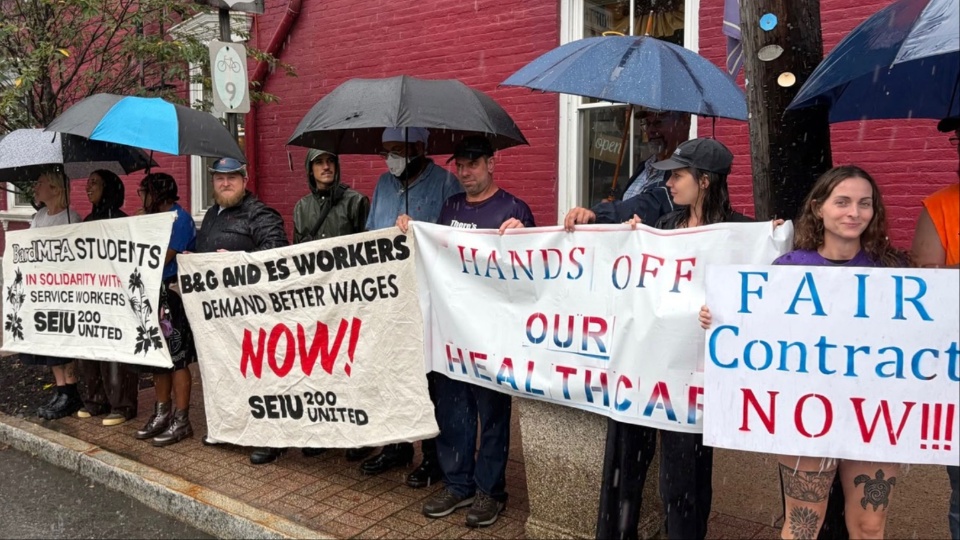
ANNANDALE-ON-HUDSON, N.Y.—About 110 service and maintenance workers at Bard College voted overwhelmingly in early July to authorize a strike, as contract negotiations reached an impasse following the expiration of their contract at the beginning of the month.
The workers, members of SEIU Local 200United representing building maintenance, groundskeeping and environmental services staff, have been bargaining since March. Union leaders say the administration has proposed health insurance concessions and wage increases well below what workers are demanding.
“A strike is not in the best interest of the College and its students, but unfortunately the Bard administration forced us into this situation,” April Pulver, an environmental services specialist and union bargaining committee member, told Northeast Public Radio.
The strike authorization vote saw 95% of participating members approve but does not guarantee a walkout. Union representative Sean Collins described it as “a measure of last resort” after 10 bargaining sessions reached an impasse.
At the center of the dispute are wage increases that keep pace with inflation, protection of college-subsidized health insurance, and hiring additional staff to address excessive workloads.
Environmental services workers currently start at $19.50 per hour. The union is demanding a starting wage of $22.75, plus annual cost-of-living adjustments. For buildings and grounds workers, the union proposed a 13.5% wage increase over three years, but the college countered with 6.5%.
Health care remains a major sticking point. The college has traditionally paid the full cost of individual health insurance premiums for its workers but now says rising costs make that “unsustainable.” But the union pointed to the institution’s growing endowment as evidence the administration can indeed afford to maintain existing benefits.
“This is a billion-dollar institution now,” Collins said. “It can afford to provide the quality benefits that it has for years.”
The union contends that staffing levels have not grown alongside the college’s physical footprint. In recent years, Bard purchased hundreds of acres of land—including the 380-acre Montgomery Place in 2016 for $18 million and the 260-acre former Unification Theological Seminary property for $14 million in 2024. The college also opened four new dormitories and expanded its Fisher Center.
“There’s been hundreds of thousands of square footage, hundreds of acres added to the campus in the past decade, and our staff in both departments has remained flat during that time,” Collins said.
Workers pointed to the $1 billion endowment Bard secured earlier this year, matching a $500 million commitment from George Soros, and the $2 million Finberg House the college intends to give to longtime former President Leon Botstein as evidence the institution can afford to invest in its workers, including hiring new ones.
The current struggle is the latest chapter in a long history of labor organizing at Bard. According to former organizer Chris Townsend, the union’s presence at Bard College was secured only after multiple failed organizing attempts.
“After four organizing efforts were smashed by the Bard administration, the fifth push succeeded after a furious battle with Botstein in 1987,” Townsend said. The first contract was finally won in 1988.
Botstein’s legacy and controversy
The contract negotiations are unfolding against the backdrop of scandals and controversy. Botstein, who served as Bard’s president for 51 years, retired effective June 30 amid scrutiny over his ties to convicted sex trafficker Jeffrey Epstein.
An independent review at the college found that Botstein minimized his relationship with Epstein during an inquiry. Records indicated Botstein and Epstein were in frequent contact, with the sex-trafficker even arriving at the campus by helicopter. Botstein invited Epstein to the 2013 graduation and suggested they attend an opera together.
The review also found that Botstein dismissed a senior faculty member’s concerns about Epstein, characterizing him as “an ordinary sex offender” who deserved the presumption of rehabilitation. The Board of Trustees thus voted to end Botstein’s tenure after receiving the review’s findings. He was allowed to retire instead.
What comes next
“We all want to come to work and do our job,” said Taylor Hermance, an environmental services worker. “But if that’s what we have to do to make a point, we are all willing to do it.”
A Bard spokesperson said the college is “committed to a fair and respectful bargaining process” and views the union’s proposals “as a starting point for a productive discussion.”
The union, however, continues to remain skeptical. Collins said the administration “forced us to take this vote.”
“If we are forced to go out on strike,” Collins said, “it’ll be timed in a manner that will send a message that without us, Bard doesn’t operate. Bard works because we do.”
We hope you appreciated this article. At People’s World, we believe news and information should be free and accessible to all, but we need your help. Our journalism is free of corporate influence and paywalls because we are totally reader-supported. Only you, our readers and supporters, make this possible. If you enjoy reading People’s World and the stories we bring you, please support our work by donating or becoming a monthly sustainer today. Thank you!
CONTRIBUTOR